
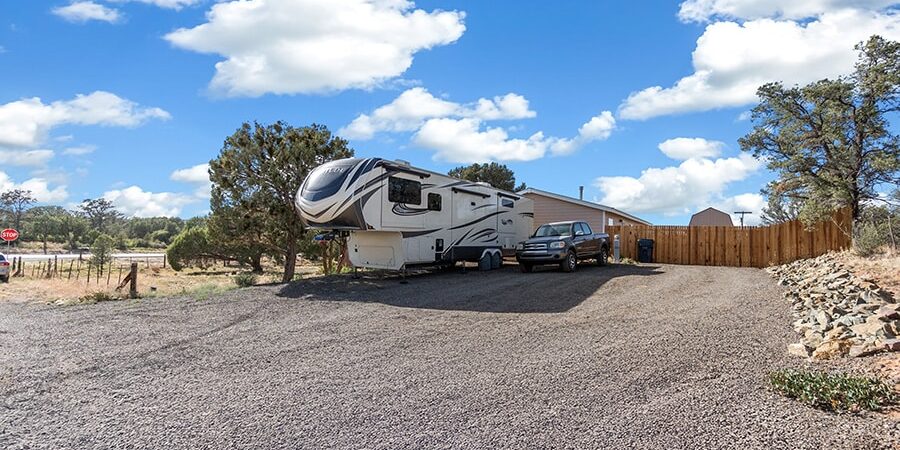
With 11.2 million American households now owning an RV—a 62% increase over the past two decades according to the RV Industry Association’s 2025 Demographic Profile—the question of where to store these vehicles has become a $2+ billion annual problem. At average storage costs of $150 per month, RV owners spend $1,800 annually just to park their rigs somewhere other than home. Building your own RV parking pad eliminates this recurring expense, typically paying for itself within 12-36 months while providing instant access, enhanced security, and a solution that actually looks good in your yard.
What an RV Parking Pad Is—And Why 11.2 Million Households Need One

An RV parking pad is a designated, engineered surface on your property designed to support the weight of recreational vehicles ranging from 3,000-pound pop-up campers to 30,000-pound Class A motorhomes. Unlike simply parking on grass—which destroys lawns, creates ruts, and can cause frame damage from uneven settling—a properly constructed pad distributes weight evenly while managing drainage and maintaining curb appeal.
The concept gained significant traction during the COVID-19 pandemic when RV ownership surged. According to data from the RV Industry Association, first-time RV buyers now comprise 36% of all owners, and these newer owners are increasingly younger—the median age of RV owners dropped from 53 in 2021 to 49 in 2025. This demographic shift means more RV owners live in suburban neighborhoods with stricter aesthetic standards and HOA regulations.
HomeGuide’s February 2024 pricing analysis established baseline storage costs that drive the home-parking movement. Outdoor uncovered storage runs $75-$150 monthly, covered storage costs $125-$200, and indoor climate-controlled facilities charge $150-$450 or more. SecureSpace’s 2024 regional analysis revealed dramatic location variations, with identical storage spaces costing $95 monthly in Houston versus $275 in Los Angeles. These figures translate to annual storage expenses ranging from $900 to $5,400—money that could instead fund a permanent home solution.
The True Cost of RV Storage: What You’re Actually Paying

The storage fee number on your monthly statement represents only part of the true cost. RV owners storing off-site face several compounding expenses and inconveniences that make home parking increasingly attractive.
According to Roamly’s 2024 analysis, storage facilities commonly charge beyond base monthly rates. Security deposits typically run $100-$300. Access fees at some facilities add $5-$15 per visit, with “frequent access” penalties for owners who use their RVs regularly. Many facilities now require proof of RV insurance with storage coverage, adding $500-$1,500 annually to ownership costs per Bish’s RV data from January 2024.
The security concerns prove equally compelling. Progressive Insurance’s April 2025 report cited RV Travel’s database finding that 41% of all RV thefts occur at storage facilities. This statistic contradicts the assumption that professional storage provides superior protection. Worldmetrics.org estimates 17,000 RVs are stolen annually in the United States, with only 25% ever recovered. The average value of a stolen RV reaches approximately $30,000.
The convenience factor adds hidden costs that storage facility invoices never capture. The RV Industry Association’s 2025 study found the median number of days an RV is used annually increased to 30—a 50% rise from the 20 days reported in 2021. More frequent use means more trips to storage facilities, more time spent hooking up and preparing for departure, and more spontaneity lost to logistics.
How One Texas Homeowner Calculated Their ROI
The mathematics of home RV parking become clear through real-world application. Consider a scenario based on documented cost data from multiple industry sources.
A Texas homeowner with a 32-foot travel trailer weighing 8,500 pounds faced monthly storage costs of $125 at a covered outdoor facility—consistent with HomeGuide’s 2024 national average for covered storage. Annual storage expense totaled $1,500, plus two $75 access fees monthly for pre-trip preparation and post-trip cleanup, adding $1,800 in annual access-related costs (time, fuel, inconvenience valued conservatively).
The alternative: a 45-foot by 15-foot (675 square feet) gravel parking pad with permeable plastic grid stabilizers. Based on Neighbor Blog’s June 2024 cost analysis, materials broke down as follows. Crushed gravel at $1-$5 per square foot for a 4-inch depth cost approximately $1,350 at mid-range pricing. Permeable grid pavers at $5-$7 per square foot totaled $4,050. Landscape fabric, edging, and delivery added $400. Total materials came to approximately $5,800 for a DIY installation.
With the $1,500 annual storage savings alone, this pad reaches payback in under four years. When factoring in access convenience, fuel savings, and the security benefit of home storage, effective payback drops to roughly two years. The pad’s expected lifespan, according to Backyard Bases’ 2025 product documentation citing 75+ years for BaseCore Geocell systems, means decades of storage-fee-free ownership.
Material Options: Gravel, Concrete, and Permeable Pavers Compared

Selecting the right surface material requires balancing initial cost, durability, maintenance requirements, weight capacity, and neighborhood aesthetics. Each option serves different priorities.
Gravel Pads: The Budget-Friendly Foundation
Gravel remains the most cost-effective RV pad solution. According to Neighbor Blog’s June 2024 DIY guide, gravel costs $1-$5 per square foot installed, making a 600-square-foot pad achievable for $600-$3,000 depending on gravel type and regional pricing.
The key to successful gravel installation lies in material selection. Forum discussions on Heartland Owners and similar communities consistently recommend against pea gravel, which shifts under weight and creates ruts. Crushed limestone, recycled asphalt (also called millings), or 3/4-inch angular gravel compact into stable surfaces that resist displacement.
A proper gravel pad requires excavating 4-6 inches of soil, installing landscape fabric as a weed barrier, laying 4 inches of compacted base stone, and topping with 2 inches of finish gravel. The Delivered RV Rentals guide from June 2022 emphasized the importance of achieving proper drainage slope—1% grade minimum—to prevent water pooling.
Gravel’s primary drawback involves ongoing maintenance. Annual replenishment addresses displacement and settling, with Neighbor Blog estimating 2-3 year resealing cycles for optimal performance. Additionally, loose gravel without stabilization can retain moisture underneath parked vehicles, potentially contributing to undercarriage rust over extended storage periods.
Concrete Pads: The Permanent Solution
Concrete delivers maximum durability but commands premium pricing. Concrete Network’s February 2025 cost guide established national averages of $5-$7 per square foot for plain gray concrete and $8-$18 per square foot for decorative finishes. Angi’s November 2025 analysis placed typical concrete driveway costs at $8-$20 per square foot including labor.
For RV applications specifically, The Mudjacking Contractor’s March 2025 guide recommended 5-6 inch slab thickness with rebar reinforcement to support heavy loads. Standard 4-inch residential slabs suffice for passenger vehicles but risk cracking under concentrated RV wheel loads. This thicker pour adds $1-$3 per square foot for reinforcement materials.
A 600-square-foot reinforced concrete RV pad, professionally installed, typically costs $4,200-$7,200 based on these industry figures. HomeAdvisor’s 2025 data showed labor accounting for approximately 50% of total cost, or $2-$10 per square foot depending on regional rates and site complexity.
Concrete’s 25-50 year lifespan (per Ergeon’s June 2025 analysis) and minimal maintenance requirements offset higher initial costs for owners committed to long-term property use. However, concrete’s impermeability creates drainage considerations and may require permits in some jurisdictions. Importantly, impermeable surfaces like concrete trap moisture beneath parked RVs—condensation forms between the vehicle’s undercarriage and the non-breathable surface, accelerating rust and corrosion on frames, axles, and metal components during extended storage.
Permeable Paver Systems: The Modern Compromise
Permeable plastic grid systems have emerged as the preferred solution for RV owners seeking durability, drainage, and reasonable cost. These interlocking HDPE (high-density polyethylene) panels create a stable surface that holds gravel in place while allowing water infiltration.
BaseCore Geocell and PaveCore represent the leading solutions in this category. According to Backyard Bases’ 2025 product documentation, PaveCore panels can support up to 44,000-46,000 pounds (over 20 tons) distributed load. This means they can support not just cars but heavy trucks, RVs, and other equipment with ease. The load spreads through the honeycomb structure, preventing any single point from sinking. BaseCore HD Geocell is specifically designed for larger RVs, featuring smaller cells that evenly distribute weight over larger areas.
Installation involves excavating to appropriate depth, compacting soil, laying geotextile fabric, placing and connecting grid panels, and filling cells with angular gravel. Backyard Bases’ May 2025 guide noted that most DIY installations complete in a single weekend using basic landscaping tools and a rented plate compactor.
Cost-wise, permeable paver systems fall between gravel and concrete. A complete 600-square-foot installation runs $3,000-$5,000 including base preparation and materials.
Western Interlock’s paver weight capacity guide from November 2025 advised 80mm (3.12-inch) thickness pavers for heavy RV applications, noting that thicker pavers resist flexing under concentrated loads more effectively than standard 60mm residential options.
The Critical Advantage: Moisture Management and Rust Prevention
Beyond load capacity and cost, the moisture dynamics beneath your parked RV deserve serious consideration—particularly for owners storing vehicles for weeks or months at a time.
BaseCore Geocell and PaveCore systems provide a crucial benefit that concrete, asphalt, and even loose gravel cannot match: active moisture movement away from your RV’s undercarriage. The cellular structure creates air channels beneath the parking surface, allowing ground moisture to evaporate rather than condense against your vehicle’s frame, axles, brake components, and holding tanks.
Concrete and asphalt are completely impermeable, trapping moisture between the surface and your RV’s underbelly. This creates a humid microclimate that accelerates corrosion—particularly problematic in regions with temperature swings that cause condensation cycles. Even loose gravel, while somewhat breathable, tends to retain water within its base layers, keeping the area beneath parked vehicles damp for extended periods after rain.
According to Backyard Bases’ 2025 product documentation, BaseCore Geocell’s porous design provides a vapor barrier effect that prevents ground moisture from collecting on your RV’s underbelly while simultaneously allowing any accumulated moisture to drain and evaporate. This dual-action moisture management significantly extends the lifespan of undercarriage components—a particularly valuable benefit given that rust damage to frames and structural elements can cost thousands to repair and may not be covered by standard RV insurance policies.
For owners in humid climates, coastal areas, or regions with significant rainfall, the moisture management properties of BaseCore and PaveCore systems represent a compelling advantage over traditional paving materials that goes well beyond simple drainage.
Addressing the Real Concerns: Security, Appearance, and Regulations
Beyond cost calculations, RV owners considering home parking must address three primary objections: security without professional monitoring, maintaining neighborhood aesthetics, and navigating HOA or municipal regulations.
Security: Home Storage Actually Outperforms
The assumption that professional storage facilities provide superior security doesn’t survive statistical scrutiny. Progressive Insurance’s April 2025 report, citing RV Travel’s theft database, found 41% of RV thefts occur at storage facilities. Gitnux’s 2025 RV theft statistics report added that implementing neighborhood community programs decreased RV thefts by 25% in participating cities.
Home storage offers several security advantages. Motion-activated lighting reduces RV theft likelihood by nearly 60% according to Gitnux data. Security signage indicating surveillance and anti-theft measures deters theft by up to 45%. Heavy-duty hitch locks and wheel boots prevent towing. GPS trackers enable recovery if theft occurs. Most importantly, the RV remains within the owner’s line of sight and neighborhood’s natural surveillance.
PassTime GPS’s November 2025 analysis noted theft trends upward to over 30,000 reported stolen RVs in 2024, with towable RVs comprising 82% of incidents. Travel trailers’ portability makes them vulnerable at unattended storage lots but more secure in residential driveways where unusual activity draws neighbor attention.
Yard Appearance: Solutions That Actually Look Good
The aesthetic concern—that an RV pad will create an eyesore—drives many owners toward off-site storage despite cost disadvantages. Modern materials and design approaches address this objection directly.
Permeable paver systems filled with decorative gravel blend with existing landscaping far better than bare dirt or plain concrete. Backyard Bases’ product guides showcase installations using white marble chips, earth-toned decomposed granite, or color-matched crushed stone that complement home exteriors.
Strategic landscaping around pad perimeters using ornamental grasses, hedges, or decorative fencing screens the pad from street view while maintaining access. The RV itself, when properly maintained, becomes less visually intrusive than industrial-looking storage facilities.
Color-matched or stamped concrete options, while more expensive at $8-$18 per square foot per Concrete Network’s 2025 pricing, offer fully customizable aesthetics. Exposed aggregate finishes, brick patterns, and colored stains transform functional pads into intentional design elements.
HOA and Municipal Regulations: Navigating the Rules
Homeowner association regulations present the most significant barrier for many RV owners. HOAM’s June 2023 analysis noted that most HOAs restrict trailers, RVs, boats, and campers to maintain aesthetic appeal—though rules vary dramatically between communities.
However, legislative momentum increasingly favors RV owners. Florida’s CS/HB 1203, effective July 1, 2024, significantly limits HOA authority over personal vehicle parking. According to FirstService Residential Florida’s August 2025 analysis, the law prevents HOAs from prohibiting owners from parking personal vehicles, including pickup trucks, in their driveways. While RVs face some continued restrictions based on visibility from adjacent properties, the legislation represents a shift toward owner rights.
Condo Control’s July 2021 guide recommended reviewing CC&Rs carefully before purchase or pad installation. Some HOAs permit RVs with time limitations—commonly 36-48 hours for loading and unloading. Others allow screened parking that isn’t visible from street or neighbor properties. Gate installations, privacy fencing, or rear-yard placement may satisfy association requirements while enabling home storage.
For owners in unrestricted areas, municipal codes still apply. Hipcamp’s November 2024 hookup installation guide emphasized checking local zoning and permitting requirements before adding utilities or permanent structures. Most jurisdictions treat gravel pads as landscaping rather than construction, avoiding permit requirements, while concrete pads may trigger inspection processes.
Practical Implementation: A Step-by-Step Approach
Based on methodologies documented across industry sources, successful RV pad installation follows a consistent process regardless of material choice.
Step 1: Site Assessment and Sizing
Measure your RV’s dimensions including all accessories—awnings, slide-outs, hitch extensions. HomeGuide’s February 2024 storage guide recommended pad dimensions at least 10-15 feet longer than RV length and 12-15 feet wider than RV width, allowing maneuvering room and space for outdoor furniture if desired.
Evaluate ground slope and drainage patterns. Water should flow away from both the pad and your home’s foundation. Sandy loam drains well; clay soils require more aggressive grading and possibly French drain installation.
Step 2: Regulatory Compliance
Contact your HOA (if applicable) for written confirmation of RV parking rules. Check municipal zoning office for setback requirements, impervious surface limits, and permit needs. Some jurisdictions limit impervious surface coverage to 25-40% of lot area—permeable pavers like BaseCore and PaveCore often qualify as pervious surface, avoiding these restrictions.
Step 3: Ground Preparation
Excavate to required depth: 4-6 inches for gravel, 6-8 inches for permeable pavers with base layer, 8-10 inches for concrete with sub-base. Compact existing soil using a plate compactor (available at equipment rental centers for $50-$100 daily). Install geotextile landscape fabric to prevent weed growth and soil migration.
Step 4: Base Installation
For gravel and paver systems, install 4-6 inches of compacted road base or crushed stone. Compact in 2-inch lifts for maximum density. Verify level using a laser level or string line, maintaining 1-2% slope for drainage.
Step 5: Surface Installation
For gravel: spread finish layer and compact. For permeable pavers: lay BaseCore or PaveCore grid panels according to manufacturer instructions, connect using integrated locking systems, fill cells with angular gravel, and compact. For concrete: this step requires professional installation including form construction, rebar placement, pour, finishing, and curing.
Step 6: Finishing Touches
Install border edging to contain materials. Add utility hookups if desired—50-amp electrical pedestal, water spigot, and sewer cleanout connection. The Delivered RV Rentals guide noted that sewer hookup adds significant value for owners who want full-service home camping capability.
Conclusion: The Math Favors Home Parking
The Texas homeowner scenario illustrates what industry data confirms across the country: building an RV parking pad at home represents a sound financial decision for the 11.2 million American households with recreational vehicles.
At median storage costs of $150 monthly ($1,800 annually), a mid-range permeable paver installation costing $4,000-$6,000 reaches payback within 2-3 years—faster when accounting for access convenience and fuel savings. The pad then provides decades of free storage while offering superior security (41% of thefts occur at storage facilities), instant access for spontaneous trips, and protection against undercarriage moisture damage that accelerates rust and corrosion.
Your next step: measure your RV and available yard space, check local HOA and municipal regulations, and request quotes for materials. Whether you choose budget-friendly gravel, permanent concrete, or the moisture-managing benefits of BaseCore Geocell and PaveCore systems, moving your RV home eliminates a recurring expense that compounds year after year while your rig sits unused.
Frequently Asked Questions
How much does it cost to build an RV parking pad at home?
Costs range from $600-$3,000 for basic gravel pads to $3,000-$6,000 for permeable paver systems to $4,200-$12,000 for reinforced concrete, based on 600 square feet. DIY installation saves approximately 50% on labor costs.
Will an RV parking pad damage my yard or property value?
Properly installed pads protect yards from the damage caused by parking heavy vehicles on grass. Well-designed pads using quality materials can enhance property value by appealing to the growing RV-owner demographic—11.2 million households and rising.
Can I park my RV at home if I live in an HOA community?
Rules vary by community. Florida’s 2024 HB 1203 limits HOA restrictions on driveway parking. Many HOAs allow RV parking with visibility screening, time limits, or rear-yard placement. Review your CC&Rs and consult your HOA board before installation.
How thick should a concrete RV pad be?
The Mudjacking Contractor recommends 5-6 inch thickness with rebar reinforcement for RV applications, compared to standard 4-inch residential slabs. This added thickness prevents cracking under concentrated wheel loads from heavy motorhomes and fifth wheels.
Do permeable pavers really support heavy RVs?
Yes. Leading permeable paver systems like PaveCore are rated for 44,000-46,000+ pounds distributed load according to manufacturer specifications. BaseCore HD Geocell is specifically designed for heavy equipment and large RVs—far exceeding typical RV weights of 8,000-30,000 pounds.
