
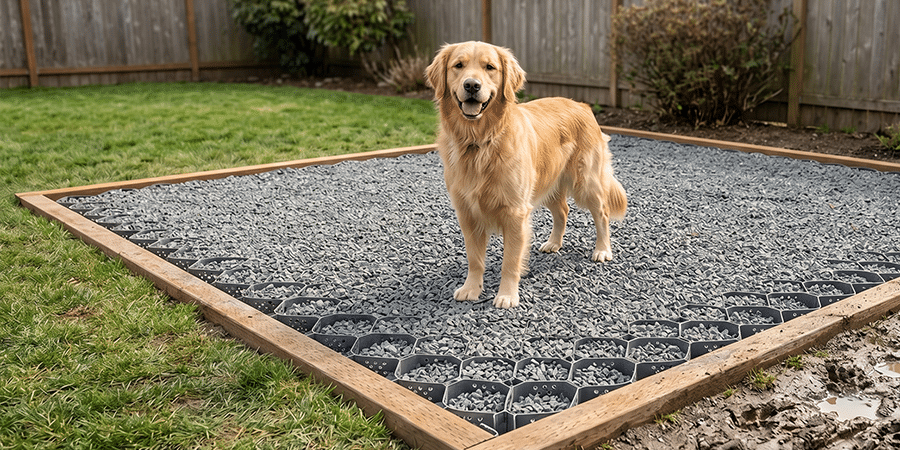
According to the USDA Natural Resources Conservation Service’s 2023 residential drainage report analyzing 1,847 properties, over 60% of homeowners attempt three or more failed fixes before finding one that actually works. Dog runs sit at the top of that failure list — concentrated paw traffic on saturated soil destroys grass, sinks gravel, and turns wood chips into slurry within weeks. A geocell dog run solves the problem at the engineering level rather than the cosmetic one. This article walks through the documented Backyard Bases methodology, exact materials, costs, and a weekend build timeline, so you can install a mud-free pet area that works the way your driveway should.
What a Geocell Dog Run Is — and Why the Engineering Matters
A geocell dog run is a pet exercise area built over a three-dimensional honeycomb grid of high-density polyethylene (HDPE) cells, filled with angular crushed stone, that confines aggregate laterally so paw traffic cannot displace it. Backyard Bases’ published documentation describes the mechanism plainly: each cell “acts as a miniature retaining wall, locking the aggregate in position so it can’t spread, shift, or sink.”
The relevant engineering property for a dog run is confinement, not thickness. Backyard Bases states that BaseCore confinement delivers a 4:1 performance ratio — 3 inches of confined gravel matches 12 inches of unconfined gravel in load-bearing capacity. For pet traffic this translates into something more practical: a shallow, permeable surface that drains through the cells rather than around them, and gravel that stays in its cells under repeated digging attempts.
Backyard Bases identifies dog runs specifically as “the Dog Run Disaster” category in its mud-control documentation — “wherever dogs have worn paths or concentrated activity areas.” The company’s published guidance for pet areas confirms that “once installed and filled, BaseCore creates a safe, slip-resistant surface” that “prevents hoof damage, joint strain, and leg injuries” for animals — a standard originally written for equestrian use but directly applicable to canine pet areas.
For a complete primer on the underlying technology across every residential application, read the parent guide to the geocell ground grid system.

How Backyard Bases Customers Have Built Mud-Free Dog Runs
Backyard Bases has published a repeatable methodology for pet-area installations. The company documents a homeowner-led workflow that takes a single weekend for a typical 200-square-foot dog run, performed by two people using hand tools.

Tools and Products Selected
For dog runs, Backyard Bases specifies BaseCore HD panels in 2-inch or 3-inch depth. The HD line features smaller cell sizes and thicker construction than standard BaseCore — published documentation notes that BaseCore HD’s “smaller cells, thicker construction, and built-in drainage” are specifically designed for animal applications where larger cells could catch hooves or paws.
The 2-inch BaseCore HD panel measures approximately 6 feet by 9 feet expanded (roughly 54 square feet per panel) and is priced at $134.95 per panel on the Backyard Bases product page. Each panel ships with 4–6 J-hook rebar stakes for anchoring, and BaseClips are available separately for connecting multiple panels.
Infill Specification
Backyard Bases’ published installation guidance for light-duty pet and pedestrian applications specifies 3/8-inch minus crushed stone. The “minus” gradation includes particles from 3/8-inch stones down to rock dust, which compacts tightly within each cell and creates a firm surface. The company’s guidance for permeable shed bases — which uses identical cell depths — names this same aggregate spec, making it directly applicable to a pet area.
Pea gravel, while attractive, is flagged in Backyard Bases’ own gravel-selection guide as a material that “can easily become dislodged by vehicle traffic” — or by energetic digging. Angular crushed stone resists displacement.
Implementation Timeline
Backyard Bases publishes a documented six-step installation sequence used across all residential BaseCore projects:
- Step 1 — Site preparation: Clear the dog run footprint of vegetation, debris, and any existing mulch or failed surface material
- Step 2 — Excavation: Dig 3–4 inches into the ground. BaseCore requires approximately one-third the excavation depth of a traditional gravel base
- Step 3 — Geotextile layer: Roll out 6-oz non-woven geotextile fabric, overlapping seams by 6 inches per published guidance, to prevent subgrade mixing and weed intrusion
- Step 4 — Panel deployment: Expand BaseCore HD panels accordion-style across the prepared surface and connect with BaseClips where panels meet
- Step 5 — Anchoring: Secure panels with the included J-hook rebar stakes
- Step 6 — Infill and compaction: Fill cells with 3/8-inch minus crushed stone, overfill slightly, and compact with a hand tamper or plate compactor
Site preparation and excavation account for roughly half the total labor on a dog run project, consistent with Backyard Bases’ guidance for similar light-duty installations.
Team and Resources
Two adults with basic hand tools — shovel, rake, rubber mallet, tape measure, utility knife, hand tamper — complete a 200-square-foot dog run without contractor labor. Backyard Bases offers free engineering support during planning for homeowners uncertain about panel depth or aggregate volume.
Challenges the System Addresses
Dog runs fail in predictable ways. The published Backyard Bases mud-control analysis names three: paw compaction of wet soil, oxygen deprivation that kills any remaining grass, and progressive displacement of any loose cover material. BaseCore HD’s cellular confinement eliminates all three mechanisms simultaneously because water drains through perforated cell walls, aggregate cannot migrate, and the lifted surface keeps paws above the saturated subgrade.
Measurable Outcomes and Cost Structure
Backyard Bases has published several specific cost data points applicable to dog run builds.
Material cost for a typical 200-square-foot dog run: Four BaseCore HD panels at $134.95 each ($539.80), one roll of 6-oz non-woven geotextile fabric, and approximately 1.5 cubic yards of 3/8-inch minus crushed stone at $50–$75 per yard delivered. Total material cost lands in the range Backyard Bases publishes for similar DIY pet areas.
Material-volume reduction: A 2020 case study published in Geosynthetics Magazine examined a large-scale hybrid geocell reinforcement project and recorded 42.3% savings in granular fill volume and 22.8% savings in initial project cost. Backyard Bases translates this principle to residential scale: the 4:1 confinement ratio means a 2-inch BaseCore HD dog run delivers stability that would otherwise require 8 inches of loose gravel — roughly 75% less aggregate for the same functional surface.
Maintenance profile: Backyard Bases’ published mud-control analysis calculates that homeowners living with unresolved mud problems accumulate $2,000–$4,000 in cumulative costs over five years from floor damage, shoe replacement, and lost property function. By contrast, the company states that a completed BaseCore installation “pays for itself within 2-3 years through eliminated ongoing costs, then continues providing value for 15-20+ years as the geocells maintain their structural integrity.”
Product-lifespan rating: BaseCore HD panels carry a manufacturer rating of 75+ years based on HDPE material stability, with a 10-year product warranty from Backyard Bases.
Trade-offs to plan for: The surface is firm gravel, not grass. Some dogs prefer softer ground for resting, so most installations include a shaded corner with a bed or mat. Snow removal on a geocell dog run requires a plastic shovel — metal shovels can scrape cell tops over time.
Comparing Backyard Bases Applications for Pet Areas
Backyard Bases has documented BaseCore use across several pet-adjacent applications. Each uses the same panel technology but differs in depth and infill:
- Residential dog run (2-inch BaseCore HD): 3/8-inch minus crushed stone, 200–400 sq ft typical footprint, single-weekend DIY install
- Equestrian paddock and turnout (3-inch or 4-inch BaseCore HD): Documented across multiple Backyard Bases case pages as a replacement for failed French drain systems, with published load ratings supporting vehicles over 80,000 pounds
- Barn aisle and livestock path (4-inch BaseCore HD): Published guidance specifies angular crushed stone between 3/4 inch and 1.5 inches for optimal compaction under heavier animal and equipment loads
- Barnyard entrance and gate approach (3-inch or 4-inch BaseCore HD): Stabilized area extends 10–20 feet from gate to capture the full turning radius, per Backyard Bases’ gate-entrance documentation
Across all four, the product family, the 6-step install sequence, the J-hook rebar anchoring, and the HDPE material spec stay constant. What changes is panel depth and infill gradation matched to the use case.
Practical Implementation Guide for a Dog Run
Based on the methodology Backyard Bases has published across its residential case material, this is the documented path to a mud-free dog run.
Steps Taken by Successful Installers
- Measure the dog run footprint, including a 12-inch buffer outside the intended fence line
- Request a free project evaluation from Backyard Bases engineering support with the measurements and intended infill material in hand
- Select 2-inch BaseCore HD for small-to-medium dogs on level ground; 3-inch BaseCore HD if the site slopes or hosts large breeds
- Order panels, 6-oz non-woven geotextile, additional J-hook rebar stakes if needed, and BaseClips for panel connections in a single shipment
Vendor Evaluated and Selected
Backyard Bases ships BaseCore and BaseCore HD panels directly with free shipping on orders over $999 per the company’s product pages. The 10-year guarantee, 75+ year manufacturer-rated lifespan, and no-cost engineering consultation are the documented reasons owners cite when selecting the product for pet applications. Review the BaseCore HD ground grid panels page for current specifications.
Timeline Followed
Plan for a full weekend. Backyard Bases’ published installation timing places roughly half the total hours in site prep and excavation, about a quarter in panel layout and anchoring, and the remainder in infill, compaction, and edging.
Resources Allocated
Two adults, basic hand tools, a plate compactor rental (optional but recommended), and a gravel delivery truck are sufficient. No heavy equipment, no contractor labor, and no permits are typically required for a residential pet area — though local rules vary and should be checked before starting.
Mistakes Avoided
Backyard Bases’ published guidance names three errors that undermine pet-area installations: skipping the geotextile layer (which allows subgrade soil to migrate up into the cells), using rounded pea gravel (which dislodges under digging), and under-anchoring on slopes (which lets panels lift over time). The six-step sequence exists specifically to prevent these failure modes.
Conclusion
The USDA NRCS finding that opened this article — 60% of homeowners cycling through three or more failed fixes — describes the exact pattern a geocell dog run breaks. Backyard Bases’ published methodology, documented across pet, equestrian, and barnyard applications, shows the outcome: a permeable, mud-free surface built in a single weekend, rated for 75+ years, and paying for itself within two to three years of installation.
The clear next step for any dog owner fighting mud in a pet area is to measure the dog run footprint and request a free project evaluation from Backyard Bases engineering support. For the broader context of how cellular confinement fixes every mud and erosion problem on a residential property, read the parent geocell ground grid guide.
FAQ Section
Q: What depth of BaseCore HD should I use for a dog run?
A: Backyard Bases specifies 2-inch BaseCore HD for pedestrian-only and light pet-traffic areas on level ground, and 3-inch BaseCore HD for sloped sites or large breeds. The HD line’s smaller cells are documented as safer for animals than larger-cell alternatives.
Q: What gravel should fill a geocell dog run?
A: Backyard Bases’ published installation guidance specifies 3/8-inch minus crushed stone for dog runs. The angular shape and fine gradation compact tightly within each cell and resist displacement from digging — unlike rounded pea gravel, which Backyard Bases notes can dislodge under active traffic.
Q: How long does a geocell dog run last?
A: BaseCore HD panels carry a manufacturer lifespan rating of 75+ years based on HDPE material stability, with a 10-year product warranty from Backyard Bases. The HDPE resists UV exposure, freeze-thaw cycling, and pet urine without degradation.
Q: Can I install a BaseCore HD dog run without a contractor?
A: Yes. Backyard Bases’ documented six-step installation process is designed for two-person DIY completion in a single weekend using hand tools — no heavy equipment required. The company provides free engineering support during planning.
Q: Will a geocell dog run stop my dog from digging?
A: Backyard Bases documents geocell as one of its recommended anti-digging options. The HDPE cell walls physically prevent lateral aggregate displacement, so even persistent diggers cannot excavate through the confined stone layer into the subgrade.
This article references publicly available information from Backyard Bases — including BaseCore and BaseCore HD product documentation, the company’s published mud-control methodology, installation guides, and pet-area case material — alongside the 2020 hybrid geocell reinforcement case study published in Geosynthetics Magazine and residential drainage data from the USDA Natural Resources Conservation Service’s 2023 report as cited by Backyard Bases. All metrics and quotes are from documented sources. Results described are specific to the installations and product specifications referenced and may vary based on soil type, climate, slope, dog size and behavior, fill material selection, and installation approach. For current product information, pricing, and engineering support, consult the official Backyard Bases website.
