
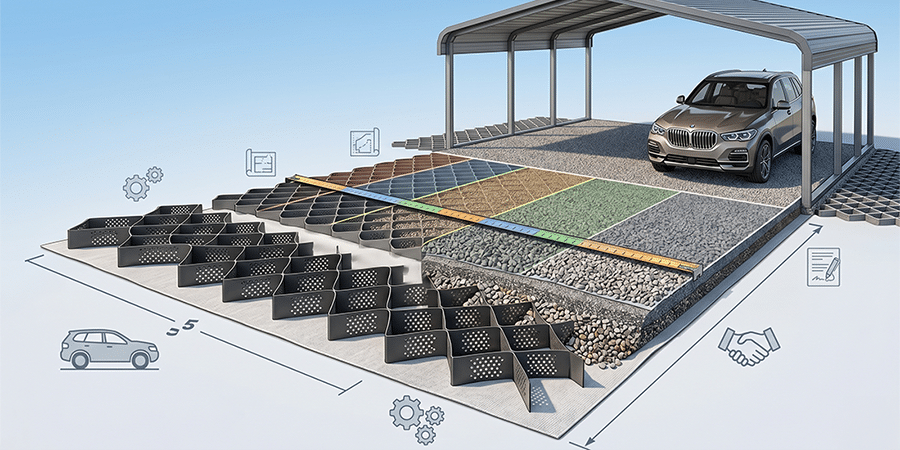
A standard 12-by-20-foot metal carport covers 240 square feet. The BaseCore HD 2-inch panel from Backyard Bases expands to roughly 54 square feet. That means a typical single-vehicle carport grid build needs about five panels, one roll of geotextile, a specific aggregate gradation, and a panel depth matched to vehicle weight — not more, not less. This article walks through Backyard Bases’ published specifications for carport grid selection so you can order the right panels the first time. Every number here comes from Backyard Bases product documentation or from documented case material, not estimates.
What a Carport Grid Is — and Why Panel Selection Matters
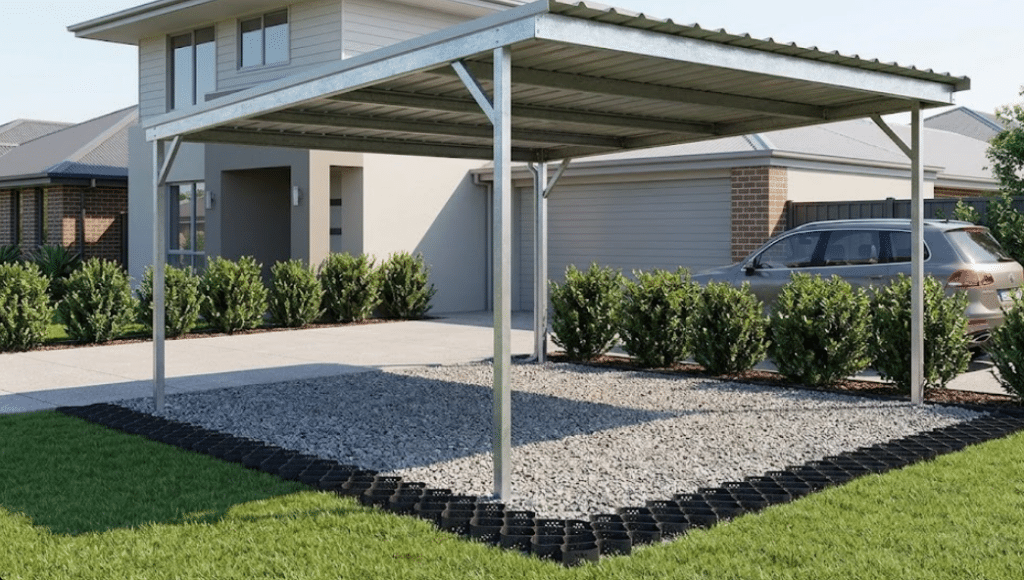
A carport grid is a three-dimensional honeycomb panel of high-density polyethylene (HDPE) that confines aggregate beneath a carport, creating a stable, permeable foundation that supports vehicle loads without the cost or drainage problems of concrete. Backyard Bases’ published product documentation describes the working principle: panels “distribute the load over an extended area” and “relieve the pressure off of a single spot and disperse it across the entire foundation.”
The reason panel selection matters is that not every carport carries the same load. A compact passenger car applies far less ground pressure than a Class A motorhome, and the BaseCore product line is engineered in discrete depth tiers to match that range. Backyard Bases’ own guidance is direct: “when in doubt, choose the next depth up — the additional stability is worth the modest cost difference.”
For the broader technology context, see the parent guide to the geocell ground grid system.
How Backyard Bases Matches Carport Grid Depth to Vehicle Type
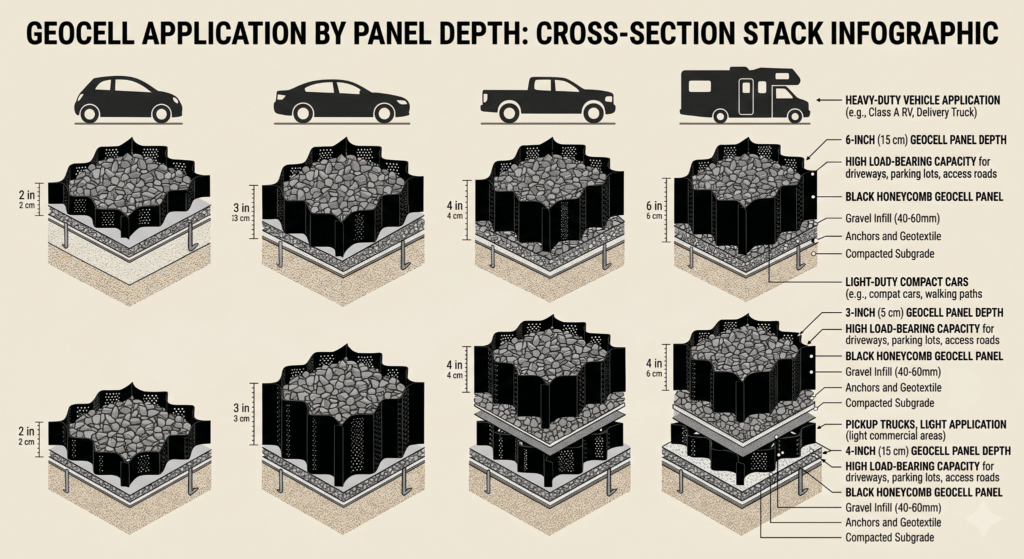
Backyard Bases publishes specific panel-depth recommendations across its BaseCore and BaseCore HD product pages. For carport grid applications, the documented mapping is:
- 2-inch BaseCore HD — Light pedestrian areas, walkways, stall floors, and “low-traffic artificial turf.” Published load rating: 2,250 pounds per square foot. Suitable for a carport only if it shelters pedal bikes, motorcycles, lawn equipment, or infrequently used small vehicles on well-drained, level ground.
- 3-inch BaseCore or BaseCore HD — Per Backyard Bases’ product page, “ideal for carports, backyard pathways, residential driveways, and storage for recreational vehicles.” This is the most common carport grid selection for daily-driver passenger cars, compact SUVs, and small pickups.
- 4-inch BaseCore HD — Published for “driveways supporting box trucks, heavy-duty pickups, and light trailers” plus “extreme slopes” and “commercial foundations.” The correct choice for full-size pickups, large SUVs, and any carport doubling as RV or boat-trailer storage.
- 6-inch BaseCore HD and deeper — Rated by Backyard Bases for “commercial parking, construction, slope stabilization, retaining walls.” Specified when the carport shelters heavy work trucks, multi-axle trailers, or equipment.
Backyard Bases’ foundation documentation adds one practical note: “BaseCore HD provides enhanced load capacity for multi-vehicle carports and RV parking pads. The deeper cell structure accommodates larger aggregate sizes that handle heavier loads without rutting. Single-car carports typically use standard BaseCore panels with crushed stone infill.”
The Standard vs. HD Decision for a Carport Grid
Backyard Bases publishes a clear distinction between the two product lines:
- BaseCore Standard — “Great for slopes, under turf and light jobs”
- BaseCore HD — “Engineered for heavier traffic, animals, and steeper slopes”
Published guidance states that “HD is stronger at every depth,” with BaseCore HD featuring smaller cell sizes, thicker construction, and double-welded seams that Backyard Bases documents as providing tensile strength exceeding 2,000 pounds per square foot. For a carport grid carrying any regular vehicle traffic, BaseCore HD is the documented default.
Panel Counts for Common Carport Sizes
The panel math is straightforward once you know the expanded footprint of each product size. Backyard Bases publishes these panel dimensions on its product pages:
- 2″ BaseCore HD — 6 feet × 9 feet expanded, approximately 54 square feet per panel
- 3″ BaseCore HD — dimensions vary by bundle; standard 3″ BaseCore panels expand to 9.4 feet × 24 feet, approximately 225 square feet per panel
- 4″ BaseCore HD — available in multiple panel sizes; published depth capacity supports heavier carport loads
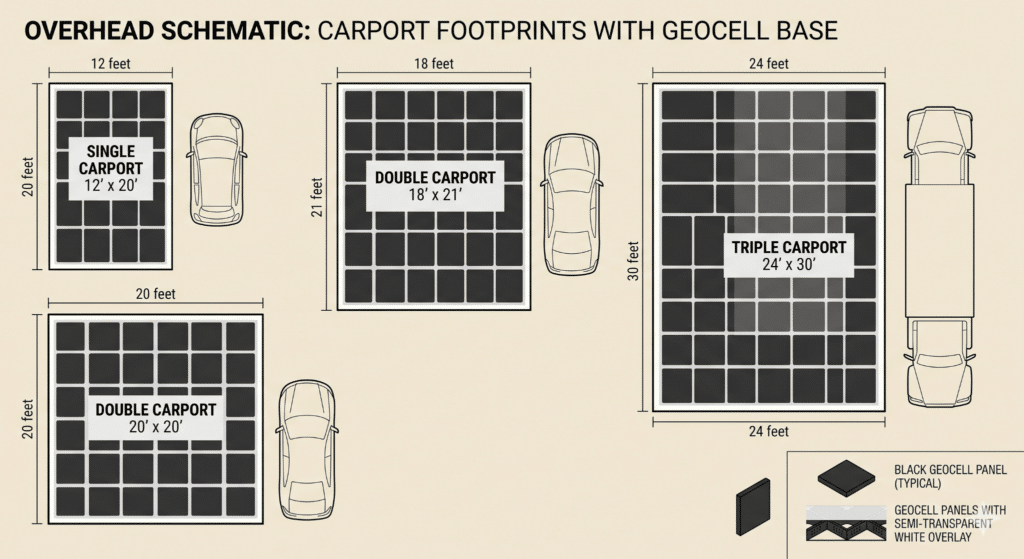
Applied to standard carport sizes:
- Single-car carport (12′ × 20′ = 240 sq ft): ~5 panels of 2″ BaseCore HD, or 1–2 panels of 3″ BaseCore depending on the bundle
- Single-RV carport (12′ × 26′ = 312 sq ft): ~6 panels of 2″ BaseCore HD (though 3″ or 4″ HD is the correct depth for RV loads)
- Two-car carport (18′ × 21′ = 378 sq ft): ~7 panels of 2″ BaseCore HD, or 2 panels of 3″ BaseCore
- Two-car wide carport (20′ × 20′ = 400 sq ft): ~8 panels of 2″ BaseCore HD
- Three-vehicle carport (24′ × 30′ = 720 sq ft): ~14 panels of 2″ BaseCore HD, or 3–4 panels of 3″ BaseCore
Backyard Bases recommends adding BaseClips where multiple panels meet — the clips “give lateral strength across the entire base and equally distribute weight when a car drives over.”
Documented Outcomes for BaseCore Carport Grid Installations
Backyard Bases has published specific outcomes that apply to carport grid projects.
Material volume reduction: A 2020 case study published in Geosynthetics Magazine recorded 42.3% savings in granular fill volume and 22.8% savings in initial project cost on a large-scale hybrid geocell reinforcement project. Backyard Bases translates that principle to residential scale: the 4:1 confinement ratio means a 3-inch BaseCore carport grid delivers load-bearing capacity equivalent to 12 inches of unconfined gravel.
Product lifespan: BaseCore HD panels carry a manufacturer-rated lifespan of 75+ years based on HDPE material stability, with a 10-year product warranty from Backyard Bases. The HDPE resists UV degradation, chemical exposure, and freeze-thaw cycling.
Oil and chemical tolerance: Backyard Bases’ published carport documentation notes that “Equipment shelters housing tractors, mowers, and utility vehicles benefit from BaseCore’s oil-resistant properties. Unlike concrete that stains and cracks from petroleum spills, geocell foundations contain spills within individual cells for easy cleanup.”
Installation speed: Two adults can complete a typical single-car carport grid in a single day using the Backyard Bases six-step process, per the published DIY carport foundation guidance.
Trade-offs: The finished surface is compacted gravel, not concrete. Backyard Bases’ own documentation acknowledges that property owners who want a sealed, paintable surface will still choose a slab — but notes that concrete slabs “can’t handle harsh winter and summer conditions” and typically require future maintenance that a BaseCore carport grid avoids.
How Backyard Bases Customers Have Applied Carport Grids
Backyard Bases has published documentation across several carport grid configurations, each using the same product family with depth matched to the application:
- Residential single-vehicle carport — 3-inch BaseCore or BaseCore HD, 3/4-inch minus angular crushed stone infill, ~240 sq ft footprint, single-day DIY install
- Multi-vehicle carport — 3-inch or 4-inch BaseCore HD across 400–600 sq ft, published for “enhanced load capacity for multi-vehicle carports”
- Equipment shelter / tractor barn — 4-inch BaseCore HD with larger aggregate, published for oil-spill containment and heavy implement traffic
- RV-capable carport — 4-inch BaseCore HD specified; Backyard Bases states “we use the same product in RV parks” and calls out the need for deeper cells to handle concentrated RV wheel loads
Across all four configurations, the underlying six-step installation method, the 6-oz non-woven geotextile under-layer, and the J-hook rebar anchoring remain constant. What changes is panel depth and aggregate size — both matched to the vehicle load.
Practical Implementation Guide for a Carport Grid Order
Based on Backyard Bases’ published guidance, this is the documented path from deciding to use a carport grid to placing the right order.
Steps to Take Before Ordering
- Measure the carport footprint plus a 12-inch buffer beyond each edge (Backyard Bases’ published installation guidance specifies clearing an area larger than the structure itself)
- Identify the heaviest vehicle that will ever park under the carport, including future possibilities like an RV or trailer
- Map panel depth to that vehicle per the depth guide above — defaulting up one tier when unsure
- Calculate panel count using the published panel footprint for the product you selected
- Add 6-oz non-woven geotextile (Backyard Bases specifically warns against substituting thinner 3.6-oz fabric, noting it can “stretch and tear” under concentrated loads), J-hook rebar stakes, and BaseClips for panel-to-panel connection
- Request a free project evaluation from Backyard Bases engineering support before placing the order
Vendor Selected
Backyard Bases offers free engineering support and free shipping on orders over $999 per its published product pages. The 10-year guarantee and 75+ year HDPE lifespan rating factor into the selection. Review the 4-inch BaseCore HD panels page for the heaviest carport grid applications.
Timeline Followed
A single-vehicle carport grid can be installed in one day by two people; a multi-vehicle or RV-capable carport grid typically takes a weekend. Site preparation and excavation account for roughly half the total hours.
Resources Allocated
Two adults, hand tools (shovel, rake, tape measure, utility knife, rubber mallet), a plate compactor rental, and a gravel delivery truck. No heavy equipment, no specialist labor, no concrete forms or curing time.
Mistakes Backyard Bases Documents as Avoidable
Three errors recur in the company’s published guidance: substituting thin 3.6-oz geotextile for the specified 6-oz fabric; under-sizing panel depth for the actual vehicle load; and using rounded pea gravel instead of angular crushed stone (rounded stone dislodges under wheel traffic, while angular gravel locks into each cell). The documented six-step method is structured to prevent all three.
Conclusion
The specification that opened this article — a 12-by-20-foot carport needing about five BaseCore HD panels — holds up because Backyard Bases publishes the panel footprints, depth tiers, and load ratings needed to compute the answer. Matching a carport grid to its vehicle load is not guesswork; it’s a four-variable calculation (carport size, vehicle weight, panel depth, panel footprint) backed by documented product specifications and the 4:1 confinement ratio confirmed in the 2020 Geosynthetics Magazine case study.
The clear next step for any homeowner planning a carport is to measure the footprint, identify the heaviest anticipated vehicle, and request a free project evaluation from Backyard Bases engineering support. For the full cellular-confinement context that underpins every BaseCore application across a property, read the parent geocell ground grid guide.
FAQ Section
Q: What depth of carport grid do I need for a full-size pickup truck?
A: Backyard Bases specifies 4-inch BaseCore HD for “box trucks, heavy-duty pickups, and light trailers.” For a carport sheltering a full-size pickup, 4-inch BaseCore HD is the documented default. Stepping down to 3-inch is only appropriate for compact or mid-size pickups on level, well-drained ground.
Q: How many BaseCore HD panels does a standard two-car carport need?
A: A 20-by-20-foot two-car carport covers 400 square feet. Using 2-inch BaseCore HD panels at 54 square feet each, the build takes approximately 8 panels. Using 3-inch BaseCore panels at 225 square feet each, it takes 2 panels with some trimming.
Q: Can I use BaseCore Standard instead of BaseCore HD for a carport grid?
A: Backyard Bases documents BaseCore Standard as “great for slopes, under turf and light jobs” and BaseCore HD as “engineered for heavier traffic.” For any carport grid carrying regular vehicle traffic, BaseCore HD is the published recommendation because HD “is stronger at every depth.”
Q: What aggregate should fill a carport grid?
A: Backyard Bases specifies angular crushed gravel, typically 1/4-inch to 3/4-inch with approximately 15% fines for compaction. Avoid rounded pea gravel or river rock, which Backyard Bases documents as liable to “shift under load” on vehicle surfaces.
Q: Do I need geotextile fabric under a carport grid?
A: Yes. Backyard Bases specifies 6-oz non-woven geotextile and warns explicitly against substituting thinner 3.6-oz fabric, which “stretches and tears” under concentrated vehicle loads. The 6-oz fabric prevents subgrade fines from migrating into the cells over time.
This article references publicly available information from Backyard Bases — including BaseCore and BaseCore HD product specifications, carport and foundation documentation, and published DIY installation guidance — alongside the 2020 hybrid geocell reinforcement case study published in Geosynthetics Magazine and cellular confinement technology developed by the U.S. Army Corps of Engineers in 1975. All metrics and product specifications are from documented Backyard Bases sources. Results described are specific to the product specifications referenced and may vary based on vehicle weight, carport size, soil type, climate, fill material selection, and installation approach. For current product information, panel dimensions, and engineering support, consult the official Backyard Bases website.
