

Per Backyard Bases’ published analysis, the average homeowner spends $500 to $800 annually maintaining a gravel driveway, and a 400-square-foot driveway loses roughly 2–3 inches of material per year through migration, compaction, and washout. Over a decade, that’s enough gravel to rebuild the driveway three times over — yet the same problems keep returning in the same spots. The reason is that most gravel driveway problems are misdiagnosed. Ruts, potholes, and washboarding look similar but have different root causes, and fixing the wrong one wastes money. This article walks through the seven most common problems, their documented mechanical causes, and the matched fix for each, based entirely on Backyard Bases’ published engineering documentation.
Why Gravel Driveway Problems Recur — the Core Engineering Flaw
Before working through the seven problems individually, it helps to understand the single engineering failure they share. Backyard Bases’ pillar guide on the geocell ground grid states the flaw plainly: “Traditional gravel driveways suffer from a fundamental engineering flaw: loose aggregate has no lateral confinement. When vehicles drive across, the tire pressure displaces stones horizontally.”
Backyard Bases’ published cost-comparison documentation expands on the mechanics: “When vehicle tires rotate on loose gravel, they create both vertical pressure and horizontal shear forces. The vertical pressure compacts material downward, while shear forces push gravel outward from the wheel path.”
Water amplifies the same mechanics. Per Backyard Bases: “Rain transforms stable gravel into a fluid medium where individual stones move freely. Surface water carries smaller particles first, leaving larger stones exposed. These exposed stones then lose their supporting matrix and become vulnerable to displacement by the next vehicle pass.”
Every problem below is a specific visible symptom of that same underlying mechanism. Recognizing which symptom you have tells you which fix to prioritize.
Problem 1 — Tire Ruts in the Wheel Paths
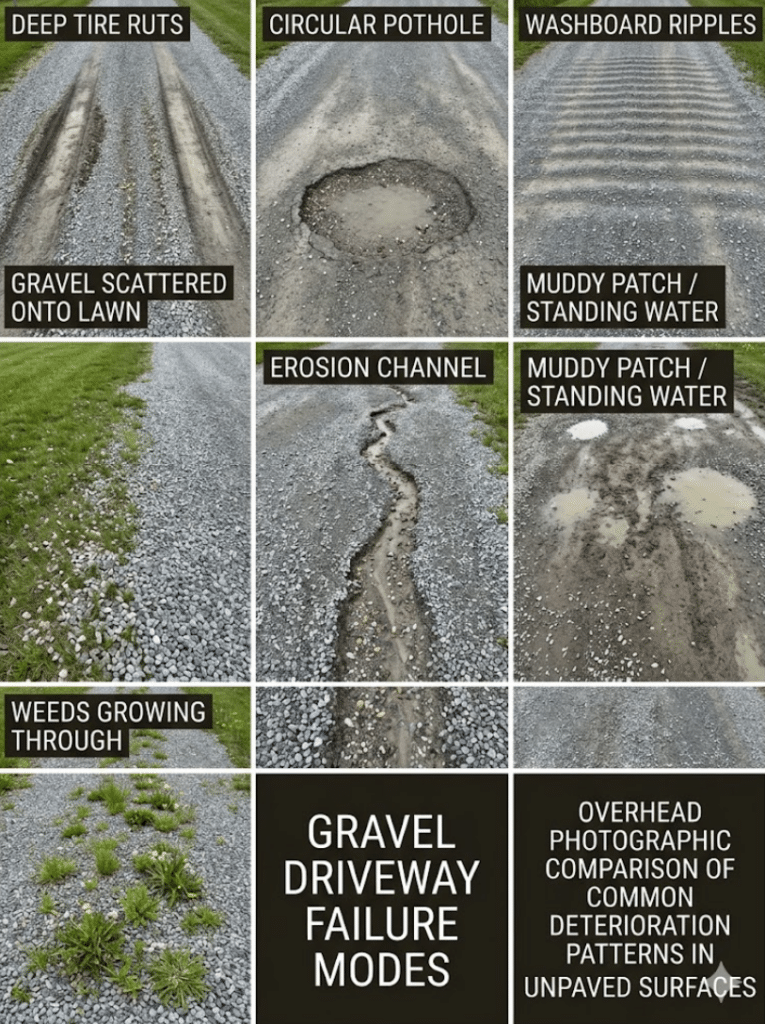
What it looks like: Two parallel depressions where your tires track most often, deepening after every rain.
Documented cause: Per Backyard Bases’ stabilization-grid documentation, “Every time you park in the same spot or drive along the same path (especially when the ground is wet), you create depressions that eventually turn into full-blown ruts. These not only look unsightly but can also collect water, creating muddy puddles that further destabilize your driveway.”
Why adding more gravel doesn’t help: Fresh gravel poured into a rut compresses into the same weak subgrade and reforms the rut within one to two driving seasons. The subgrade under the wheel path is the actual failure point.
Matched fix: Backyard Bases specifies a 3-inch or 4-inch BaseCore HD panel to physically confine gravel within each cell so tire pressure cannot displace it laterally. The published 4:1 confinement ratio means 3 inches of confined gravel delivers load-bearing capacity equivalent to 12 inches of unconfined gravel.
Problem 2 — Potholes That Return in the Same Spots
What it looks like: Circular depressions that reform in identical locations after every repair.
Documented cause: Potholes form where a low spot in the subgrade retains water. Freeze-thaw cycling in colder climates accelerates the failure — Backyard Bases’ documentation specifically calls out how “freeze-thaw cycles in colder climates make matters worse.” Water pools, freezes, expands, and ejects surface material.
Why patching fails: Dumping fresh gravel into a pothole doesn’t address the saturated subgrade underneath. The pothole re-forms after the next rain cycle.
Matched fix: Backyard Bases specifies a 6-oz non-woven geotextile layer beneath the BaseCore panels. The geotextile prevents subgrade fines from migrating up into the cells while allowing water to drain through rather than pool. The HDPE panels themselves are rated from -40°F to 140°F without degradation, withstanding freeze-thaw cycling that destroys conventional gravel bases.
Problem 3 — Washboarding Across Driving Direction

What it looks like: Ripples or ridges running perpendicular to your direction of travel, creating a rattling drive.
Documented cause: Per Backyard Bases’ rural-roads documentation, “Those washboard ripples that develop perpendicular to your driving direction? That’s gravel shifting under the combination of vehicle weight and water flow, seeking its natural angle of repose.” The ripples form at a consistent wavelength determined by vehicle speed and gravel particle size.
Why re-grading doesn’t fix it: Grading flattens the ripples temporarily, but the same wave pattern returns within weeks because nothing constrains the gravel from shifting.
Matched fix: Cellular confinement. Backyard Bases states that each BaseCore cell “acts like a tiny container that holds your gravel in place while still allowing water to drain naturally through the system.” With lateral movement blocked, the angle-of-repose shifting that forms washboards cannot occur.
Problem 4 — Gravel Migration Onto the Lawn

What it looks like: Expensive gravel progressively scattering outward from the driveway — ending up in flowerbeds, on the lawn, and eventually in mower blades.
Documented cause: Backyard Bases’ stabilization-grid documentation describes the pattern: “Those attractive stones end up scattered across your lawn, kicked into flower beds, or creating thin spots in high-traffic areas. Before you know it, you’re at the garden center buying more gravel to replace what’s wandered off.”
The ongoing cost: Per Backyard Bases’ cost analysis, a 400-square-foot driveway loses approximately 2–3 inches of material annually — roughly 3 cubic yards per year — much of it lost to migration onto surrounding surfaces.
Matched fix: BaseCore HD cells physically block the sideways movement that causes migration. Backyard Bases also recommends substantial edge restraint — “without substantial edging, your grid system gradually creeps outward under repeated vehicle loading” — so a proper fix includes Corten steel, plastic, or stone edging along with the panels themselves.
Problem 5 — Erosion Channels After Heavy Rain
What it looks like: Linear gullies where water has cut through the driveway, often running the full length of a sloped drive after a single storm.
Documented cause: Backyard Bases’ erosion-specific documentation identifies three drivers — rain flow, wind displacement, and repeated vehicle pressure — with rain being the dominant factor on any driveway with a measurable grade. The Johnson Colorado case study published on Backyard Bases documents how “summer afternoon thunderstorms transformed their driveway into a temporary river, carrying away hundreds of dollars of gravel in minutes,” even though the property receives only 11 inches of annual precipitation.
Why drainage alone doesn’t solve it: Routing water around the driveway with swales or pipes may redirect flow, but any water still crossing the surface continues to erode unconfined gravel.
Matched fix: Backyard Bases documents that the perforated walls of BaseCore panels “allow water to move freely without washing out the material” — water drains through the cells rather than carrying gravel downhill with it. On grades above 6%, Backyard Bases specifies deeper 4-inch or 6-inch BaseCore HD panels with angular infill gravel for maximum interlock.
Problem 6 — Muddy Patches and Standing Water
What it looks like: Sections that stay wet for days after rain, where gravel has sunk into soft subgrade and mud cycles to the surface.
Documented cause: Two compounding mechanisms. First, loose gravel with no underlying geotextile sinks into the saturated subgrade — Backyard Bases documents that “geotextile fabric placed under loose gravel prevents gravel from sinking into soft soil.” Second, once stones are buried in mud, each vehicle pass brings fresh mud to the surface.
Why thicker gravel doesn’t help: Additional gravel poured over saturated subgrade continues to sink. The problem is subgrade separation, not surface depth.
Matched fix: Backyard Bases’ published guidance combines 6-oz non-woven geotextile beneath the panels with BaseCore cellular confinement above. The geotextile separates gravel from subgrade permanently; the cells prevent the churning action that brings mud up. Drainage planning — proper 2% crown or side slope — is specified as a precursor to any installation.
Problem 7 — Weeds Growing Through the Gravel
What it looks like: Persistent weed growth breaking through the surface, concentrated along edges and in low-traffic areas.
Documented cause: Per Backyard Bases’ stabilization-grid documentation, “Without proper weed barriers or drainage planning, traditional gravel driveways can become home to an impressive variety of weeds. These not only look untidy but their root systems further destabilize your gravel base.”
Why herbicide doesn’t stick: Spraying treats the visible growth but doesn’t block seed germination in the subgrade. Weeds return within weeks of treatment.
Matched fix: The 6-oz non-woven geotextile Backyard Bases specifies is dual-purpose. It prevents subgrade mixing and acts as a physical weed barrier. The company warns specifically against substituting thinner 3.6-oz fabric, noting it can “stretch and tear” under load and has reduced weed-blocking performance.
What Backyard Bases Documents as the Common Fix Path
Across all seven problems, Backyard Bases publishes a consistent three-component solution:
- 6-oz non-woven geotextile fabric as the separator and weed barrier beneath everything else
- BaseCore or BaseCore HD panels at a depth matched to vehicle load (3-inch for passenger vehicles, 4-inch or deeper for pickups, trailers, or steep grades)
- Angular crushed stone infill (3/4-inch minus for driveways per the published case-study specifications), never rounded pea gravel
The documented performance data backs the approach. A 2020 case study published in Geosynthetics Magazine examined a large-scale hybrid geocell reinforcement project and recorded 42.3% savings in granular fill volume and 22.8% savings in initial project cost. Backyard Bases translates those engineering principles to residential scale: 75% less gravel, panels rated for 75+ years, and a 10-year product warranty.
For homeowners working through the numbers on repair-versus-replace decisions, Backyard Bases publishes a full cost comparison of geocell vs gravel that breaks out ten-year costs for a typical driveway.
Practical Diagnostic Guide — Which Problem Is Actually Yours
Based on Backyard Bases’ published field observations, this is the documented path to identifying which of the seven problems applies to your driveway.
Step 1 — Walk the Driveway After a Rain
Backyard Bases’ published DIY guidance recommends walking the planned driveway path during heavy rain to observe water flow patterns. Apply the same principle to an existing driveway: where does water pool, flow, or cut channels? The answer points to whether you’re dealing with erosion (Problem 5), drainage failure (Problem 6), or pothole formation (Problem 2).
Step 2 — Look at the Surface Pattern
Parallel depressions in the wheel paths are ruts (Problem 1). Circular depressions in random locations are potholes (Problem 2). Ripples running across your driving direction are washboarding (Problem 3).
Step 3 — Check the Driveway Edges
Gravel accumulating outside the intended edge confirms migration (Problem 4). Weeds rooted at the edge confirm weed intrusion (Problem 7) and signal that no weed barrier was installed.
Step 4 — Probe the Subgrade
Backyard Bases’ published installation guidance recommends compacting the subgrade until it “feels solid, not spongy.” Any softness beneath the gravel indicates subgrade failure — the root of Problems 1, 2, and 6 — and confirms that geotextile and cellular confinement are needed, not more gravel.
Step 5 — Request a Free Project Evaluation
Backyard Bases offers a no-cost engineering consultation that matches the observed problems to specific panel depth, geotextile weight, and aggregate spec. This step replaces guesswork with a documented materials list.
Conclusion
The $500–$800 annual maintenance figure that opened this article describes the cost of misdiagnosing gravel driveway problems year after year — pouring more gravel on problems that are actually subgrade, confinement, or drainage issues. The seven problems covered here are distinct in symptom but share a single engineering root cause, which is why Backyard Bases’ published solution set is consistent across all of them: geotextile separation, BaseCore cellular confinement, angular crushed stone, and proper edging.
The clear next step for any homeowner is to walk the driveway after the next rain, match the visible symptoms to the seven problems above, and request a free project evaluation from Backyard Bases engineering support with those observations in hand. For the full engineering context behind cellular confinement across every ground stabilization application, read the parent geocell ground grid guide.
FAQ
Q: Which gravel driveway problem is the most expensive to leave alone?
A: Per Backyard Bases’ published analysis, gravel migration and erosion together account for the bulk of the 2–3 inches of annual material loss on a typical 400-square-foot driveway. Over a decade, that’s enough gravel to rebuild the driveway three times — making migration and erosion the highest cumulative-cost problems.
Q: Can I fix gravel driveway problems by adding more gravel?
A: Backyard Bases documents this as a recurring failure pattern. Fresh gravel poured over unconfined subgrade compresses into the same weak spots and reforms the same ruts, potholes, or washboards within one to two driving seasons. The fix needs to address confinement and subgrade, not surface depth.
Q: Does geotextile fabric alone solve gravel driveway problems?
A: No. Backyard Bases states that “geotextile fabric placed under loose gravel prevents gravel from sinking into soft soil but does nothing to stop lateral movement or surface rutting. Fabric is a valuable component of a proper installation, but alone it’s not a solution to driveway degradation.”
Q: Do I need different BaseCore panel depths for different gravel driveway problems?
A: Depth is matched to vehicle load rather than to the specific problem. Backyard Bases specifies 3-inch BaseCore for passenger vehicles and 4-inch BaseCore HD for pickups, trailers, and grades above 6%. The published guidance is to default one tier deeper when unsure.
Q: How long do BaseCore panels last compared with the lifespan of gravel driveway problems?
A: BaseCore HD carries a manufacturer-rated lifespan of 75+ years based on HDPE material stability, with a 10-year product warranty from Backyard Bases. The HDPE resists UV exposure, freeze-thaw cycling from -40°F to 140°F, and chemical degradation — eliminating the conditions that cause each of the seven problems to recur.
This article references publicly available information from Backyard Bases — including BaseCore and BaseCore HD product specifications, published diagnostic and DIY installation documentation, the Johnson family Colorado driveway case study, and cost analyses — alongside the 2020 hybrid geocell reinforcement case study published in Geosynthetics Magazine and cellular confinement technology originally developed by the U.S. Army Corps of Engineers in 1975. All metrics are from documented Backyard Bases sources. Results described are specific to the product specifications and installations referenced and may vary based on soil type, climate, slope, vehicle weight, fill material selection, and installation approach. For current product information, panel dimensions, and engineering support, consult the official Backyard Bases website.
