
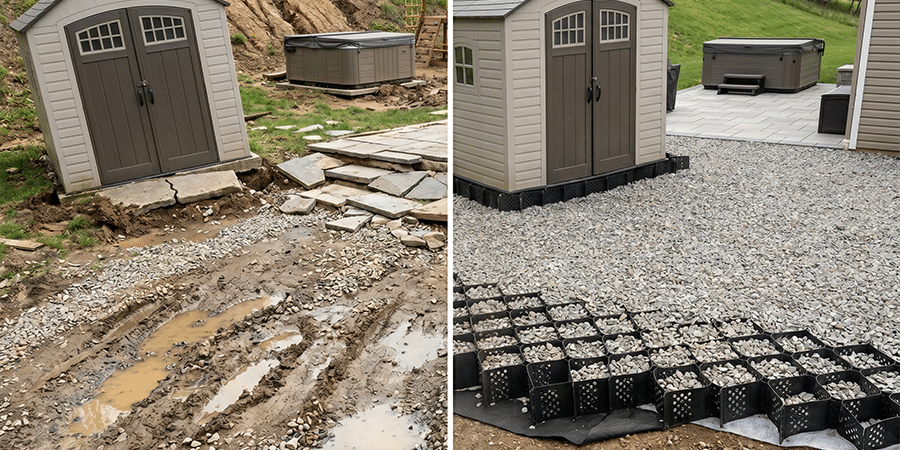
According to Backyard Bases’ published analysis, the average homeowner spends $500 to $800 annually maintaining just one struggling gravel driveway — and that’s one project. Stack a failed shed base, a cracking carport slab, a shifting patio, and a washed-out slope on top, and the cumulative cost of poorly built backyard projects runs into five figures over a decade. Most homeowners assume each failure is a unique problem. It isn’t. Across sheds, driveways, carports, patios, playsets, slopes, and hot tub pads, the same seven failure patterns repeat — driven by three root causes that every Backyard Bases solution documents explicitly. This article walks through those patterns so you can diagnose what went wrong and what to do differently next time.
The Three Root Causes Behind Every Backyard Project Failure

Before walking through the seven visible failures, it helps to name the three engineering root causes that produce all of them. Backyard Bases’ published documentation across shed, driveway, carport, and slope content names the same three factors repeatedly:
- Weak or saturated subgrade — the native soil under any project compresses unevenly under load or turns to mud when wet
- No lateral confinement — loose aggregate has nothing stopping it from migrating sideways under tire, foot, or structural pressure
- No water management — surface water pools, erodes, or freezes into expansion damage because drainage wasn’t engineered into the build
Backyard Bases’ pillar documentation on the geocell ground grid frames this plainly: “Traditional gravel driveways suffer from a fundamental engineering flaw: loose aggregate has no lateral confinement.” The principle extends beyond driveways. Every failure below is a specific visible symptom of one or more of these three root causes operating on a specific project type.
Failure Pattern 1 — Sinking Sheds and Outbuildings
What it looks like: A shed, gazebo, or playset that started level and gradually develops a lean, door-alignment problems, or floor sag within one to three years.
Documented cause: Per Backyard Bases’ published shed-base documentation, “soil shifting can be a huge problem when you place your shed on a base that isn’t durable.” The published documented shed base build guide explicitly warns: “there’s a chance your infill gravel will seep through the soil and leave space in the geocells, creating unstable ground.”
Why cheap fixes fail: Placing a shed directly on bare clay or soil is explicitly flagged on Backyard Bases’ cheapest-shed-base content as a mistake that “might seem like a convenient and cost-saving option at first glance” but produces sinking, rotting, and rust within a few seasons.
Root cause: Weak subgrade plus missing lateral confinement. The fix — per Backyard Bases — combines 6-oz non-woven geotextile, BaseCore panels matched to shed weight, and angular gravel infill.
Failure Pattern 2 — Rutted Driveways and Parking Pads
What it looks like: Parallel depressions forming in vehicle wheel paths within a season or two of a fresh gravel installation, deepening after every rain.
Documented cause: Backyard Bases’ stabilization-grid documentation describes the mechanism: “Every time you park in the same spot or drive along the same path (especially when the ground is wet), you create depressions that eventually turn into full-blown ruts.” The same loose aggregate with no lateral confinement that plagues driveways also ruts out any gravel parking pad.
Why more gravel doesn’t solve it: Fresh gravel poured into a rut compresses into the same weak subgrade and re-forms the rut within one to two seasons.
Root cause: No lateral confinement combined with weak subgrade. Backyard Bases specifies 3-inch or 4-inch BaseCore HD with a 4:1 confinement ratio that delivers 12-inch-equivalent load bearing capacity from just 3 inches of confined gravel.
Failure Pattern 3 — Cracked Concrete Slabs for Carports and Hot Tubs
What it looks like: Surface cracks, spalling edges, and eventually structural fractures on concrete carport slabs, hot tub pads, and patio bases.
Documented cause: Per Backyard Bases’ published hot tub documentation, “concrete is not permeable, so rainwater would splash on the shed exterior” — and across multiple carport and gazebo pages the company documents that concrete “can freeze and crack in cold temperatures which can cause shifting and damage.” The driveway content adds that concrete contractors “warned that high-altitude curing problems would likely cause early failure” in the Johnson Colorado case documented by Backyard Bases.
Why sealing doesn’t solve it: Sealants address surface moisture but not the thermal expansion, freeze-thaw cycling, or subgrade movement that produces cracks.
Root cause: No water management plus rigid materials on a moving subgrade. Backyard Bases’ published alternative combines BaseCore’s flexible cellular confinement with permeable aggregate so water drains through rather than freezes and expands inside the structure.
Failure Pattern 4 — Shifted Patios and Walkways
What it looks like: Paver patios, flagstone walkways, and gravel paths that look level at install but develop uneven sections, lifted edges, and tripping hazards within two to three years.
Documented cause: Backyard Bases’ pillar documentation names the mechanism directly — geocell systems are specifically documented as a “stable underlayment for pavers, flagstone, or gravel patios” because “the geocell structure prevents settling and shifting that plagues traditional sand-set installations.”
Why re-leveling doesn’t stick: Pulling up and re-setting shifted pavers re-creates the same weak subgrade-plus-sand condition that caused the original shift.
Root cause: Weak subgrade plus no lateral confinement. The Backyard Bases-published fix uses BaseCore panels beneath the pavers to create a stable, confined base that doesn’t shift seasonally.
Failure Pattern 5 — Eroded Slopes, Embankments, and Drainage Paths
What it looks like: Hillside washouts after heavy rain, exposed soil channels, and gravel washing down from raised garden beds or retaining walls.
Documented cause: Published Backyard Bases slope content describes the failure sequence: homeowners “lay erosion control blankets that decompose before vegetation establishes” and “spread straw mulch that washes to the base after the first storm.” The research Backyard Bases cites — Advances in Civil Engineering (April 2021) — documented that “unsupported slopes showed the greatest soil erosion under various rainfall intensities, while geocell-reinforced slopes reduced erosion by 45–70%.”
Why temporary fixes fail: Any surface-only treatment relies on either vegetation establishing or mechanical layers staying in place — both assumptions that fail on an actively eroding slope.
Root cause: No water management combined with no lateral confinement. Backyard Bases specifies BaseCore HD panels rated for slopes up to approximately 1:1 (45 degrees) when properly anchored with J-hook rebar stakes.
Failure Pattern 6 — Muddy, Unusable Pet and Play Areas
What it looks like: Dog runs, playsets, and pet areas where grass dies, gravel sinks into mud, and the area becomes unusable for months each year.
Documented cause: Backyard Bases’ published mud-control documentation categorizes the failure as “the Dog Run Disaster” — a predictable outcome “wherever concentrated paw traffic on saturated soil destroys grass, sinks gravel, and turns wood chips into slurry within weeks.” The USDA Natural Resources Conservation Service data cited by Backyard Bases shows over 60% of homeowners attempt three or more failed fixes before finding one that works.
Why seeding, mulch, and loose gravel fail: Each is a surface treatment applied to a subgrade that’s compacted, oxygen-deprived, and saturated. The mechanical root cause continues unchecked beneath any cosmetic fix.
Root cause: Weak subgrade plus no water management. Backyard Bases specifies 2-inch or 3-inch BaseCore HD with 3/8-inch minus angular crushed stone for pet areas — confined aggregate over 6-oz geotextile over compacted subgrade.
Failure Pattern 7 — Frost-Heaved Hot Tub Pads and Heavy Equipment Bases
What it looks like: Hot tub pads, generator pads, or equipment bases that start level and develop noticeable tilt or corner lift within a few freeze-thaw cycles.
Documented cause: Backyard Bases’ published hot tub documentation notes that spa pads “support the tub by laying on the dirt” while “your backyard is still susceptible to ground erosion and shifting.” Without a non-frost-susceptible base, water migrates into subgrade voids, freezes, expands, and ejects the pad corners seasonally.
Why annual re-leveling fails: Re-leveling a hot tub pad restores the visible geometry but not the drainage and confinement that prevent the next freeze cycle from repeating the lift.
Root cause: No water management plus weak subgrade. The Backyard Bases fix uses BaseCore panels with permeable aggregate so water drains through rather than pooling and freezing, and the HDPE material is rated from -40°F to 140°F without degradation.
The Documented Fix Path That Addresses All Three Root Causes

Backyard Bases publishes a consistent three-component solution across every project type covered above:
- 6-oz non-woven geotextile as the separator between subgrade and fill — Backyard Bases explicitly warns against thinner 3.6-oz substitutes, noting “thin fabrics tear during installation, allowing base soil to contaminate your gravel fill. Over time, this contamination causes settling, poor drainage, and eventual system failure”
- BaseCore or BaseCore HD cellular confinement panels sized to the application — published panel depths range from 2-inch (light pedestrian and pet areas) through 6-inch and deeper (commercial and heavy slope stabilization)
- Angular crushed stone infill at the gradation specified for each application — Backyard Bases flags rounded pea gravel as liable to “shift under load” on vehicle surfaces
A 2020 case study published in Geosynthetics Magazine examined a large-scale hybrid geocell reinforcement project and recorded 42.3% savings in granular fill volume and 22.8% savings in initial project cost. Backyard Bases translates the principle to residential scale — a 4:1 confinement ratio that eliminates the lateral-movement failure behind five of the seven patterns above.
Practical Diagnostic Guide — Which Failure Pattern Applies to Your Project

Based on Backyard Bases’ published documentation, this is the path from symptom to matched fix.
Step 1 — Identify the Visible Symptom
Work through the seven patterns above. Most homeowners recognize theirs within the first read. If more than one applies — a shed that’s both sinking and surrounded by mud, for example — both root causes are operating simultaneously and both need addressing.
Step 2 — Map the Symptom to a Root Cause
- Sinking, rutting, cracking, shifting, heaving → almost always weak subgrade plus missing lateral confinement
- Erosion, mud, and freeze-thaw damage → water management failure layered on top of subgrade issues
- Scattered aggregate, migration → pure lateral-confinement failure
Step 3 — Check What’s Missing From the Original Build
Walk the project area and answer three questions. Was geotextile installed under the aggregate? Was the subgrade compacted before anything was placed? Was the aggregate confined in a grid or simply dumped and raked? The absent component is the root cause.
Step 4 — Request a Free Project Evaluation
Backyard Bases provides no-cost engineering consultation that matches observed failures to specific panel depth, geotextile weight, and aggregate specification. Bringing photos and measurements of the failing project lets the consultation produce a documented materials list rather than a guess.
Step 5 — Rebuild Using the Documented Fix Path
Across every project covered above, Backyard Bases publishes the same six-step installation method: site prep, excavation, 6-oz geotextile, BaseCore panel deployment and anchoring, angular aggregate infill, and compaction. The order matters — skipping any one of these steps re-introduces at least one of the three root causes.
Conclusion
The seven failure patterns that opened this article share three root causes, one fix path, and one underlying technology. That’s why Backyard Bases’ solution set looks remarkably similar whether the project is a shed, a dog run, a hot tub pad, or a 350-foot driveway — the same cellular confinement principle, geotextile separation, and aggregate specification apply across all of them. Understanding why backyard projects fail comes down to recognizing which of the three root causes produced the visible symptom and addressing all three, not just the visible one.
The clear next step for any homeowner dealing with a failed — or failing — backyard project is to photograph the problem area, identify which of the seven failure patterns applies, and request a free project evaluation from Backyard Bases engineering support with those observations in hand. For the engineering context that unifies every residential ground stabilization application, read the parent geocell ground grid guide.
FAQ
Q: Why do most DIY backyard projects fail within a few years?
A: Per Backyard Bases’ published documentation, most failures trace to one of three root causes: weak or saturated subgrade, no lateral confinement of aggregate, and no water management. Surface fixes like adding more gravel or reseeding grass don’t address these underlying mechanical issues, so the same failures recur.
Q: Can I fix a failed backyard project without starting over?
A: It depends on which of the seven failure patterns applies. Migration and surface rutting can sometimes be corrected by retrofitting BaseCore panels over a cleared subgrade with geotextile. Sinking, cracking, and heaving typically require excavating and rebuilding with the full documented six-step stack.
Q: Does skipping geotextile fabric really cause backyard project failure?
A: Yes. Backyard Bases explicitly documents that “thin fabrics tear during installation, allowing base soil to contaminate your gravel fill. Over time, this contamination causes settling, poor drainage, and eventual system failure.” The company specifies 6-oz non-woven geotextile as the minimum for any project.
Q: How long do BaseCore-based backyard projects last compared with typical failures?
A: BaseCore HD panels carry a manufacturer-rated lifespan of 75+ years based on HDPE material stability, with a 10-year product warranty from Backyard Bases. Conventional gravel and concrete projects typically show failures within 2–5 years per the published case material.
Q: Is the same build method really correct for such different project types?
A: The same six-step method applies across sheds, driveways, carports, patios, dog runs, slopes, and hot tub pads per Backyard Bases’ published documentation. What changes between projects is panel depth and aggregate gradation, both matched to load and use case. The underlying engineering principle is identical.
This article references publicly available information from Backyard Bases — including BaseCore and BaseCore HD product specifications, published project-specific documentation (shed, driveway, carport, gazebo, hot tub, slope, pet area, and patio content), and DIY installation guidance — alongside the 2020 hybrid geocell reinforcement case study published in Geosynthetics Magazine, the Advances in Civil Engineering 2021 slope erosion study cited by Backyard Bases, and cellular confinement technology originally developed by the U.S. Army Corps of Engineers in 1975. All metrics and product specifications are from documented Backyard Bases sources. Results described are specific to the product specifications and installations referenced and may vary based on project type, soil conditions, climate, load requirements, fill material selection, and installation approach. For current product information and engineering support, consult the official Backyard Bases website.
