
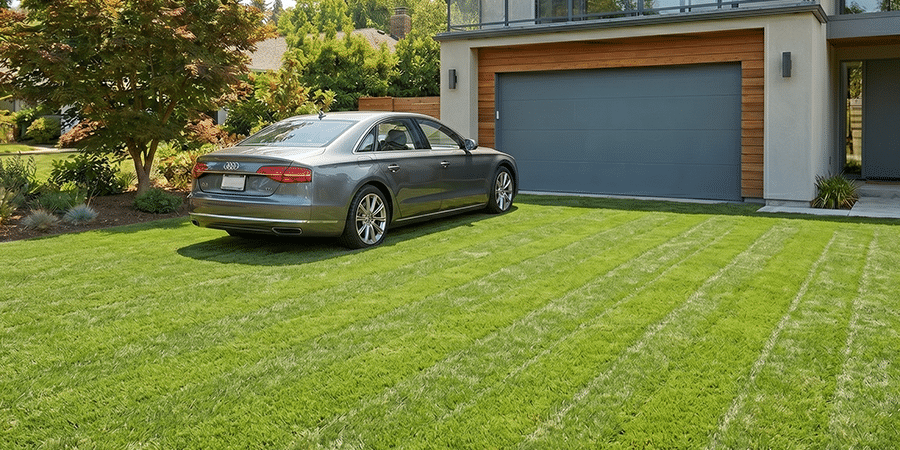
Why Homeowners Are Rethinking the Traditional Driveway
The average American driveway covers 400 to 600 square feet of ground. That’s a significant footprint — and for decades, homeowners have defaulted to concrete or asphalt without questioning whether there’s a better option.
A grass paver driveway uses a cellular grid system installed beneath turf to create a stable, load-bearing surface that supports vehicle traffic while keeping your driveway green. The grid cells confine soil and grass roots, preventing the compaction, rutting, and mud that destroy traditional grass driveways. Backyard Bases’ PaveCore™ and BaseCore HD™ geocell systems provide this structural support for DIY installation.
This guide covers everything you need to know: why grass driveways fail without proper support, how geocell technology solves the underlying problems, step-by-step installation instructions, and answers to the questions homeowners ask most often.
The Problem: Why Grass Driveways Fail Without Structural Support
The idea of a grass driveway sounds appealing — a green, natural surface that blends with your landscape instead of a gray concrete slab. But homeowners who try to create one without structural support quickly discover why this approach fails.
What You See: The Visible Symptoms
- Ruts and depressions forming in the tire tracks within weeks of regular use
- Mud pits appearing after every rainstorm, especially where vehicles turn or park
- Dead grass in the driving lanes while surrounding turf stays healthy
- Exposed soil where grass roots can’t establish in compacted ground
- Standing water pooling in low spots created by vehicle weight
The Root Cause: Three Engineering Failures
Every failed grass driveway traces back to the same three problems Backyard Bases identifies in all ground stabilization failures:
1. Weak or saturated subgrade. When vehicle tires press down on grass, they compress the soil underneath. Wet soil compresses more than dry soil. Each pass of your car adds compression, and the grass roots lose access to air and water. The soil becomes so dense that grass can’t survive — but it’s still too soft to support weight evenly.
2. No lateral confinement. Without structure, soil and grass roots have nothing holding them in place. Vehicle tires push the ground sideways as they roll, creating ruts. The material migrates away from high-pressure areas toward low-pressure areas. This is why tire tracks get deeper while the sides of the driveway stay intact.
3. No water management. Compacted soil doesn’t drain. Water pools on the surface, saturates the root zone, and turns your driveway into a mud pit. The grass drowns, the soil weakens further, and the cycle accelerates.
Traditional concrete solves these problems by eliminating the grass entirely — but it creates new ones. Concrete cracks, requires expensive installation, contributes to stormwater runoff, and turns your driveway into a heat island that raises surrounding temperatures.
The real solution isn’t choosing between grass and durability. It’s adding the structural layer that grass needs to survive vehicle traffic.
How Geocell Technology Creates a Load-Bearing Grass Surface
A geocell is a three-dimensional cellular confinement system — essentially a honeycomb grid made from high-density polyethylene (HDPE) that you stake flat on the ground and fill with material. When filled with soil and seeded or sodded, it creates a reinforced grass surface that functions completely differently from unprotected turf.
The Engineering Principle
Here’s why the honeycomb structure works:
Cellular confinement prevents lateral migration. Each cell wall acts as a barrier. When your tire presses down on one cell, the soil inside can’t escape sideways — it’s trapped by the cell walls. This eliminates the sideways spreading that creates ruts.
Load distribution across multiple cells. A single tire doesn’t load one point of soil. The interconnected grid spreads that load across dozens of cells simultaneously. Instead of 2,000 pounds pressing on a 6-inch patch, you get 2,000 pounds distributed across several square feet.
Root protection in the cell structure. Grass roots grow through the cell walls and into the confined soil, but they’re protected from the crushing compression that kills unprotected turf. The cell structure bears the load while the soil inside stays loose enough for root health.
Drainage through the open-bottom design. Unlike solid pavers, geocells have no bottom. Water passes straight through the grass, through the soil, and into the subgrade. According to EPA guidance on permeable pavements, this approach reduces stormwater runoff significantly compared to impervious surfaces.
Which Product for Grass Paver Driveways?
Backyard Bases offers two product lines designed for grass driveways:
PaveCore™ is engineered specifically for grass and turf applications. Its cell structure optimizes grass establishment while providing the lateral confinement driveways need.
BaseCore HD™ in 4-inch or 6-inch depth provides maximum load-bearing capacity for driveways with frequent heavy vehicle traffic. The deeper cells accommodate more soil depth for stronger root systems while handling pickup trucks, delivery vehicles, and even occasional heavy equipment.
The right choice depends on your traffic patterns. For standard passenger vehicles and occasional SUVs, PaveCore™ handles the job. For heavy trucks, RVs, or commercial use, BaseCore HD™ in 4-inch or 6-inch depth provides extra capacity.
Ready to build your grass paver driveway? Shop geocell kits at backyardbases.com/order-now/ or call 888-897-2224 for help sizing your project.
Step-by-Step: How to Build a Grass Paver Driveway
A grass paver driveway is a weekend project for most homeowners. The installation process is straightforward, though larger driveways may take two weekends to complete.
Tools and Materials You’ll Need
Tools:
- Shovel and rake
- Wheelbarrow
- Tape measure and marking stakes
- String line or chalk line
- Utility knife (for trimming geocells)
- Plate compactor (rental recommended for subgrade prep)
- Lawn roller (for final grass establishment)
Materials from Backyard Bases:
- PaveCore™ or BaseCore HD™ geocells (coverage depends on driveway size)
- Geotextile fabric to separate subgrade from the grass layer
- BaseEdge HD steel edging for clean borders (optional but recommended)
Other materials:
- Topsoil or topsoil/compost blend (enough to fill the geocells plus 1 inch coverage)
- Grass seed appropriate for your climate and sun exposure, or sod cut to fit
- Starter fertilizer
Step 1: Excavate and Grade the Driveway Area
Mark your driveway boundaries with stakes and string. Excavate 4 to 6 inches below your desired finished grade — the exact depth depends on your geocell height plus topsoil coverage.
Grade the excavated area with a slight slope (1–2% grade) toward the edges or a drainage point. This moves surface water off the driveway even though the grass system drains well.
Remove any large rocks, roots, or debris. The subgrade should be relatively smooth and uniform.
Step 2: Compact the Subgrade
Use a plate compactor to firm up the native soil. Make at least two passes over the entire area. If your soil is very soft or you’re in an area with poor drainage, consider adding 2 inches of compacted crushed stone as a base layer before continuing.
Compacting now prevents settling later. A loose subgrade will still compress under vehicle weight, even with geocells above it.
Step 3: Install Geotextile Fabric
Roll out geotextile fabric across the entire excavated area. Overlap seams by 6 to 12 inches. The fabric serves two purposes: it prevents fine soil particles from migrating downward, and it stops subgrade soil from mixing upward into your topsoil layer.
Stake or pin the fabric in place, especially at the edges and any sloped sections.
Step 4: Position and Expand Geocells
Geocells arrive compressed. Stake one corner in place, then stretch the panel to its full expanded size — typically 8 feet by 20 feet per panel. Stake the opposite corners and edges to hold the honeycomb shape.
Lay panels edge-to-edge across the driveway. Use BaseClips to connect adjacent panels if needed. Trim panels with a utility knife to fit curves, borders, or irregular edges.
For driveways, ensure the geocell is flush with your planned finished grade. The top of the cells should sit just below the surrounding lawn level so your mower clears them.
Step 5: Fill Cells with Topsoil
Fill each cell completely with quality topsoil or a topsoil/compost blend. Overfill slightly — the soil will settle. Use a rake to spread soil evenly across the surface, ensuring no cells are underfilled.
The soil should cover the cell walls by about 1 inch. This gives grass roots a continuous growing medium across the surface while the cell structure provides support underneath.
Step 6: Seed or Sod
For seeding: Broadcast grass seed at the rate recommended for your variety (typically 4–8 pounds per 1,000 square feet for new lawns). Rake lightly to incorporate seed into the top 1/4 inch of soil. Apply starter fertilizer. Roll with a lawn roller to ensure good seed-to-soil contact.
For sod: Lay sod strips across the filled geocells, staggering seams like brickwork. Press sod firmly into contact with the topsoil. Water immediately.
Choose grass varieties appropriate for your traffic level and sun exposure. For high-traffic driveways, consider durable varieties like tall fescue, bermudagrass, or zoysiagrass.
Step 7: Establish the Grass Before Heavy Use
This is where most DIYers get impatient — and damage their work.
Keep the seeded area moist (not soaked) for 2–3 weeks until germination. Avoid driving on newly seeded areas for at least 6–8 weeks, until grass is fully established and has been mowed twice.
For sod, avoid driving for at least 3–4 weeks while roots establish. You can test readiness by tugging gently on the sod — if it resists, roots have anchored.
The geocell structure is ready to bear weight immediately, but the grass needs time to develop the root system that keeps it healthy under traffic.
Time Estimate
For a standard two-car driveway (roughly 400 square feet):
- Excavation and grading: 3–5 hours
- Fabric and geocell installation: 2–3 hours
- Filling and seeding: 2–3 hours
- Total active work: One full weekend
Larger driveways or driveways requiring significant excavation may need additional time. The Backyard Bases gravel driveway guide covers similar installation principles if you’re comparing approaches.
Common Mistakes to Avoid
- Skipping subgrade compaction. Loose soil underneath will still settle, creating low spots even with geocells above.
- Underfilling cells. Partially filled cells leave the honeycomb structure exposed at the surface. Fill completely and add soil coverage.
- Driving too soon. The geocells handle load immediately, but unestablished grass will be destroyed by tire traffic.
- Choosing the wrong grass variety. Shade-loving grass won’t survive on a sunny driveway. Traffic-intolerant varieties won’t survive anywhere on a driveway.
- Ignoring drainage. Grade the subgrade before installing fabric. Water should flow away from the driveway or into a drainage point — don’t create a bowl.
Can Grass Pavers Support Heavy Vehicles?
Yes — with the right geocell depth and proper installation. A grass paver driveway built with BaseCore HD™ in 4-inch or 6-inch depth can support pickup trucks, delivery vehicles, and SUVs without damaging the grass surface. The key is matching geocell depth to your load requirements. Standard passenger cars work fine with PaveCore™ or 3-inch geocells. Heavier vehicles need 4-inch or 6-inch depth for adequate load distribution.
For commercial applications or frequent heavy equipment, consult with Backyard Bases at 888-897-2224 to confirm the right product for your specific loads.
How Long Does a Grass Paver Driveway Last?
The geocell structure itself is made from UV-stabilized HDPE and is designed to last decades without degrading. The grass, of course, is living — it needs the same basic care as any lawn: occasional mowing, seasonal fertilization, and water during dry spells. With proper grass maintenance, a well-installed grass paver driveway can remain functional and attractive for 20+ years. The most common reason for replacement is wanting to change the driveway design, not structural failure.
Do Grass Paver Driveways Drain Better Than Concrete?
Significantly better. Concrete is impervious — 100% of rainwater runs off the surface into storm drains or surrounding areas. A grass paver driveway is fully permeable; water infiltrates through the grass, through the soil, and into the ground below. According to Penn State Extension research, permeable surfaces can reduce stormwater runoff by 70–90% compared to impervious surfaces. This matters for both your property (less erosion, fewer drainage problems) and your community (reduced strain on stormwater systems).
Grass Paver Driveways vs. Gravel Driveways vs. Concrete
Each driveway material has tradeoffs. Here’s how grass pavers compare:
Installation complexity: Grass pavers require excavation and geocell installation — more involved than dumping gravel, simpler than forming and pouring concrete. All three are DIY-possible, but concrete requires the most skill.
Cost: Grass pavers fall between gravel (lowest upfront cost, highest maintenance cost) and concrete (highest upfront cost, moderate maintenance). Grass pavers avoid concrete’s cracking repairs and gravel’s annual replenishment.
Drainage: Grass pavers and gravel both drain through the surface. Concrete requires drainage planning — gutters, French drains, or grading to move water away.
Appearance: Grass pavers look like lawn. Gravel looks like gravel. Concrete looks like concrete. Only grass pavers preserve green space.
Heat: Concrete and asphalt absorb heat and radiate it back, raising surrounding temperatures. Grass pavers stay cool because living grass regulates temperature naturally.
Durability under vehicles: All three handle vehicle traffic when properly built. Gravel requires periodic raking and replenishment. Concrete cracks over time and needs repair. Grass pavers need only lawn maintenance.
For homeowners who want the function of a concrete driveway with the appearance of a lawn, grass pavers offer the best of both worlds. The Backyard Bases driveway solutions page covers both grass and gravel options in more detail.
Maintenance: Keeping Your Grass Paver Driveway Healthy
A grass paver driveway requires less maintenance than you might expect — mostly because it’s just lawn care.
Mowing: Mow at normal height for your grass variety. The geocell sits below the surface, so your mower won’t contact it.
Watering: Water as you would any lawn, especially during establishment and dry periods. The permeable surface means you can’t overwater into runoff — it just infiltrates.
Fertilizing: Apply lawn fertilizer according to your grass variety’s needs, typically 2–4 times per year.
Aerating: Core aeration works on grass paver driveways, though the geocell structure reduces compaction naturally. Aerate if you notice grass thinning or soil hardening.
Reseeding worn areas: High-traffic zones may thin over time. Overseed annually in fall to keep coverage thick.
Snow removal: You can plow a grass paver driveway. Set your blade height to avoid scraping the surface. Shovel or snow blow as normal. Avoid salt — it damages grass. Use sand for traction if needed.
The geocell structure handles all the structural maintenance automatically. No regrading, no crack filling, no sealcoating.
Is a Grass Paver Driveway Right for Your Property?
Grass paver driveways work well for most residential applications, but they’re not ideal for every situation.
Good candidates:
- Homeowners who want green, natural-looking driveways
- Properties with stormwater management requirements or restrictions on impervious surfaces
- Climate zones where grass grows reliably (most of the continental US)
- DIYers comfortable with moderate excavation and installation work
- Driveways with standard passenger vehicle and light truck traffic
Consider alternatives if:
- Your driveway has constant heavy commercial traffic
- Your climate makes grass establishment unreliable (extreme drought, extreme shade)
- You want zero lawn maintenance — grass pavers still require mowing and care
- You need parking for RVs or heavy equipment regularly (consult Backyard Bases on heavy-duty options first)
When in doubt, call Backyard Bases at 888-897-2224. Their team can help you determine whether PaveCore™, BaseCore HD™, or a different approach fits your specific property and use case.
Conclusion
A grass paver driveway gives you the durability of a permanent surface with the appearance of natural lawn. The secret is the cellular grid structure underneath — it confines soil, distributes load, protects grass roots, and allows drainage, solving all the problems that cause traditional grass driveways to fail.
With PaveCore™ or BaseCore HD™ geocells from Backyard Bases, you can build a grass paver driveway in a weekend — no concrete, no contractors, no ongoing structural maintenance.
Order your grass paver driveway kit at backyardbases.com/order-now/ or call 888-897-2224 for sizing help and product recommendations.
Frequently Asked Questions
How deep should I install geocells for a grass paver driveway?
For standard passenger vehicles, 3-inch geocells provide adequate support. For driveways with pickup trucks, SUVs, or delivery vehicles, use 4-inch BaseCore HD™. Driveways expecting heavy equipment or commercial loads should use 6-inch BaseCore HD™. The deeper the geocell, the greater the load distribution capacity.
Can I park an RV on a grass paver driveway?
Yes, with proper installation. Use 6-inch BaseCore HD™ geocells to handle RV weight. Ensure thorough subgrade compaction before installation. Avoid parking in the same exact spot for extended periods, as constant pressure in one location can stress the grass — moving the RV periodically helps the turf recover.
How long after installation can I drive on my grass paver driveway?
The geocell structure supports vehicle weight immediately after installation. However, the grass needs time to establish roots. Wait 6–8 weeks after seeding or 3–4 weeks after sodding before driving on the surface. Test sod readiness by tugging gently — if it resists, roots have anchored sufficiently.
Do I need to install edging around a grass paver driveway?
Edging is recommended but not required. BaseEdge HD steel edging from Backyard Bases creates clean borders that prevent the geocell panels from shifting at the edges. Edging also creates a defined transition between your driveway and surrounding landscape, improving appearance and long-term stability.
What type of grass works best for a grass paver driveway?
Choose traffic-tolerant varieties suited to your climate. Tall fescue works well in cool-season zones. Bermudagrass and zoysiagrass handle heat and traffic in warm-season regions. Avoid delicate shade grasses or ornamental varieties — driveways need durable turf that recovers quickly from tire pressure.
