
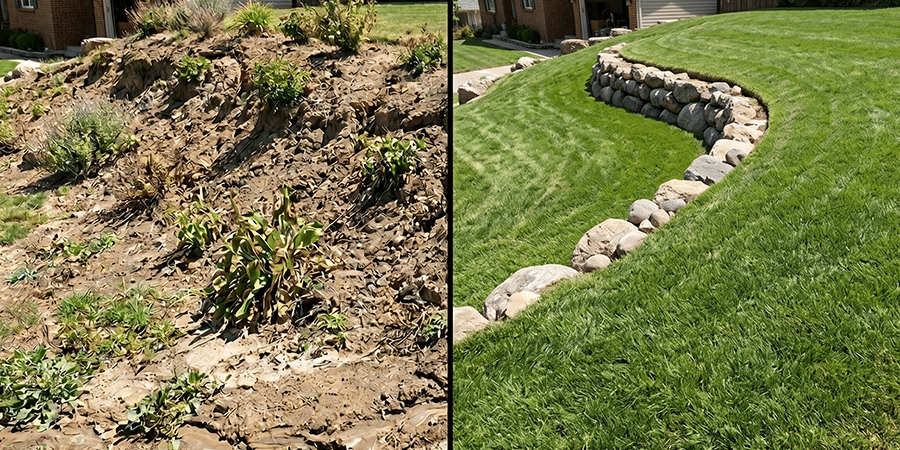
Every heavy rainstorm reveals the same frustrating pattern: mulch migrating into your driveway, bare soil appearing where grass used to grow, and gravel pathways turning into miniature riverbeds. The average homeowner spends $200–$400 annually replacing washed-out landscaping materials — money that literally flows into the storm drain.
The most effective landscaping erosion control combines three elements: a permeable barrier that lets water drain while holding soil in place, ground cover that absorbs rainfall impact, and cellular confinement systems like geocells that lock aggregate and soil into a stable matrix. Unlike loose mulch or gravel that washes away, geocell ground grids create permanent stability by preventing lateral movement of fill materials during heavy rain and runoff.
This guide from Backyard Bases explains why your current erosion control methods keep failing, which techniques actually work for different yard conditions, and how to install a permanent solution yourself in a single weekend. We’ll cover everything from mild slope stabilization to heavy-traffic areas where traditional landscaping can’t survive.
Why Your Landscaping Keeps Washing Away
Before buying more mulch or spreading another load of gravel, you need to understand why erosion keeps winning. Every landscaping erosion failure traces back to one or more of three root engineering problems — and most common fixes only address the symptoms.
Root Cause 1: No Lateral Confinement
What it looks like: Gravel migrates sideways off pathways. Mulch piles up against downhill edging. River rock spreads into lawn areas. Decorative stone disappears from beds after every storm.
What’s actually happening: Loose materials have nothing holding them in place. When water flows across the surface — or when you walk on them — individual particles move in the path of least resistance. Edging helps at borders, but does nothing to prevent movement within the bed itself. The material isn’t washing away so much as it’s spreading everywhere.
Root Cause 2: Weak or Saturated Subgrade
What it looks like: Muddy depressions form in lawn areas. Landscape fabric sinks and becomes visible. Stepping stones tilt or settle unevenly. Plants heave out of the ground after freeze-thaw cycles.
What’s actually happening: The native soil underneath your landscaping compresses unevenly when wet, or it can’t drain fast enough to stay stable. Clay-heavy soils are especially prone to this — they absorb water, expand, then crack and erode when they dry. Without subsurface drainage and load distribution, any material you place on top will eventually follow the soil downward.
Root Cause 3: No Water Management
What it looks like: Channels form through mulched areas. Gravel develops ruts and low spots. Downspout discharge zones turn into craters. Slopes show exposed roots and bare soil.
What’s actually happening: Water concentrates and accelerates instead of spreading and infiltrating. According to Penn State Extension’s stormwater research, runoff velocity increases dramatically on compacted or bare surfaces — and that velocity is what moves your landscaping materials. A single downspout can discharge over 600 gallons during a one-inch rainfall, and without dispersion, all that water carves a path through whatever’s in its way.
Why Common Fixes Fail
Most homeowners respond to erosion with one of these approaches:
- Adding more material: Another layer of mulch or gravel just becomes another layer to wash away. The underlying drainage and confinement problems remain.
- Installing landscape fabric: Fabric prevents weed growth, but it doesn’t prevent lateral movement of material above it or address subsurface drainage. Water pools on top of it, accelerating surface runoff.
- Building retaining walls: Walls hold back slopes, but they don’t stabilize the fill materials in front of them. Gravel against a retaining wall still migrates sideways with foot traffic and water flow.
- Pouring concrete: Concrete eliminates erosion but also eliminates drainage. Water has to go somewhere, and impervious surfaces concentrate runoff at edges and low points — often causing worse erosion in adjacent areas.
Effective landscaping erosion control requires addressing all three root causes simultaneously: confine materials laterally, stabilize the subgrade, and manage water flow. That’s where cellular confinement systems like geocell ground grids change the equation.
How Geocell Ground Grids Solve Landscaping Erosion
Geocells are honeycomb-shaped panels made from high-density polyethylene (HDPE) that expand into a grid of interconnected cells. When filled with gravel, soil, or aggregate, the cells create a unified, stable matrix that can’t migrate, rut, or wash away. Originally developed by the U.S. Army Corps of Engineers for military road construction, this technology is now available to homeowners through BaseCore™ geocell systems from Backyard Bases.
Lateral Confinement: Locking Materials in Place
Each cell in a geocell grid acts like an individual container. When you fill the cells with gravel or decorative stone, that material can’t spread sideways — even under foot traffic, vehicle weight, or rushing water. The cell walls absorb horizontal force and redistribute it across the entire grid structure.
This is fundamentally different from edging, which only contains materials at the perimeter. Geocells provide internal confinement throughout the entire surface area. A 4-inch deep BaseCore™ panel filled with ¾-inch gravel creates a rigid surface that performs like a solid slab — but drains like gravel.
Load Distribution: Protecting the Subgrade
The cellular structure spreads point loads across a wider area, reducing pressure on the soil beneath. This prevents the compression and rutting that destabilizes loose-fill landscaping. For applications like gravel driveways, pathways that see regular foot traffic, or utility access areas, load distribution is what keeps surfaces level long-term.
When paired with geotextile fabric underneath, the system also prevents fine soil particles from migrating upward into the aggregate layer — a process called subgrade intrusion that gradually turns gravel beds muddy.
Permeable Drainage: Managing Water Without Pooling
Unlike concrete or solid pavers, geocell-stabilized surfaces remain fully permeable. Water infiltrates through the aggregate fill and drains into the soil below. This reduces surface runoff velocity, minimizes erosion at discharge points, and recharges groundwater rather than overwhelming storm drains.
For slopes and hillsides, this permeability is critical. Water that can infiltrate doesn’t accelerate downhill. The USDA Natural Resources Conservation Service recommends permeable ground covers as a primary erosion control strategy specifically because they slow water at the point of impact.
Ready to stop replacing washed-out landscaping? Explore BaseCore™ geocell solutions or call 888-897-2224 for help sizing your project.
Step-by-Step: Installing Geocell Erosion Control in Your Yard
This installation guide covers a standard 10×10-foot landscaping area — a common size for pathway sections, decorative beds, or transition zones that see erosion. Scale the materials proportionally for larger projects.
Tools and Materials Needed
- BaseCore™ geocell panels (2″ depth for decorative beds, 3″–4″ depth for pathways or slopes)
- Geotextile fabric (non-woven, minimum 4 oz/sq yd)
- BaseEdge HD steel edging (for perimeter containment)
- ¾-inch crushed gravel or decorative stone (approximately 1 cubic yard per 80 sq ft at 4″ depth)
- Shovel, rake, wheelbarrow
- Plate compactor (rental, ~$80/day) or hand tamper for small areas
- Tin snips or utility knife (for trimming geocell panels)
- Landscape stakes or ground anchors
Step 1: Excavate and Grade the Area (1–2 hours)
Remove existing mulch, loose gravel, or vegetation from the project area. Excavate to a depth of 4–6 inches below your desired finished grade — this accounts for the geotextile, geocell depth, and aggregate fill.
Grade the subgrade to eliminate high spots and fill low spots. For drainage, maintain a minimum 1–2% slope away from structures. On hillsides, work with the existing slope rather than fighting it — geocells stabilize slopes up to 45 degrees.
Common mistake: Skipping excavation and placing geocells directly on top of existing soil. This leaves the weak subgrade in direct contact with your fill material, eventually transferring settlement and drainage problems to the surface.
Step 2: Install Geotextile Fabric (30 minutes)
Roll out geotextile fabric across the entire excavated area, extending 6–12 inches beyond the project perimeter. Overlap seams by at least 6 inches. The fabric separates your aggregate fill from the native soil, preventing mud migration while allowing water to drain through.
Secure fabric edges with landscape staples every 2–3 feet to prevent shifting during geocell installation.
Step 3: Expand and Position Geocell Panels (30–45 minutes)
BaseCore™ panels arrive compressed. Expand each panel to its full size (typically 8×4 feet per panel) and position on top of the geotextile. Stake corners and edges using the integrated anchor points to prevent the expanded grid from collapsing during filling.
For larger areas, connect multiple panels using BaseClips. Trim panels to fit curves, corners, and irregular boundaries using tin snips — the HDPE material cuts cleanly.
On slopes, position the long axis of cells perpendicular to the water flow direction. This creates a series of mini check-dams that slow runoff and capture sediment.
Step 4: Fill Cells with Aggregate (1–2 hours)
Shovel or wheelbarrow crushed gravel into each cell, filling to the top of the cell walls or slightly above (⅛–¼ inch overfill). Use angular crushed stone rather than round river rock — angular particles interlock better and resist movement.
For decorative applications, fill cells 90% with structural gravel, then top with ½ inch of decorative stone. This gives you the appearance you want while maintaining stability underneath.
Step 5: Compact the Surface (30–45 minutes)
Run a plate compactor over the filled geocell surface, making two to three passes. Compaction settles the aggregate into the cells and creates interlock between particles. Add additional gravel to any cells that settle below the cell walls and re-compact.
For small areas or delicate decorative stone, use a hand tamper instead. The goal is a firm, level surface where individual stones don’t shift underfoot.
Step 6: Install Perimeter Edging (30 minutes)
BaseEdge HD steel edging provides a clean visual border and prevents edge cells from spreading under pressure. Install edging after filling so it sits flush with the finished surface. Drive stakes every 3–4 feet and at corners.
Time estimate: A 10×10-foot area takes approximately 4–6 hours for one person, or 2–3 hours with a helper. Larger projects benefit from having gravel delivered directly to the work area rather than wheelbarrowing from a pile.
What Is the Best Erosion Control for a Sloped Yard?
For sloped yards, the best erosion control combines cellular confinement with permeable aggregate fill. Geocell systems like BaseCore™ work on slopes up to 45 degrees because the cell walls physically prevent material from migrating downhill — even during heavy runoff events. Install cells perpendicular to the slope direction so each row acts as a miniature terrace, and pair with geotextile fabric underneath to prevent subgrade washout.
Traditional slope solutions like erosion control blankets or hydroseeding provide temporary cover while vegetation establishes, but they don’t address the fundamental problem of loose material on an incline. Geocells create permanent, load-bearing stability that supports foot traffic, lawn equipment, and runoff without degrading.
Does Gravel Prevent Erosion or Make It Worse?
Loose gravel often makes erosion worse because it migrates, ruts, and channels water rather than dispersing it. However, gravel confined within a geocell system becomes an excellent erosion control surface. The cells prevent lateral movement while allowing water to infiltrate, giving you the drainage benefits of gravel without the maintenance problems. Choose angular crushed stone rather than round pea gravel — the sharp edges interlock better within cells and resist displacement.
For driveways and high-traffic areas, 3″–4″ depth BaseCore™ provides the load-bearing capacity to handle vehicles while keeping gravel locked in place.
How Do Geocells Stop Erosion?
Geocells stop erosion through cellular confinement — each honeycomb cell acts as an individual container that holds fill material in place regardless of slope, water flow, or traffic load. When filled with aggregate, the cells create a unified matrix where forces transfer horizontally through cell walls rather than displacing surface material. Water drains vertically through the permeable fill instead of sheeting across the surface, which eliminates the velocity that causes erosion. Learn more about how geocell technology works on the Backyard Bases site.
Conclusion
Effective landscaping erosion control isn’t about buying more mulch or building higher walls — it’s about addressing the three root causes that make materials wash away: no lateral confinement, weak subgrade, and poor water management. BaseCore™ geocell systems solve all three simultaneously, creating stable, permeable surfaces that last decades instead of seasons.
Stop replacing landscaping materials every year. Order your BaseCore™ kit at backyardbases.com or call 888-897-2224 for help sizing your project.
Frequently Asked Questions
How deep should geocells be for erosion control?
For most landscaping erosion control applications, 2″–4″ deep geocells provide adequate stability. Use 2″ depth for decorative beds and light pedestrian areas. Choose 3″–4″ depth for slopes, pathways with regular foot traffic, or areas with concentrated runoff. Steeper slopes and vehicle-traffic areas benefit from 4″–6″ depth BaseCore™ systems.
Can I use geocells on a steep hillside?
Yes, BaseCore™ geocells work on slopes up to 45 degrees. Install the cells with the long axis perpendicular to the slope direction, and stake them securely before filling. Each row of cells acts as a mini-terrace that slows water and captures sediment. For slopes over 3:1 (about 33%), consider the 4″ or 6″ depth system for additional stability.
What type of gravel works best in geocells for erosion control?
Angular crushed stone in ¾-inch to 1-inch size works best. The sharp edges interlock within cells and resist displacement better than round river rock or pea gravel. For decorative applications, fill cells 90% with structural crushed stone, then add a ½-inch layer of your preferred decorative stone on top. See the full gravel types and sizes guide for detailed recommendations.
Do I need geotextile fabric under geocells?
Yes, geotextile fabric should be installed under geocell systems. The fabric prevents fine soil particles from migrating upward into your aggregate fill — a process that gradually turns gravel beds muddy. It also provides additional subgrade separation, improving drainage and long-term stability. Use non-woven fabric rated at minimum 4 oz/sq yd.
How long does a geocell erosion control system last?
HDPE geocell systems like BaseCore™ are designed to last 20+ years under normal conditions. The material resists UV degradation, chemical exposure, and temperature extremes. Unlike loose mulch or gravel that requires annual replacement, a properly installed geocell system is a one-time investment. The aggregate fill may need occasional topping off in high-traffic areas, but the cellular structure itself remains permanent.
