
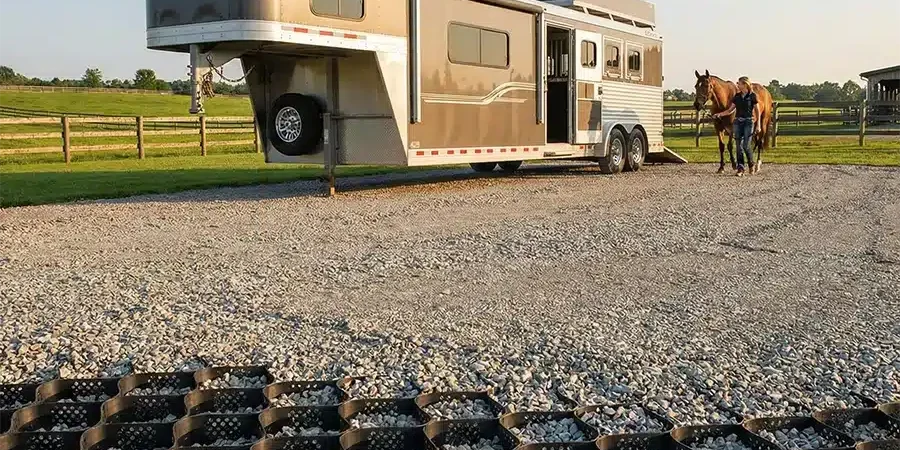
If you’ve ever backed your horse trailer into its usual spot after a week of rain and watched the tires sink into a soup of mud and displaced gravel, you already understand the problem. A loaded two-horse bumper-pull trailer can easily weigh 7,000–10,000 pounds—more than enough to destroy unprepared ground in a single season. Factor in a gooseneck rig with living quarters and you’re looking at 12,000–15,000 pounds grinding the same patch of earth every time you haul. This guide shows you how BaseCore HD 3″ geocell ground grids eliminate ruts, mud, and constant re-grading—whether you choose gravel or grass—and how you can install a permeable, low-maintenance horse trailer parking pad in a single weekend.
What Geocell Ground Grids Are—And Why Your Trailer Pad Needs One
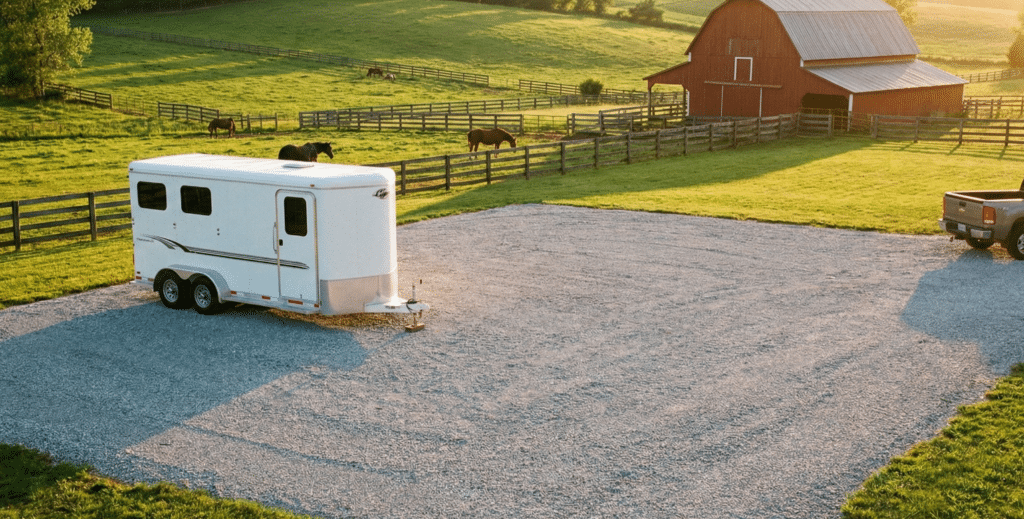
A geocell is a cellular confinement system made from thick, high-density polyethylene (HDPE) with double-welded seams. Picture a honeycomb-shaped grid that you lay on the ground and fill with gravel or topsoil. Once filled and compacted, the cells lock your fill material in place, preventing the lateral movement that causes ruts, potholes, and gravel migration every time you park a heavy trailer.
We recommend BaseCore HD 3″ geocells for horse trailer parking. The HD designation matters: BaseCore HD features significantly smaller cells and more cell walls per panel than standard geocell products, creating a denser load-distribution network beneath your trailer’s tires. The manufacturer states that the HD model is “engineered to outperform geocells up to two times its height,” meaning a 3″ HD panel delivers the load support you’d typically need a 6″ standard product to achieve.
This isn’t new or experimental technology. Geocell ground grids have been used by the U.S. military as load support for temporary roads since the 1970s. If cellular confinement can handle tanks on soft ground, it can handle your horse trailer on a rainy Tuesday.
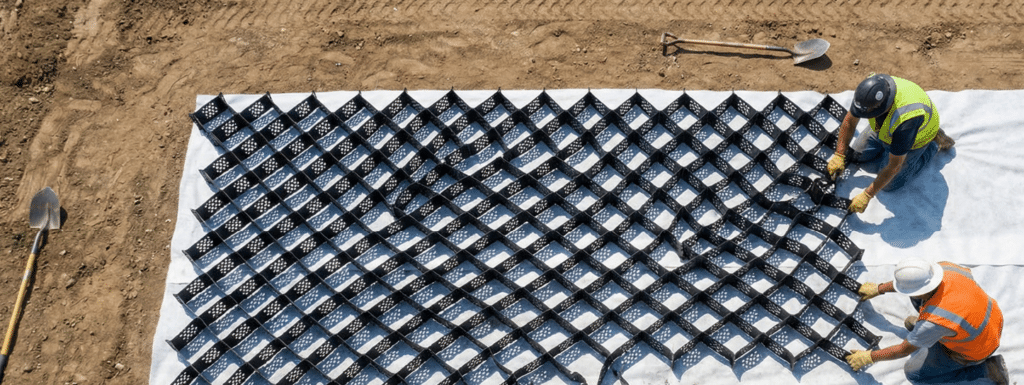
Each panel ships collapsed flat and expands accordion-style on site. Panels connect with clip connectors, so you can tile them to fit any parking area shape or size. You can also trim panels with scissors or a utility knife to work around drainage features, fence posts, or irregular property lines.
Gravel vs. Grass Infill: Choosing the Right Surface for Your Horse Trailer Pad

Gravel Infill: The Workhorse Option
For horse trailer parking that sees regular weekly use—show seasons, trail rides, vet calls—gravel-filled geocell is the most practical choice. Angular crushed gravel in ⅜″ to ¾″ sizing works best for parking applications. The angular edges interlock within each cell, creating superior compaction and resistance to displacement under heavy loads.
Here’s the number that matters most: 3″ of geocell-confined gravel provides the same load-bearing strength as 12″ of loose, unconfined gravel. That means instead of excavating a foot deep and hauling in tons of stone, you’re working with a fraction of the material and achieving equal or superior performance. Expect to use roughly 50% less aggregate or more compared to a traditional gravel-only parking pad—a significant savings when you’re covering a full trailer-length area.
Documented installations show that geocell-confined angular gravel stays exactly where it’s placed through extreme freeze-thaw cycling, heavy seasonal rains, and repeated heavy vehicle traffic. No regrading. No refilling. No seasonal stone deliveries. That’s a dramatic departure from the loose gravel cycle most horse property owners know too well.
Grass Infill: The Eco-Friendly Alternative
For properties where aesthetics are a priority or local codes favor permeable green surfaces, geocell panels can also be filled with topsoil and seeded with grass. This approach effectively turns your parking pad into reinforced turf that can handle trailer weight without the rutting and destruction that bare grass would suffer. Green-colored geocell panels are even available for vegetated applications so that any visible cell edges blend seamlessly into the surrounding lawn.
Grass-infilled pads work best for lighter and less frequent use. If your trailer sits in the same spot for weeks at a time, the turf beneath the tires will suffer from lack of sunlight. But for properties that rotate parking positions or use the pad primarily for short-term loading and unloading, grass infill provides a beautiful, permeable surface that reduces heat buildup and stormwater runoff while keeping your property looking like a horse farm—not a construction site.
How Geocell Engineering Protects Your Parking Pad
The load-bearing performance of BaseCore HD comes from several engineering features working together:
Double-welded seams. Testing shows these welds actually exceed the base material strength, eliminating the most common failure point in geocell construction. Under your trailer’s concentrated tire loads, the seams won’t be the weak link.
Dense cell network. The HD model packs more cell walls and weld points per panel area than standard geocell. More walls mean more load distribution points—exactly what you need when a trailer tongue jack concentrates thousands of pounds on a single spot.
Perforated cell walls. Every cell wall features perforations that allow water to pass through the system. This means natural drainage without French drains, limestone sub-bases, or any of the expensive water management systems that concrete pads require.
Heavy-gauge HDPE construction. The material is UV-resistant, chemical-resistant, weather-resistant, and non-toxic to soil. It won’t crack in extreme cold or soften in summer heat.
For horse trailer owners specifically, there’s an additional consideration most people overlook: your horses walk on and around this surface during loading and unloading. Once installed and filled, geocell creates a safe, slip-resistant surface that prevents hoof damage and joint strain. The flush-mount anchoring caps have no exposed metal, eliminating trip hazards for both horses and handlers. That dual-purpose safety—supporting vehicle weight while remaining safe for equine traffic—is what makes geocell the ideal horse trailer parking solution.
What You’ll Save: The Real Cost of Doing Nothing
The financial case for geocell-stabilized parking comes down to one truth: loose gravel is cheap to install and expensive to maintain, while geocell costs a little more upfront and virtually eliminates ongoing costs.
The geocell panels themselves typically add about $1.00–$1.50 per square foot beyond what you’d spend on gravel alone. For a typical horse trailer pad, that’s a modest premium. But here’s where it pays back: you’ll use 50% less aggregate or more thanks to the cellular confinement, and you won’t be calling for gravel deliveries and regrading services every year.
Think about what you’re spending now. If you’re regrading your parking area even once a year—buying replacement stone, renting or borrowing equipment, spending a Saturday you’d rather be riding—those costs add up fast. Most property owners find that the geocell investment pays for itself within a few seasons through eliminated maintenance alone.
Concrete might seem like the permanent alternative, but it costs significantly more per square foot, requires a specialist crew, takes up to 28 days to cure before you can park on it, and is completely impermeable—meaning you’ll also need drainage infrastructure. And concrete still cracks.
Geocell-stabilized gravel is permeable, immediately usable after compaction, DIY-friendly, and rated by the manufacturer to last 75+ years. That’s a foundation you install once and never think about again.
Step-by-Step: Building Your Horse Trailer Parking Pad
Step 1: Plan Your Pad Size
A standard two-horse bumper-pull trailer is approximately 7–8 feet wide and 16–20 feet long. Add 3–4 feet on each side for maneuvering room and safe horse loading. For a gooseneck, plan even longer. Not sure how many panels you need? Our team can help you calculate the right quantity based on your trailer dimensions and property layout—reach out for a free project evaluation.
Step 2: Clear and Excavate
Remove debris, roots, and obstacles from the area. Excavate approximately 4–5 inches so the geocell panels sit flush with the surrounding ground. Alternatively, use steel border edging to contain the pad at grade level with less digging.
Step 3: Lay Geotextile Fabric
Place non-woven geotextile fabric between the soil and geocell panels. This barrier suppresses weeds, prevents your gravel from mixing into the subgrade over time, and enhances load distribution. Overlap seams by 8–12 inches. We carry a heavy-duty 6 oz non-woven geotextile that’s nearly twice as thick as the standard fabric most suppliers offer.
Step 4: Expand and Connect Panels
Each panel expands accordion-style with two people. Secure them with included rebar stakes and flush-mount caps. Connect adjacent panels with clip connectors. The caps sit completely flush with no exposed metal—important when horses walk near or on the pad during loading.
Step 5: Fill and Compact
Fill each cell with angular crushed gravel, extending approximately 2 inches above the cell tops. Compact the entire surface with a plate compactor, running it slowly over every inch including edges. If any geocell becomes exposed after compaction, add more gravel and compact again.
Step 6: Park Your Trailer
Unlike concrete, which requires weeks to cure, your geocell-stabilized pad is ready for immediate use after compaction. Pull your trailer in the same day you finish the project.
For a detailed walkthrough with photos, check out our full geocell installation manual.
Beyond the Parking Pad: One Product, Multiple Uses on Your Property
One of the biggest advantages for equestrian property owners is that BaseCore HD isn’t a single-use purchase. The same geocell panels you use for your trailer pad are ideal for horse arenas, paddocks, barn aisles, access roads, livestock paths, and wash rack areas. Geocell lifts your surface and keeps fill material in place while allowing water to drain through—eliminating mud buildup and improving usability even after heavy rain or snow.
The panels that stabilize your parking pad can extend into high-traffic zones around your barn, creating a unified ground stabilization system across your entire property. That means fewer products to research, one consistent installation method, and a single solution for every mud and drainage problem on your farm.
Browse our full BaseCore HD product line to find the right configuration for your property.
Conclusion
Every horse trailer owner knows the frustration of watching a perfectly good parking area turn into a muddy, rutted mess after one bad storm. The underlying problem is simple: unconfined fill material migrates under heavy loads. BaseCore HD 3″ geocells solve that problem by locking gravel or topsoil inside a dense honeycomb of HDPE cells, creating a stable, permeable, load-distributing surface that handles trailer-weight loads without breaking down.
Whether you choose gravel for maximum durability or grass for a natural look, installation requires no specialist and no heavy equipment—just a weekend, a helper, and a plate compactor.
Your next step: Contact our team for a free project evaluation. We’ll assess your specific trailer weight, soil conditions, and property layout to recommend the exact geocell configuration for your horse trailer parking pad.
Frequently Asked Questions
Q: How thick should geocell be for horse trailer parking?
A: We recommend 3″ BaseCore HD geocell for horse trailers. The HD model delivers significantly greater strength at each depth than standard geocell products, making 3″ HD sufficient for trailers up to 15,000 lbs.
Q: Can you park a horse trailer on grass without ruining it?
A: Yes, with geocell stabilization beneath the turf. Fill the cells with topsoil and seed with grass to create reinforced turf that supports trailer weight. Rotate parking positions periodically to prevent prolonged tire compression on one spot.
Q: How much extra does geocell add to a gravel parking pad?
A: The geocell panels typically add about $1.00–$1.50 per square foot beyond gravel-only costs. However, you’ll use 50% less aggregate or more, and you eliminate annual regrading and gravel replacement—so the investment pays back within a few seasons.
Q: Do I need a contractor to install geocell panels?
A: No. Installation requires no formal training or heavy equipment. Two people with basic tools, geotextile fabric, and a plate compactor can complete a typical trailer pad in a single weekend.
Q: How long does a geocell parking pad last?
A: The manufacturer rates BaseCore geocell panels at 75+ years depending on the application. The HDPE material resists UV degradation, chemicals, weather, and corrosion—far outlasting concrete, asphalt, or loose gravel.
This article references publicly available product documentation, installation guides, and published technical specifications from BaseCore (basecore.co) dated 2023–2026. All performance claims and product ratings are sourced from manufacturer documentation. Results may vary based on climate, soil conditions, trailer weight, usage frequency, and installation approach. For current product specifications and project guidance, contact our team directly.
