
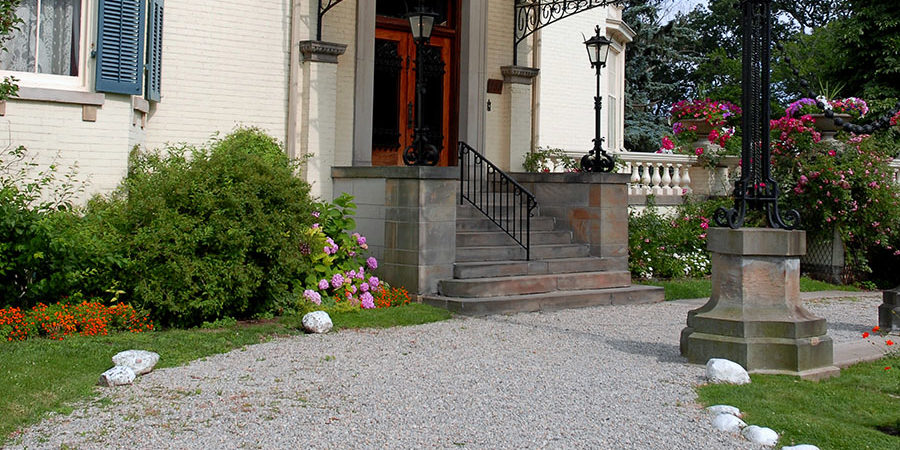
A typical city block generates more than five times the stormwater runoff of a forested area the same size, according to the U.S. Environmental Protection Agency. Your driveway contributes directly to this problem—or it can become part of the solution. Permeable driveways allow rainwater to filter through the surface and into the ground below, reducing flooding, recharging groundwater, and filtering pollutants before they reach local waterways.
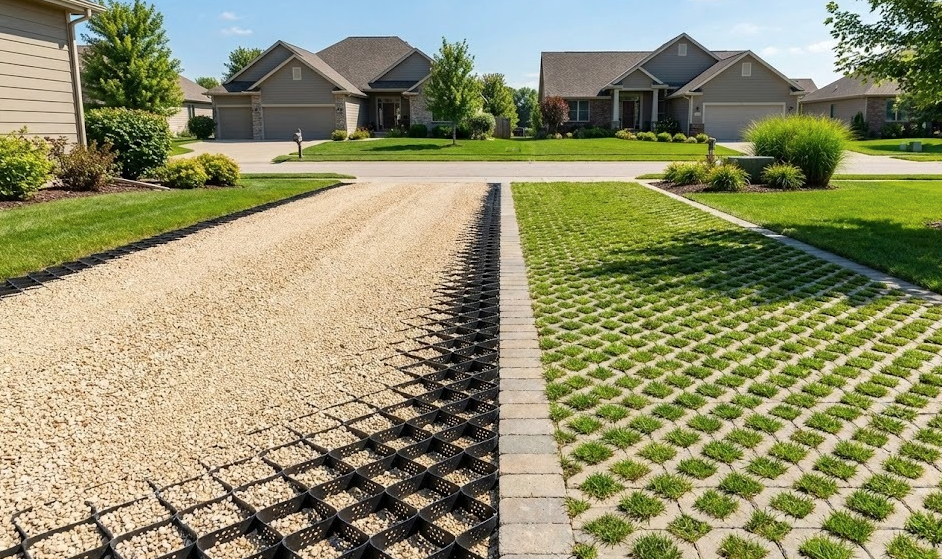
This guide compares permeable driveway options from Backyard Bases: the perforated BaseCore geocell system designed specifically for drainage, PaveCore grass pavers built for ground stabilization, plus pervious concrete alternatives. You’ll learn the costs, benefits, installation requirements, and long-term performance of each—plus which solution delivers the best combination of durability, drainage, and value for residential properties.
Why Permeable Driveways Matter: The Environmental Case
The Hidden Cost of Traditional Driveways
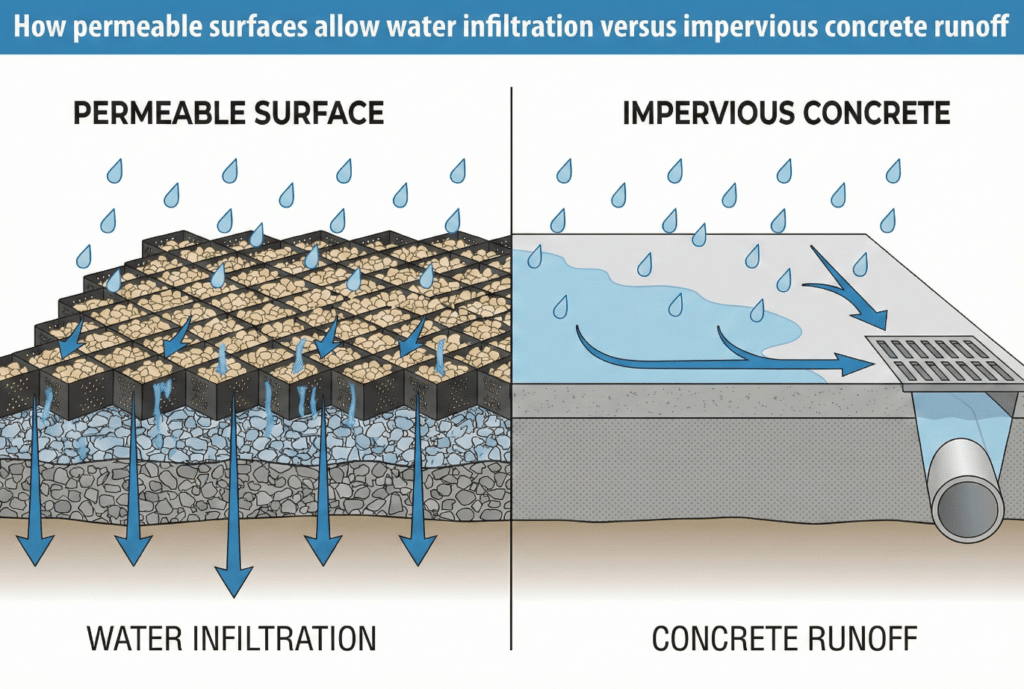
When rain falls on a conventional concrete or asphalt driveway, almost 100% runs off the surface. This runoff doesn’t simply disappear—it carries motor oil, brake dust, fertilizer residue, and other pollutants directly into storm drains and local waterways.
The U.S. Geological Survey documents this clearly: as watersheds urbanize, impervious surfaces replace vegetation, reducing the area where infiltration to groundwater can occur. More stormwater runoff occurs—runoff that must be collected by extensive drainage systems, leading to more frequent and more severe flooding events.
Penn State Extension quantifies the impact: when more than 10 to 20% of a watershed has impervious cover, runoff doubles. For individual properties, this means your standard permeable driveway options actively contributes to neighborhood flooding, stream erosion, and water quality degradation.
How Permeable Surfaces Solve the Problem
Permeable driveways work by allowing water to pass through the surface rather than running off. The water filters through aggregate layers below, where natural processes remove pollutants before the water reaches groundwater supplies.
According to EPA documentation on stormwater management, permeable pavements provide stormwater volume reduction, detention, and pollutant removal. The agency notes that permeable pavements can qualify for LEED credits and meet EPA stormwater regulations that limit runoff from developed properties.
Beyond environmental benefits, permeable driveways often reduce or eliminate the need for expensive drainage systems, french drains, or retention ponds—saving thousands in construction costs while delivering superior long-term performance.
Option 1: Perforated BaseCore Geocell Systems — Built for Drainage
What It Is
BaseCore geocell systems use three-dimensional honeycomb structures made from high-density polyethylene (HDPE) to confine and stabilize gravel or crushed stone. What sets BaseCore apart from other ground stabilization products is its perforated design—holes punched throughout the cell walls that allow water to move freely in all directions.
According to Backyard Bases product documentation, the perforation (holes) in the BaseCore allow water to move freely without washing out the material, protecting properties from sinking, ruts, potholes, runoff and more. This dual-function design delivers both ground stabilization and active drainage in a single system.
Originally developed by the U.S. Army Corps of Engineers in 1975 for military road construction, geocell technology has evolved into a versatile residential solution. BaseCore and BaseCore HD represent the current generation specifically engineered for driveways, parking pads, and other high-traffic residential applications where drainage is critical.
How Perforated Geocells Work for Drainage
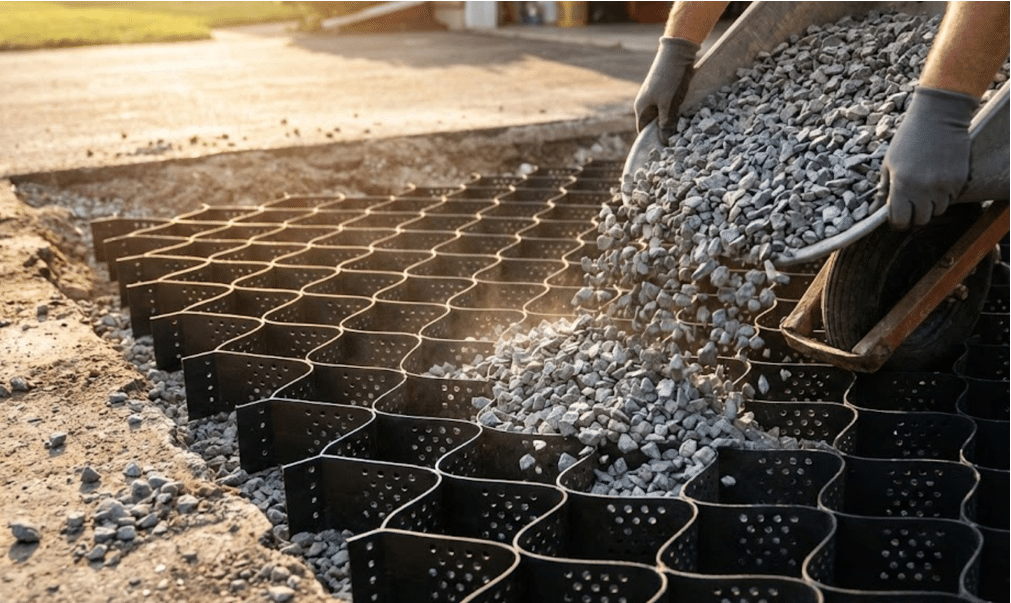
BaseCore panels arrive collapsed and expand into a honeycomb grid on-site. Once secured with anchor stakes, the cells are filled with angular crushed gravel. The confined gravel creates a semi-rigid surface that distributes vehicle weight evenly while maintaining permeability through the perforated walls.
According to Backyard Bases technical specifications, perforated geocell technology creates structural support through three-dimensional confinement while the perforations ensure water passes completely through the system rather than pooling. This combination makes BaseCore particularly effective for artificial turf drainage, pet areas, and any application where water management is essential.
Backyard Bases documentation states that using 3 inches of BaseCore-confined gravel provides equivalent structural performance to 12 inches of loose gravel—a dramatic material reduction that translates to significant cost savings while maintaining full drainage capability.
Cost Analysis
| Component | Cost per Square Foot |
| BaseCore panels | $1.25–$3.00 |
| Geotextile fabric | $0.15–$0.30 |
| Angular gravel (delivered) | $0.50–$1.00 |
| Total installed (DIY) | $1.85–$4.30 |
| Total installed (contractor) | $4.00–$7.00 |
For a standard 600-square-foot two-car driveway:
- DIY installation: $1,290–$2,580
- Contractor installation: $2,400–$4,200
Advantages
Superior drainage by design: Unlike products built solely for stabilization, BaseCore’s perforations allow water to pass directly through the gravel and into the ground below. No pooling, no ice formation from standing water, no drainage system required.
Lowest long-term cost: Unlike loose gravel (requiring annual replenishment) or pervious concrete (needing specialized maintenance), BaseCore driveways require minimal upkeep. Backyard Bases documents a 75+ year service life with proper installation.
DIY-friendly installation: Most homeowners complete installation in a single weekend without heavy equipment. No forms, no curing time, no specialized skills required.
Flexibility: The HDPE material withstands freeze-thaw cycles that crack concrete and buckle asphalt. BaseCore installations perform reliably through 200+ freeze-thaw cycles annually without degradation.
Immediate use: Drive on it the same day you install it—no curing or settling time required.
Disadvantages
Gravel aesthetic: Some homeowners prefer the smooth appearance of concrete or the green look of grass pavers. However, decorative aggregates can provide attractive alternatives to standard gray gravel.
Periodic top-up: Heavy traffic areas may require occasional gravel addition, though far less frequently than loose gravel driveways.
Best Applications
BaseCore perforated geocell systems excel for driveways, RV/boat parking pads, artificial turf bases, pet areas, and anywhere requiring vehicle access with superior drainage. The technology works equally well on flat ground and slopes up to 45 degrees.
Option 2: PaveCore Grass Pavers — Built for Stabilization
What It Is
PaveCore is an eco-friendly grass and gravel paver system designed primarily for ground stabilization. These 2-inch tall, fixed hexagonal pavers interlock seamlessly, creating a stable surface that supports grass growth while handling vehicle and pedestrian traffic.
According to Backyard Bases product specifications, PaveCore’s hexagonal design provides superior stability and load-bearing strength with a compression strength of up to 200 tons per square meter. The interlocking panels ensure a solid foundation that resists sinking and shifting even under heavy use.
Unlike the perforated BaseCore system engineered for active water movement, PaveCore is designed to stabilize ground surfaces while allowing grass to grow through the open cells. Water infiltration occurs through the grass and soil within the cells rather than through perforated walls.
How PaveCore Works
PaveCore panels snap together without additional connectors, creating a rigid, interlocking surface. The hexagonal cells can be filled with soil and seeded for grass growth, or filled with gravel for a more traditional appearance.
According to Backyard Bases installation documentation, PaveCore can be placed directly over existing healthy grass. The grids settle into the turf, allowing grass to grow up through the openings. This method works perfectly for converting lawn areas to occasional parking without destroying established grass.
Each panel measures approximately 13.11″ x 13.11″ x 1.97″ and covers about 1.19 square feet. Panels come packaged in bundles of 9 pieces covering 10.71 square feet total.
Cost Analysis
| Component | Cost per Square Foot |
| PaveCore panels | $4.00–$6.00 |
| Soil/gravel fill | $0.50–$1.50 |
| Grass seed or sod | $0.50–$2.00 |
| Total installed (DIY) | $6.00–$11.50 |
| Total installed (contractor) | $9.00–$16.00 |
Note: PaveCore typically costs 3–5 times more per square foot than BaseCore geocell systems, reflecting its different design purpose and hexagonal construction.
For a standard 600-square-foot two-car driveway:
- DIY installation: $3,600–$6,900
- Contractor installation: $6,000–$10,800
Advantages
Natural appearance: PaveCore creates a “hidden driveway” that blends with surrounding lawn—ideal for properties where visible driveways detract from landscaping or where HOA requirements mandate green coverage.
Exceptional load capacity: Each panel supports up to 44,000–46,000 lbs distributed, handling cars, trucks, RVs, and heavy equipment with ease.
Cool surface: Unlike asphalt that absorbs heat, grass surfaces stay cool through transpiration, reducing the urban heat island effect.
Dual function: The surface serves as both driveway and green space, maintaining lawn appearance while supporting vehicles.
Easy installation on existing grass: PaveCore can be installed directly over healthy turf, eliminating excavation for certain applications.
Disadvantages
Higher cost: At 3–5x the price of BaseCore per square foot, PaveCore represents a significant investment compared to perforated geocell systems.
Not designed for drainage: PaveCore is built for stabilization, not water management. While grass cells are permeable, the system lacks the engineered perforations that make BaseCore specifically effective for drainage applications.
High maintenance: Grass pavers require all lawn maintenance—mowing, watering, fertilizing, and weed control—plus the challenges of maintaining grass in high-traffic areas.
Wear patterns: Repeated vehicle traffic in the same path can stress or kill grass in wheel tracks, creating visible wear patterns.
Climate limitations: Grass pavers perform poorly in arid climates or during drought conditions without significant irrigation.
Slower establishment: Grass establishment requires weeks to months before the surface is fully established and visually complete.
Best Applications
PaveCore suits properties where a green, lawn-like appearance is the priority over maximum drainage performance. Ideal for overflow parking areas used occasionally, secondary driveways accessing detached garages, and properties where maintaining green space coverage is required by local regulations or HOA rules.
Choosing Between BaseCore and PaveCore: Drainage vs. Stabilization
The fundamental difference between these Backyard Bases products comes down to primary function:
BaseCore perforated geocell: Engineered for drainage and stabilization. The perforated walls actively move water through the system, making it ideal for areas with drainage concerns, artificial turf installations, pet areas, and any application where water management is critical.
PaveCore grass pavers: Engineered for ground stabilization with grass growth. Built to create stable, load-bearing surfaces while maintaining a natural lawn appearance. Best for applications where aesthetic considerations outweigh drainage requirements.
| Feature | BaseCore (Perforated) | PaveCore (Grass Paver) |
| Primary Function | Drainage + Stabilization | Stabilization + Aesthetics |
| Perforated Design | Yes — engineered drainage | No — grass infiltration only |
| Cost (DIY, 600 sq ft) | $1,290–$2,580 | $3,600–$6,900 |
| Cost Comparison | Baseline | 3–5x more expensive |
| Maintenance | Minimal | High (lawn care required) |
| Best For | Drainage, pets, turf | Green appearance, HOAs |
| Installation Speed | Same-day use | Weeks to establish grass |
Option 3: Pervious Concrete
What It Is
Pervious (or porous) concrete is a special concrete mix with little or no fine aggregate (sand), creating a network of voids that allow water to pass through. The surface looks similar to conventional concrete but with a slightly rougher, more open texture.
How It Works
Water drains through the concrete surface at rates of 3–8 gallons per minute per square foot—far faster than most rainfall intensities. The water enters an aggregate base layer below, which provides storage and promotes infiltration into the subsoil.
Cost Analysis
According to HomeAdvisor 2025 data, pervious concrete costs $8 to $16 per square foot installed, compared to $5 to $7 for standard concrete.
For a 600-square-foot driveway:
- Pervious concrete: $4,800–$9,600
- Standard concrete (for comparison): $3,000–$4,200
Advantages
Familiar appearance: Pervious concrete looks similar to standard concrete, making it acceptable in neighborhoods or HOAs with aesthetic restrictions.
Professional engineering: When properly installed, pervious concrete delivers reliable, long-term performance with documented stormwater benefits.
No surface maintenance: Unlike permeable pavers, there are no joints to keep clear.
Disadvantages
Professional installation required: Pervious concrete demands specialized equipment, trained crews, and precise mixing—not a DIY option.
Climate sensitivity: Cannot be poured in freezing temperatures or extreme heat. Installation windows are limited in many climates.
Clogging concerns: Fine sediment can clog the pore structure over time. Pressure washing or specialized vacuum sweeping is required to maintain permeability.
Repair difficulty: Damaged sections cannot be patched like standard concrete. Repairs require cutting out and replacing entire areas.
Freeze-thaw vulnerability: Despite advances, pervious concrete remains more susceptible to freeze-thaw damage than standard concrete.
Head-to-Head Comparison
| Factor | BaseCore (Perforated) | PaveCore (Grass) | Pervious Concrete |
| Cost (600 sq ft) | $1,290–$4,200 | $3,600–$10,800 | $4,800–$9,600 |
| DIY Possible | Yes | Yes | No |
| Installation Time | 1 weekend | 1 weekend + grow-in | 1–2 days + curing |
| Lifespan | 75+ years | 10–20 years | 15–25 years |
| Maintenance | Minimal | High (ongoing) | Moderate (annual) |
| Drainage Design | Perforated for active flow | Grass infiltration only | Porous surface |
| Cold Climate | Excellent | Fair | Fair |
| Aesthetics | Functional gravel | Natural grass | Traditional concrete |
Why Perforated BaseCore Geocell Leads for Drainage Applications
After analyzing all options, perforated BaseCore geocell systems emerge as the optimal choice for homeowners prioritizing drainage performance. Here’s why:
Best Value for Drainage
At $2–$4 per square foot for complete DIY installation, BaseCore costs a fraction of PaveCore grass pavers or pervious concrete while delivering superior drainage through its engineered perforations. The 75+ year lifespan and minimal maintenance create unmatched long-term value.
Purpose-Built Perforated Design
BaseCore’s perforated cell walls are specifically engineered to move water freely through the system. This isn’t incidental permeability—it’s the core design feature that makes BaseCore effective for artificial turf drainage, pet areas, stormwater management, and flood-prone properties.
Proven Technology
Geocell technology has 50 years of documented performance in demanding applications. BaseCore brings this industrial-grade performance to residential scale with perforations optimized for water movement.
Installation Accessibility
Most homeowners can install BaseCore in a single weekend with basic tools. No concrete trucks, no specialized equipment, no professional crews required.
Conclusion
Every square foot of impervious driveway on your property contributes to stormwater runoff, localized flooding, and water quality degradation. Permeable driveways transform this liability into an asset—filtering rainwater, recharging groundwater, and reducing strain on municipal stormwater systems.
For properties where drainage is the priority, perforated BaseCore geocell systems deliver the best combination of performance, value, and accessibility. At a fraction of the cost of alternatives, with weekend DIY installation, and featuring purpose-built perforations for water management, BaseCore makes permeable driveways achievable for any homeowner.
For properties where green aesthetics matter most, PaveCore grass pavers provide ground stabilization with a natural lawn appearance—though at 3–5x the cost and without BaseCore’s engineered drainage capabilities.
Your next step: Visit BackyardBases.com to calculate your project requirements, compare BaseCore perforated geocell and PaveCore grass paver specifications, and access free installation guides.
Frequently Asked Questions
How much does a permeable driveway cost compared to traditional concrete?
Permeable options range from $2 to $18 per square foot. Perforated BaseCore geocell systems cost $2–$4/sq ft (DIY), while PaveCore grass pavers cost $6–$12/sq ft. Standard concrete costs $5–$7/sq ft, and pervious concrete runs $8–$16/sq ft.
What’s the difference between BaseCore and PaveCore from Backyard Bases?
BaseCore features perforated walls engineered specifically for drainage and water movement. PaveCore is a grass paver system designed for ground stabilization and green aesthetics. BaseCore costs 3–5x less per square foot than PaveCore.
Will a permeable driveway work in cold climates with snow and ice?
Perforated BaseCore geocell systems excel in cold climates—the flexible HDPE material handles freeze-thaw cycles that damage rigid surfaces. Grass pavers like PaveCore are more vulnerable to cold-climate wear, and pervious concrete faces freeze-thaw challenges.
Can I install a permeable driveway myself or do I need a contractor?
BaseCore perforated geocell and PaveCore grass paver systems are both DIY-friendly, with most homeowners completing installation in a single weekend. Pervious concrete requires professional installation for reliable results.
How do permeable driveways handle heavy vehicles like trucks or RVs?
BaseCore HD is rated for heavy vehicle loads including trucks and RVs. PaveCore supports up to 44,000 lbs distributed load. Both handle heavy traffic when properly installed with appropriate base preparation.
