
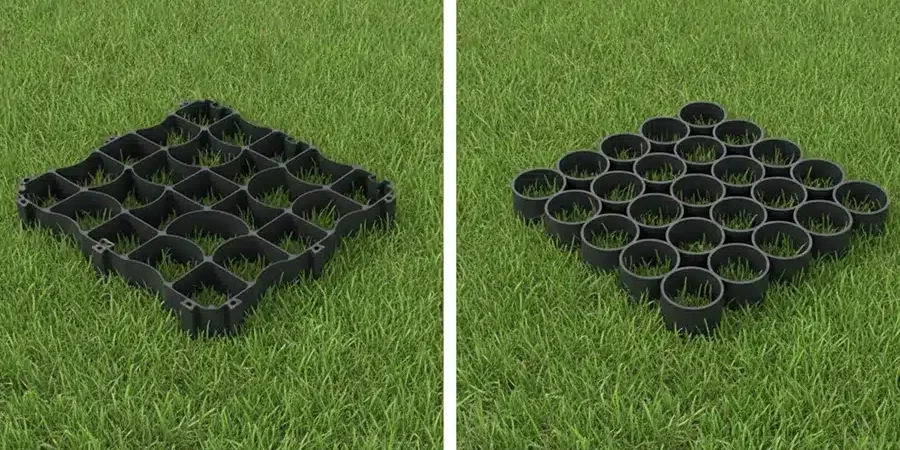
You want to park on grass without destroying your lawn. No ruts, no mud, no concrete slab eating up green space on your property. Permeable grass pavers solve that problem, and two names keep coming up in every search: PaveCore vs TrueGrid. Both are HDPE plastic grid systems. Both support heavy vehicles. Both let grass grow through the surface. But when you dig into the details—cell design, installation, load ratings, warranty, and especially cost—the differences add up fast. This guide compares the two products using only published specifications and documented data so you can decide which grass paver actually delivers the best value for your home.
What These Products Are and How They Work
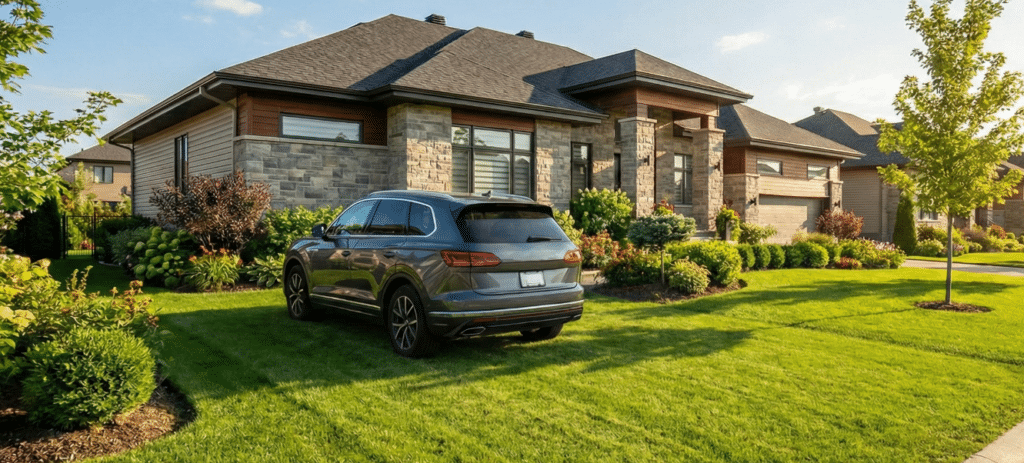
Both PaveCore vs TrueGrid are permeable paver systems—interlocking plastic grids you lay on a prepared surface and fill with topsoil and grass seed or gravel. The grid cells hold fill material in place, distribute vehicle weight across the entire surface, and prevent the ruts and compaction that destroy ordinary lawns under tire traffic.
Both products are manufactured from the same core material: 100% high-density polyethylene (HDPE). This is important because it means the raw material strength, UV resistance, chemical resistance, and weather durability are fundamentally equivalent between the two products. HDPE is the same industrial-grade polymer used in everything from underground pipe systems to marine-grade equipment. When someone claims one HDPE paver is “stronger material” than another HDPE paver, that’s marketing—not material science.
The real differences are in engineering design, cell geometry, installation method, and price.
PaveCore uses a hexagonal cell design with a built-in tongue-and-groove locking system. Each paver measures 13.11″ x 13.11″ x 1.97″ and snaps directly to adjacent pavers without any separate connectors, clips, or hardware. The manufacturer describes it as a system that “interlocks like building blocks.”
TrueGrid offers multiple product lines. Their PRO LITE is their residential offering, using cylindrical cells with what they describe in their published specifications as “patented flex joints” and “3-point locking tabs.” Their heavier PRO PLUS targets commercial applications at a significantly higher price point.
Same material. Different designs. Different price tags.
Load Capacity: Both Handle Anything You’ll Park at Home
This is the first question every homeowner asks, and both products deliver numbers that far exceed anything residential.
PaveCore carries a published compression strength of up to 200 tons per square meter. The standard model supports approximately 44,000–46,000 lbs distributed load per published product specifications. The PaveCore HD model pushes that to 30 tons per square meter for commercial and industrial applications.
TrueGrid PRO LITE publishes a 120,000 lb load class rating in their product specifications. Their commercial PRO PLUS model rates at 250,000+ lbs—but at a commercial price point most homeowners don’t need.
What this means for you: Your 5,000 lb sedan, your 7,000 lb SUV, your neighbor’s heavy pickup—neither product will be the weak link. Both products exceed residential vehicle loads by an enormous margin. If someone tries to sell you on load capacity alone as the reason to choose one over the other, they’re solving a problem that doesn’t exist in your driveway.
The decision should come down to the factors that actually differ in daily residential use: how well grass grows, how easy installation is, how long the product lasts, and what it costs.
Cell Design: Why It Matters for Grass Growth
For a grass parking application, cell geometry isn’t just an engineering detail—it directly determines how your parking area looks six months after installation.
PaveCore’s hexagonal cell design creates a honeycomb pattern that maximizes open area within each cell. More open area means more soil volume per square foot, which means more room for root development and healthier, denser grass coverage. The hexagonal shape also distributes compression forces evenly across each cell wall, so the structural support doesn’t come at the expense of growing space. The tongue-and-groove locking system holds soil and seed in place during establishment, reducing erosion and washout during the critical first weeks when grass is germinating.
TrueGrid’s cylindrical cell design uses round cells with the grid framework forming the load-bearing structure between them. This geometry provides excellent compression strength, but the round cell shape inherently leaves more grid material visible at the surface between cells. For gravel applications, this is irrelevant. For grass applications where you want the grid to disappear beneath the turf, cell geometry matters.
What this means for you: If your primary goal is a grass parking area that looks like a lawn—not a parking lot with grass growing through it—the hexagonal design provides more consistent, even grass coverage with less visible grid structure once turf establishes.
Installation: The Honest Weekend DIY Comparison

Both products market themselves as DIY-friendly. Both deliver on that promise, but the practical experience differs.
PaveCore installation requires zero separate connectors. The tongue-and-groove locking system is built into every paver. You prepare your sub-base, lay geotextile fabric, snap the pavers together by hand, and fill with soil and seed (or gravel). The panels are a fixed, rigid shape, so what you see is what you get—no expansion, no stretching, no guessing about final coverage. Trimming at edges and borders can be done with basic tools.
TrueGrid PRO LITE installation uses male-tab-to-female-slot connections pressed together with foot pressure. The grids come in pre-assembled sheets. Cutting on site requires a power saw—an angle grinder, circular saw, or handsaw per TrueGrid’s own published installation guide. That’s an additional tool requirement that PaveCore doesn’t impose.
Both systems go down fast on a simple rectangular area. The difference shows up at the edges—around curves, landscape borders, garden beds, and irregular shapes where cutting and fitting matter. PaveCore’s simpler cutting and connector-free design reduces installation time and frustration in those real-world conditions.
For a detailed walkthrough of the full grass paver installation process, see our guide on how to build a permeable grass driveway.
Warranty: What Each Company Stands Behind
Both products carry a 10-year warranty covering workmanship and manufacturer’s defects.
TrueGrid’s published warranty documentation states their coverage “does not cover defects attributable to causes or occurrences beyond TRUEGRID’s control and unrelated to the manufacturing process, including, but not limited to, abuse, misuse, mishandling, neglect, improper storage, improper installation, improper alteration or improper application.” Their warranty page also notes they “do not directly provide construction or installation services and do not warranty installation.”
PaveCore is backed by a 10-year warranty and supported by our team, which means you have direct access to project guidance before, during, and after your installation. We don’t just sell you pavers and send you a warranty card—we help you get the installation right the first time so warranty claims become irrelevant.
Both products are built from the same HDPE material that resists UV degradation, chemicals, freeze-thaw cycles, and general weathering. The underlying material will outlast the warranty period by decades.
Cost: Where PaveCore Pulls Ahead
Here’s where the comparison gets decisive for homeowners working with a real budget.

PaveCore is approximately 20% less expensive than TrueGrid for equivalent grass paver coverage. That’s not a minor difference—on a typical residential parking pad of 300–600 square feet, that 20% savings translates directly into money you keep in your pocket or redirect toward sub-base materials, topsoil, and grass seed.
And that 20% savings comes with no sacrifice in material quality. Both products use the same HDPE material. Both handle residential loads with massive overhead. Both install as a DIY weekend project. PaveCore simply delivers equivalent performance at a lower price point.
Additionally, PaveCore’s built-in locking system means no separate connectors to purchase. That’s another cost TrueGrid doesn’t always make obvious in the headline price—when you need clips, connectors, or accessories to complete your installation, the true project cost creeps above the per-unit paver price.
What this means for you: For a 400 sq ft grass parking pad, that 20% savings could cover the cost of your geotextile fabric, topsoil, and grass seed—effectively making the finishing materials free compared to choosing the more expensive option.
Head-to-Head Summary
| Feature | PaveCore | TrueGrid PRO LITE |
| Material | 100% HDPE | 100% post-consumer recycled HDPE |
| Cell Design | Hexagonal honeycomb | Cylindrical cells |
| Connectors Required | None (built-in tongue and groove) | Tab-and-slot (built into grid) |
| Approximate Load Capacity | 96,000 lbs + load class | 120,000 lb load class |
| Grass Growth Area | Maximized by hexagonal open cells | Reduced by cylindrical grid structure |
| Cutting Tools | Basic hand tools | Power saw recommended |
| Warranty | 10 years | 10 years |
| Relative Cost | ~20% less | Higher |
| Personalized Support | Direct project guidance from our team | Quote-based |
Which One Should You Choose?
For most homeowners building a grass parking area—a side-yard pad, an overflow driveway extension, guest parking, or an access route to a backyard shed—PaveCore delivers the combination of performance, grass-friendly design, installation simplicity, and value that makes the most sense.
You get the same HDPE material durability. You get load capacity that far exceeds anything residential. You get a hexagonal cell design optimized for grass growth. You get a connector-free installation that genuinely works as a weekend DIY project. And you save approximately 20% on material cost compared to TrueGrid.
Plus, PaveCore pairs seamlessly with BaseCore geocell for areas on your property that need deeper ground reinforcement—soft soil zones, slopes, or areas with drainage challenges. One product family, one team supporting you, and a consistent system across your entire property.
Browse the full PaveCore Eco Grass and Gravel Paver product page for specifications and ordering, or contact our team for a free project evaluation.
Frequently Asked Questions
Q: Are PaveCore vs TrueGrid made from the same material?
A: Yes. Both products are manufactured from high-density polyethylene (HDPE), which provides equivalent UV resistance, chemical resistance, and weather durability. The differences between the two products lie in cell design, installation method, and price—not base material.
Q: Can grass pavers really hold a heavy truck without sinking?
A: Yes. PaveCore is rated for approximately 44,000–46,000 lbs distributed load. TrueGrid PRO LITE publishes a 120,000 lb load class. Both far exceed typical residential vehicle weights, including heavy pickups, SUVs, and loaded trailers.
Q: How long until the grass fills in and hides the pavers?
A: With proper topsoil, quality seed, and consistent watering, expect grass to fill in within 4–8 weeks during growing season. Sod provides a green surface almost immediately. PaveCore’s hexagonal cell design maximizes the open growing area, helping grass establish more evenly across the surface.
Q: How much can I save choosing PaveCore over TrueGrid?
A: PaveCore is approximately 20% less expensive than TrueGrid for equivalent coverage. On a 400 sq ft parking pad, that savings can cover the cost of geotextile fabric, topsoil, and grass seed for your project.
Q: What maintenance does a grass paver parking area require?
A: Mow normally as you would any lawn. Water and fertilize based on your grass type. Periodically check that soil hasn’t settled below the paver tops—add a light topping of soil if needed. No re-grading, no crack repair, and no resurfacing like concrete or asphalt requires.
This article is published by Backyard Bases for informational and educational purposes only. All product specifications, load ratings, and warranty terms for TrueGrid are sourced exclusively from TrueGrid’s own publicly available documentation, published product pages, and public retail listings as of early 2026. All PaveCore specifications are sourced from manufacturer-published data. This article represents our editorial comparison based on publicly available information and is not endorsed by, affiliated with, or sponsored by TrueGrid Pavers or Airlite Plastics Company.
TrueGrid® and PRO LITE® are registered trademarks of their respective owners. Any references to TrueGrid products are for comparative purposes only and do not imply any association, sponsorship, or endorsement. Product specifications, pricing, availability, and warranty terms are subject to change by their respective manufacturers. We make no guarantees regarding the accuracy or completeness of third-party product information. Results with any permeable paver system depend on site conditions, soil type, installation quality, climate, and maintenance. Consumers should conduct their own research and consult manufacturer documentation directly before making purchasing decisions.