
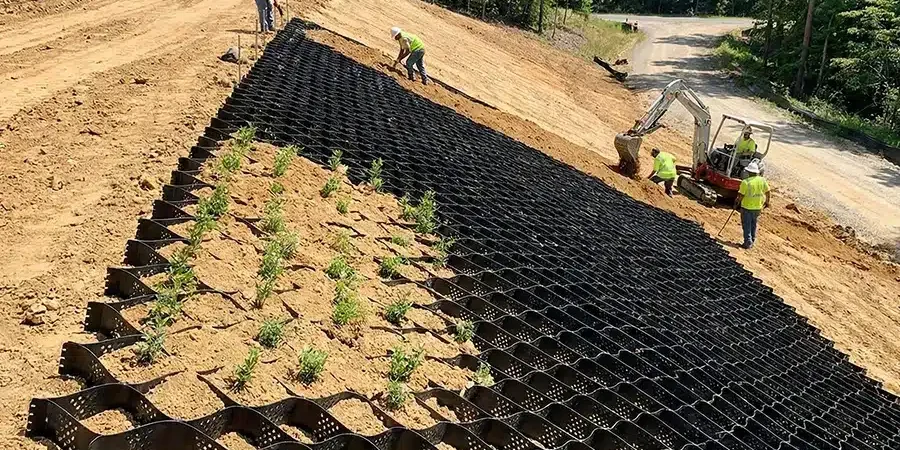
Every time it rains, you watch it happen. Water carves fresh channels down your hillside. Mulch migrates to the bottom of the slope in muddy clumps. Bare soil appears where grass used to be. If you’ve tried sod, erosion blankets, or just throwing more seed and topsoil at the problem, you already know those approaches are temporary fixes at best—especially on steeper grades. A peer-reviewed study published in the journal Sustainability (MDPI, 2022) confirmed what every frustrated homeowner suspects: on bare slopes, even moderate rainfall causes horizontal cracking, soil displacement, and progressive failure. But that same study found that geocell-reinforced slopes maintained their structural integrity under identical conditions. This guide shows you how BaseCore HD geocell ground grids permanently solve landscape slope erosion control—and how you can install one yourself.
Why Your Slope Keeps Eroding (And Why Quick Fixes Don’t Last)

slope erosion control isn’t a cosmetic problem—it’s a physics problem. When rain hits a bare or poorly protected hillside, gravity pulls water downhill. That water dislodges soil particles and carries them with it, forming rills that become gullies that become serious structural damage over time. The steeper the slope, the faster the water moves, and the more destructive it becomes.
Most homeowners cycle through the same sequence of temporary repairs. You lay erosion control blankets that decompose before vegetation establishes. You spread straw mulch that washes to the base after the first storm. You reseed and resod, only to watch the new turf slough off in sheets because the root system never had a chance to anchor into unstable soil. Each failed attempt costs money, wastes a weekend, and leaves the slope worse than before because you’ve disturbed the surface without solving the underlying problem.
The underlying problem is lateral soil movement. Topsoil on a slope wants to move downhill under the force of gravity and water. Until you physically confine that soil in place and give it time to develop root structure, no amount of seed or blanket will hold.
That’s exactly what geocell technology does.
What Geocell Is—And How It Stops Slope Erosion
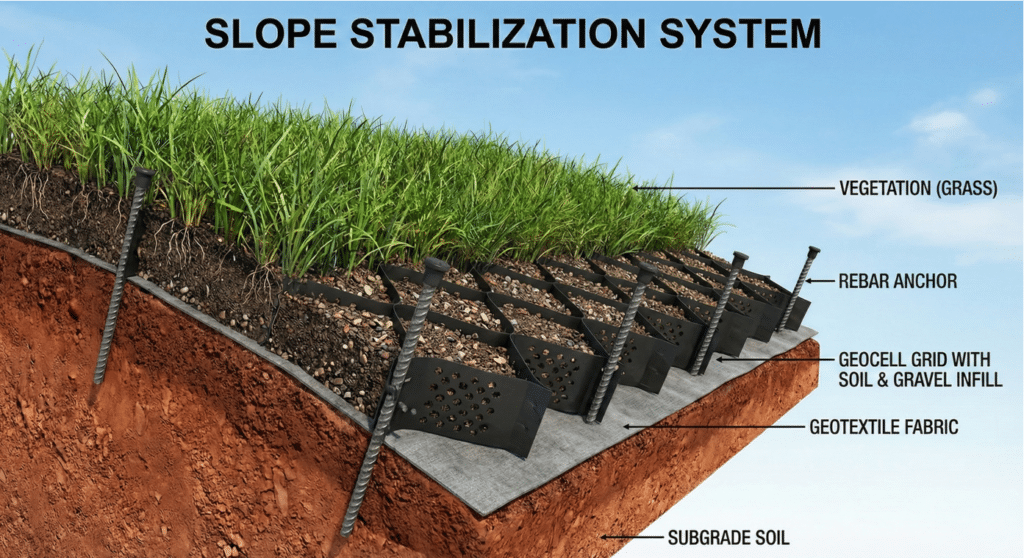
A geocell is a three-dimensional honeycomb grid made from high-density polyethylene (HDPE). You expand it across your slope, anchor it in place, and fill the cells with soil, gravel, or a combination of both. Each cell acts as a miniature retaining wall, confining fill material and preventing the lateral movement that causes erosion.
We recommend BaseCore HD geocells for landscape slope applications. The HD model features smaller cells and more cell walls per panel than standard geocell products, creating a denser confinement network. The manufacturer states that BaseCore HD is “engineered for heavier traffic, animals, and steeper slopes”—making it the right choice when your hillside has a grade that standard products can’t reliably hold.
Geocell technology was originally developed for military use in the 1970s, providing temporary road surfaces for tanks and heavy equipment over soft ground. That same cellular confinement principle—locking fill material inside interconnected HDPE cells to create a stable, load-distributing surface—is what makes it so effective against slope erosion. The cells prevent soil from migrating downhill while perforations in the cell walls allow water to pass through, eliminating the hydrostatic pressure buildup that causes traditional slope armor to fail.
Here’s the key advantage for landscape slopes specifically: once filled with topsoil and seeded, vegetation root systems grow through the perforated cell walls from one cell to the next. Published geocell technical documentation describes this as “cross-root growth,” creating an interlocking bio-mechanical structure where the geocell provides immediate structural stability while the vegetation establishes a permanent, self-sustaining root network. The geocell protects the slope on day one; the vegetation takes over long-term.
Gravel vs. Vegetation: Choosing the Right Infill for Your Slope
Vegetated Topsoil: The Landscape-Friendly Solution
For most residential landscape slopes, topsoil infill with grass seed or sod is the preferred approach. The geocell cells hold the topsoil in place long enough for root systems to establish—solving the exact problem that causes sod and seed to fail on unprotected slopes. Once vegetation is established, the slope looks like a natural hillside. Green-colored geocell panels are available specifically for this application, so any cell edges that remain visible blend into the surrounding turf.
The peer-reviewed research published in Sustainability (MDPI, 2022) specifically studied this combination. Researchers found that “soil reinforcement using geocells and vegetation is one of the best forms of soil protection for shallow slope failure control. The geocell supports the vegetation growth and the vegetation cover provides protection against surface erosion.” In their physical models, geocell-reinforced slopes maintained integrity under rainfall intensities up to 100 mm/h, while bare slopes developed horizontal cracks and significant displacement.
Vegetated geocell slopes also provide environmental benefits that hardscape solutions don’t. Root systems filter stormwater runoff. Grass canopy reduces the impact energy of raindrops hitting the soil surface. Living ground cover slows water velocity across the slope face. And unlike concrete or rip rap, a vegetated geocell slope actually improves over time as root networks strengthen.
Gravel or Crushed Stone: The Heavy-Duty Alternative
For slopes where vegetation isn’t practical—steep utility corridors, drainage swales, areas with heavy shade that can’t sustain grass, or slopes that need to support foot traffic or equipment access—angular gravel or crushed stone provides maximum structural stability. The geocell cells lock angular aggregate in place, preventing the downhill migration that makes loose gravel on slopes worthless within a single season.
Gravel-filled geocell is also the right choice for slopes along driveways, walkways, or any area where you need an immediately functional surface without waiting for vegetation to establish. The slope is ready for use the moment you finish compacting the gravel.
For many residential landscape slopes, a hybrid approach works well: gravel-filled geocell at the base of the slope where water flow is concentrated and foot traffic occurs, transitioning to vegetated geocell on the upper slope face for aesthetic appeal.
How Geocell Engineering Protects Your Hillside

The erosion control performance of BaseCore HD comes from several engineering features working together:
Cellular confinement. Each cell acts as an individual retaining pocket, preventing lateral soil movement. Published geotechnical research confirms that confined soil within geocells demonstrates dramatically higher shear resistance than unconfined soil on the same slope grade.
Perforated cell walls. Perforations typically cover 5–20% of each cell wall, striking a balance between drainage and structural integrity. Water passes through freely, eliminating the hydrostatic pressure that causes retaining walls and solid slope armor to fail. At the same time, the perforations allow plant roots to grow between cells, creating the cross-root interlock that provides long-term biological reinforcement.
Flexible conformity. Unlike rigid concrete slope solutions, geocell panels flex to follow the natural contours of your hillside. Published installation documentation describes the panels as “flexible with ground contours so you can match the slope angle.” This means no gaps between the slope surface and the stabilization layer—gaps where water would otherwise tunnel underneath and undermine the entire system.
Anchoring redundancy. Geocell panels on slopes are secured with rebar stakes driven through the cells into the subgrade, plus clip connectors between adjacent panels. The flush-mount caps on the stakes eliminate trip hazards and present a clean surface. On steeper grades, tendon systems can be integrated for additional hold-down force.
UV and chemical resistance. The HDPE material is rated for UV resistance and is non-toxic to soil. The manufacturer rates the product at 75+ years of service life, meaning a properly installed geocell slope stabilization is a one-time investment.
What You’ll Save: The Real Cost of Repeated Slope Repairs
If you’ve been fighting slope erosion for years, you already know what it costs. A load of topsoil and seed after every heavy rain season. Sod that sloughs off within months. Erosion blankets that need replacement annually. Landscape contractor visits that add up to hundreds or thousands of dollars per year—and the slope still erodes.
The geocell panels themselves typically add about $1.00–$1.50 per square foot beyond what you’d spend on soil or gravel alone. But you’ll use roughly 50% less fill material or more compared to simply piling unconfined material on a slope, because the cellular confinement eliminates the waste from washout and migration. And you won’t be repurchasing and re-applying material every season.
Consider the alternative at the other end of the spectrum: retaining walls. A professionally installed retaining wall can run $25–$50+ per square foot of wall face, requires engineering and permits on many slopes, and addresses only the base of the hill rather than the entire slope surface. Rip rap (large stone armor) requires heavy equipment for placement and costs significantly more than geocell with gravel infill for equivalent coverage.
Geocell occupies the sweet spot: meaningfully less expensive than hard engineering solutions, dramatically more effective than repeated soft fixes, and installable without a specialist crew.
Step-by-Step: Installing BaseCore HD Geocells on Your Landscape Slope
Step 1: Assess Your Slope
Evaluate the grade, the soil type, and the drainage pattern. Most residential geocell systems can stabilize slopes up to approximately 1:1 (45 degrees). For gentle to moderate landscape slopes—the kind found in most backyards, side yards, and property borders—a 3″ BaseCore HD panel is an excellent starting point. Steeper or taller slopes may benefit from thicker panels or a tendon-anchored system. Not sure what you need? Reach out to our team for a free project evaluation.
Step 2: Prepare the Slope Surface
Remove loose debris, dead vegetation, and any material that’s already actively eroding. You don’t need to excavate on slopes the way you would for a flat parking pad—the geocell lies directly on the slope face. Grade the surface as smooth as reasonably possible to eliminate voids beneath the panels.
Step 3: Lay Geotextile Fabric
Roll non-woven geotextile fabric across the entire slope face, overlapping seams by 8–12 inches. The fabric prevents subgrade soil from migrating upward through the geocell while allowing water to pass through. We carry a heavy-duty 6 oz non-woven geotextile that’s nearly twice as thick as the standard fabric most suppliers offer.
Step 4: Expand and Anchor Geocell Panels
Starting at the top of the slope, expand each panel and anchor it with rebar stakes driven through the cells into the subgrade. Work downhill, connecting adjacent panels with clip connectors. Trim panels with scissors or a utility knife to fit around obstacles, drainage pipes, or irregular slope edges. The flush-mount caps keep the surface safe for foot traffic with no exposed metal.
Step 5: Fill the Cells
For vegetated slopes, fill each cell with quality topsoil, leaving approximately ½ inch of space below the cell rim for seed and a light mulch topping. For gravel slopes, fill with angular crushed stone and compact. For hybrid approaches, fill lower slope cells with gravel and upper cells with topsoil.
Step 6: Seed and Establish Vegetation (If Applicable)
Seed the topsoil-filled cells with an erosion-control grass blend appropriate for your climate and sun exposure. Apply a light layer of straw mulch on top—the geocell cells will hold it in place, unlike an unprotected slope where mulch washes away immediately. Water according to your seed blend’s requirements. The geocell protects the slope structurally while the grass establishes, solving the chicken-and-egg problem that defeats most slope seeding attempts.
For a detailed walkthrough with photos, check out our full geocell installation manual.
Beyond the Hillside: Other Erosion-Prone Areas on Your Property
Once you see how geocell stabilizes a landscape slope, you’ll start noticing other areas on your property that could benefit from the same technology. Drainage swales that wash out after storms. Side yard pathways on grades. The area around your downspout discharge where water concentrates and carves channels. Driveway edges where gravel migrates onto the lawn. Garden terrace walls that need structural reinforcement behind them.
The same BaseCore HD panels you use on your hillside work for all of these applications. That versatility means one product, one installation method, and one solution for every erosion and stabilization challenge on your property.
Browse our full BaseCore HD product line to find the right panel depth and configuration for your project.
Conclusion
Slope erosion isn’t something you manage—it’s something you solve. Every temporary fix you’ve tried has failed for the same reason: unconfined soil on a slope will always migrate downhill under the force of gravity and water. BaseCore HD geocells break that cycle by physically confining soil and aggregate inside a dense honeycomb of HDPE cells, creating immediate structural stability while allowing vegetation to establish the permanent root network that provides long-term, self-sustaining erosion protection.
Peer-reviewed research confirms what thousands of geocell installations have demonstrated in practice: geocell-reinforced slopes maintain their integrity under heavy rainfall conditions that cause bare slopes to crack, displace, and fail. Whether you fill with topsoil and grass for a natural landscape look or angular gravel for maximum structural performance, the installation requires no specialist, no heavy equipment, and delivers results that last decades—not seasons.
Your next step: Contact our team for a free project evaluation. We’ll assess your slope grade, soil conditions, and drainage patterns to recommend the exact geocell configuration for your property.
Frequently Asked Questions
Q: How steep of a slope can geocell stabilize?
A: Most geocell systems can stabilize slopes up to approximately 1:1 (45 degrees) with proper anchoring and infill. For typical residential landscape slopes, a 3″ BaseCore HD panel with standard rebar anchoring is well suited. Steeper grades may require thicker panels or tendon systems.
Q: Will grass actually grow through geocell on a slope?
A: Yes. The perforated cell walls allow root systems to grow between cells, creating cross-root interlock that strengthens the slope over time. Peer-reviewed research published in Sustainability (MDPI, 2022) confirmed that geocell-supported vegetation is “one of the best forms of soil protection for shallow slope failure control.”
Q: How much does geocell add to a slope erosion control project?
A: The geocell panels typically add about $1.00–$1.50 per square foot beyond basic soil or gravel costs. However, you’ll use roughly 50% less fill material or more because the cells eliminate washout, and you won’t need to repeat the project every season—making it far less expensive over time than repeated temporary repairs.
Q: Do I need a contractor to install geocell on a slope?
A: Not for most residential landscape slopes. Two people with basic tools, geotextile fabric, and rebar stakes can install geocell on a typical backyard hillside in a weekend. Larger or unusually steep slopes may benefit from professional installation.
Q: How long does a geocell slope stabilization last?
A: The manufacturer rates BaseCore HD geocell panels at 75+ years depending on the application. The HDPE material resists UV degradation, chemicals, and weather. Once vegetation establishes through the cells, the combined bio-mechanical system becomes essentially permanent.
This article references publicly available product documentation and installation guides from BaseCore (basecore.co), peer-reviewed research from MDPI Sustainability journal (2022) and Wiley Advances in Civil Engineering (2021), and published geotechnical engineering resources dated 2021–2026. All performance claims are sourced from manufacturer documentation or published academic research. Results may vary based on slope grade, soil type, climate, rainfall patterns, vegetation selection, and installation quality. For current product specifications and project guidance, contact our team directly.
