
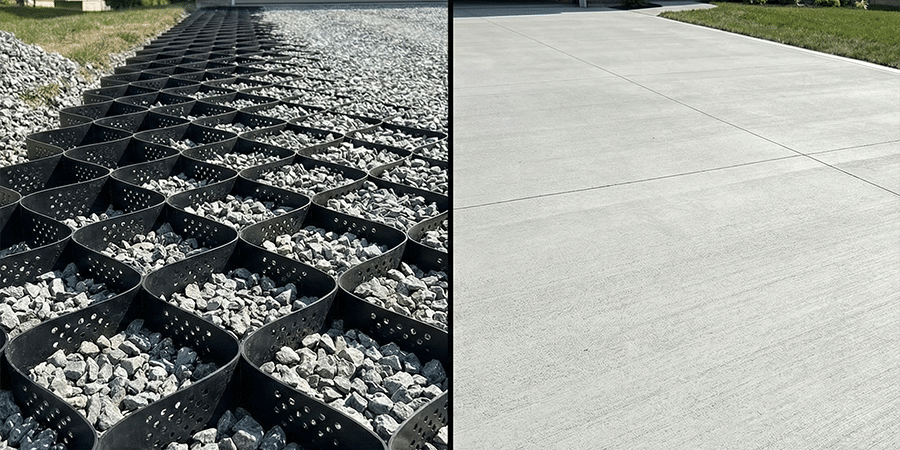
A Colorado family spent $3,500 annually maintaining their steep gravel driveway until they discovered a military-grade solution that cost them just $2.20 per square foot to install. Their BaseCore geocell driveway has required zero maintenance in three years. If you’re facing expensive concrete quotes, watching your gravel migrate downhill after every rainstorm, or dealing with potholes and ruts on a long farm lane, this article reveals exactly how cellular confinement technology delivers concrete-level durability at a fraction of the cost — and why property owners across North America are making the switch to BaseCore products from Backyard Bases.
What Is a Geocell Driveway? Understanding the Technology Through Real Applications
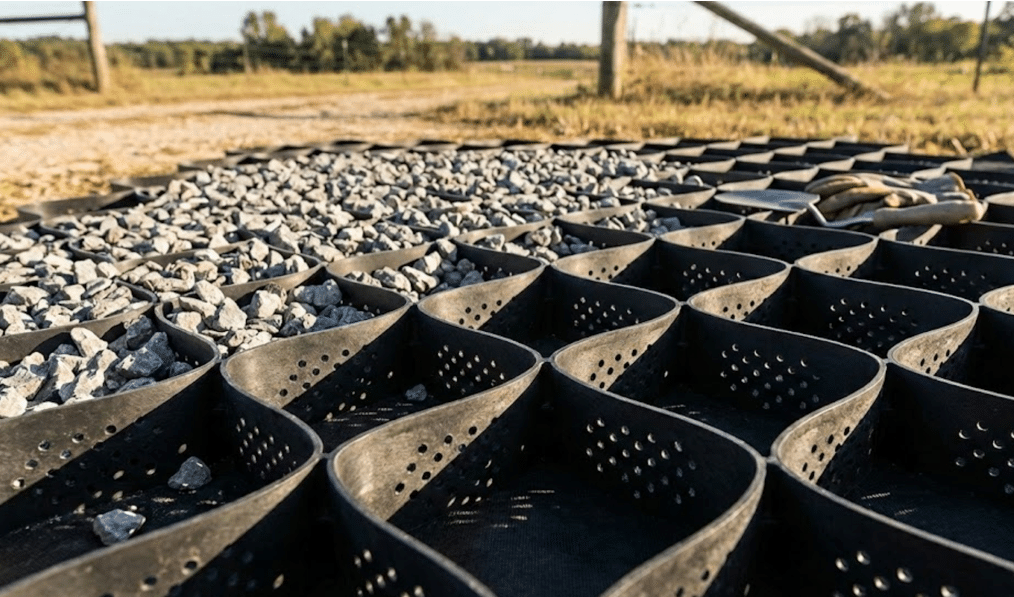
A geocell driveway uses a three-dimensional honeycomb grid made from high-density polyethylene (HDPE) to confine and stabilize infill materials like gravel, sand, or crushed stone. According to Wikipedia’s documentation on cellular confinement systems, the U.S. Army Corps of Engineers developed this technology in 1975 to build tactical roads over soft ground for heavy military vehicles. Engineers at the Waterways Experiment Station discovered that sand-confinement systems performed significantly better than conventional crushed stone sections.
The technology works through a principle called cellular confinement. When you fill the honeycomb cells with aggregate and compact it, the cell walls prevent lateral movement of the infill material. As documented on Backyard Bases’ product pages, the BaseCore honeycomb structure evenly distributes pressure from applied loads across the lateral axis throughout the entire surface, which prevents the cracking and erosion common with traditional driveway materials.
BaseCore geocell panels are manufactured from thick-gauge HDPE, a thermoplastic polymer that provides excellent resistance to UV degradation, chemicals, and temperature extremes. According to Backyard Bases’ published specifications, BaseCore panels range from 2 inches to 8 inches in height, with taller cells recommended for heavier vehicle loads such as tractors, RVs, and work trucks.
Backyard Bases offers two BaseCore product lines: standard BaseCore panels for light-duty applications like residential driveways and pathways, and BaseCore HD panels engineered for demanding applications including farm lanes, commercial parking, and areas with steep slopes. BaseCore HD features smaller cell sizes and thicker construction, with double-welded seams providing tensile strength exceeding 2,000 pounds per square foot.
How One Family Conquered a 6% Grade Driveway: The Johnson Case Study

The most documented implementation of BaseCore geocell technology comes from a family property in Colorado’s high desert at 7,200 feet elevation. Their challenging driveway project, detailed in a published case study from 2025, illustrates exactly how the system performs under extreme conditions.
The Problem
The Johnsons faced a 350-linear-foot driveway with a 6% grade — steep enough that loose gravel migrated downhill after every rainstorm and snowmelt. Previous annual maintenance averaged $3,500, including spring regrading, fresh gravel delivery, erosion repairs, and equipment rental. The extreme grades required hiring equipment operators for safety, further increasing costs.
Their elevation created additional challenges. Intense UV radiation at 7,200 feet degrades materials faster than at sea level. Asphalt contractors quoted 40% premiums for elevation-related complications, and concrete contractors warned that high-altitude curing problems would likely cause early failure.
The Solution
After consulting with BaseCore technical support, the family selected BaseCore 3-inch standard panels for their residential driveway. For aggregate, they chose 3/4-inch minus angular granite from a local quarry 20 miles away. The “minus” designation meant the material included particles from 3/4-inch stones down to rock dust, with approximately 18% passing the #200 sieve — a gradation that creates superior compaction within geocell cells.
Installation Timeline and Process
The installation followed the documented 6-step process available on Backyard Bases:
- Site Preparation: Cleared vegetation and debris from the driveway path
- Excavation: Dug 3-4 inches into the ground — notably, BaseCore requires only one-third the excavation depth compared to traditional foundation materials
- Geotextile Installation: Rolled out 6 oz non-woven geotextile fabric to prevent subgrade mixing and weed growth
- Panel Deployment: Expanded the collapsible geocell panels accordion-style across the prepared surface
- Connection: Secured panels together using BaseClips and anchored with BaseCaps
- Infill: Filled cells with 4 inches of aggregate (3 inches within cells plus 1 inch of topping)
The entire 4,200 square foot driveway (350 feet x 12 feet wide) was completed by general laborers without specialized equipment.
Documented Cost Breakdown
The case study provides exact figures for the complete project:
| Item | Cost |
| BaseCore 3″ Panels | $4,200 |
| Geotextile Fabric | $450 |
| Angular Granite Aggregate | $3,800 |
| BaseCaps and BaseClips | $350 |
| Rebar Stakes | $150 |
| Labor (DIY with helpers) | $300 |
| Total Project Cost | $9,250 |
This works out to $2.20 per square foot installed — exceptional value compared to the alternatives they had quoted.
Measurable Outcomes: Three Years of Performance Data
The Johnson family’s BaseCore installation has generated documented results over three years of use, providing concrete evidence of long-term performance.
Cost Comparison Analysis
According to the case study, the family received the following quotes before choosing geocell:
- Asphalt: $8-10 per square foot (contractors warned it would crack within two years on the steep grades)
- Concrete with reinforcement: $14+ per square foot
- Elaborate drainage system: $32,000 (separate quote for French drains and retention structures)
Their BaseCore solution at $2.20 per square foot represented savings of 72-84% compared to asphalt and 84% compared to reinforced concrete.
Maintenance Savings
The true economic benefit appears when calculating avoided expenses:
- Previous annual maintenance: $3,500
- Three-year savings: $10,500
- Maintenance performed since BaseCore installation: Zero
The case study notes that the family “hasn’t moved a single stone for maintenance — unthinkable with their previous loose gravel surface.”
Winter Performance
The flexible geocell system accommodates thermal movement without damage. The case study reports that while neighboring asphalt driveways show extensive cracking and concrete drives exhibit spalling, the BaseCore installation has weathered 200+ freeze-thaw cycles with no signs of degradation.
For snow removal, the family sets their plow blade 1 inch high to prevent cell contact while removing adequate snow for safe travel. The textured aggregate surface provides excellent winter traction.
Why Traditional Driveway Materials Fail: The Pain Points BaseCore Solves
The Gravel Migration Problem
According to the Inch Calculator’s 2025 gravel driveway cost guide, gravel shifts over time due to pockets of space between pebbles. Homeowners must periodically top-dress their driveways by adding or replenishing surface gravel every few years. Ruts and potholes form regularly, and stray pebbles migrate onto lawns and other unwanted areas.
BaseCore’s cellular confinement system eliminates this problem entirely. The published specifications on Backyard Bases state that the honeycomb structure holds infill material in place even through heavy weather systems and vehicle traffic. Because geocell confines materials within individual cells, you don’t need to replenish your driveway’s infill.
The Concrete Cost Crisis
Current concrete driveway pricing presents significant challenges for property owners. According to Angi’s 2025 cost data, homeowners can expect to pay between $8 and $20 per square foot for concrete driveway installation, with average projects ranging from $2,700 to $14,500. The Concrete Network reports the national average at $5-18 per square foot, making total costs between $3,200 and $11,500.
These costs don’t include removal of existing driveways (add $1.50-$4 per square foot) or the reinforcement needed for heavy vehicles (add $1-3 per square foot for rebar or wire mesh).
Beyond initial costs, concrete creates additional challenges:
- Settlement time: 3-27 days before use
- Specialist requirements: Professional crews needed for proper installation
- Weather limitations: Cannot pour during cold weather
- Cracking: Prone to damage from freeze-thaw cycles
- Impermeability: Causes water pooling and runoff issues
The Long Farm Lane Dilemma
Rural property owners face unique challenges with extended driveways. According to AccuDirt’s gravel driveway cost analysis, a quarter-mile private road (1,320 feet x 16 feet wide) runs between $26,400 and $38,016 for gravel alone — before any drainage systems, permits, or annual maintenance.
Backyard Bases’ farm-focused product line addresses this directly: BaseCore geocell panels can be installed by general laborers or property owners themselves, eliminating the specialist costs that make long driveways prohibitively expensive with concrete. The panels support tractors, trucks, and heavy equipment that regularly traverse farm properties. As noted on the Backyard Bases farms page, these foundations create “lifetime parking areas, pads or driveway extensions with ease” while offering “customizable load support and strength no matter how heavy your vehicle is.”
Practical Implementation Guide: How to Install a BaseCore Geocell Driveway

Based on Backyard Bases’ published installation guide and documented project methodologies, here’s the practical approach successful property owners have followed:
Step 1: Evaluate Your Requirements
Backyard Bases’ product selection guide recommends:
- 2-inch panels: Walking paths, light parking, stall floors
- 3-inch panels: Light vehicles, trailers, residential driveways
- 4-6+ inch panels: Commercial parking, construction traffic, slope stabilization, farm equipment
For most residential driveways supporting SUVs and sedans, 3-inch BaseCore panels provide adequate support. Properties with regular truck traffic or steep slopes should consider BaseCore HD versions for added strength. The 4-inch BaseCore HD is specifically “designed for driveways supporting box trucks, heavy-duty pickups, and light trailers” and is “perfect for extreme slopes, farm and barn areas.”
Step 2: Calculate Materials
BaseCore’s geocell system reduces aggregate requirements by up to 50% compared to traditional installations because the cell walls displace volume that would otherwise require fill material. As documented: “Using just 3 inches of BaseCore provides you with the same strength as 12 inches of gravel would without a cellular confinement system.”
For a typical driveway, plan for:
- Geocell panels to cover the entire surface area
- Geotextile fabric (Backyard Bases recommends their 6 oz non-woven fabric)
- Aggregate infill: depth of cells plus 1 inch topping
- BaseCaps and BaseClips for connections
Step 3: Prepare the Site
Clear all vegetation and debris. Excavate 3-4 inches — notably, BaseCore’s system requires only one-third the excavation depth of traditional foundations. This shallower dig reduces labor, protects underground utilities, and cuts disposal costs.
Step 4: Install Geotextile Base
Roll out geotextile fabric across the prepared surface, securing with landscape staples. This layer prevents subgrade mixing, inhibits weed growth, and improves drainage.
Step 5: Deploy and Connect Panels
Expand BaseCore panels accordion-style across the geotextile. Trim panels with standard scissors to fit around obstacles like trees or drainage pipes. Connect adjacent panels using BaseClips and secure to the ground using BaseCaps — the flush-mount design eliminates trip hazards and tire puncture risks.
Step 6: Fill and Compact
Add aggregate infill, filling cells completely plus approximately 1 inch of topping material. Angular crushed stone provides the best interlock and stability. Compact with a plate compactor or vehicle traffic.
Critical Success Factors
Based on documented installations:
- Use angular aggregate: Rounded pea gravel provides less interlock than angular crushed stone
- Include fines: Material with “minus” gradation (like 3/4″ minus) compacts better than single-size aggregate
- Source locally: Reduces transportation costs significantly
- Install in any weather: Unlike concrete, geocell installation isn’t weather-dependent
The 75-Year Value Proposition: Backed by a 10-Year Guarantee
BaseCore geocell panels last more than 75 years depending on specific project applications. The HDPE material resists UV degradation, chemical exposure, and temperature extremes. Panels won’t crack under extreme temperatures, won’t rust over time, and are even reusable for new projects.
Backyard Bases backs their BaseCore HD products with a 10-Year Guarantee, providing peace of mind for your investment.
This longevity creates compelling long-term economics:
| Material | Lifespan | Initial Cost (600 sq ft) | 75-Year Total Cost |
| Gravel (unmaintained) | 10-20 years | $1,800 | $6,750+ maintenance |
| Asphalt | 15-20 years | $4,800-$6,000 | $18,000+ |
| Concrete | 25-40 years | $4,800-$12,000 | $14,400+ |
| BaseCore Geocell | 75+ years | $1,320 + aggregate | $1,320 + aggregate |
As one verified customer review on Backyard Bases notes: “Used this for my auto shop lot parking and is perfect. Great service and very high quality product.”
Conclusion
The Johnson family’s Colorado project demonstrates what’s possible when military-grade technology meets residential applications. Their $9,250 investment replaced $3,500 in annual maintenance costs, delivering complete payback in under three years while creating a driveway that has required zero maintenance through 200+ freeze-thaw cycles.
For property owners facing $8-20 per square foot concrete quotes, watching gravel wash away after every storm, or needing affordable reinforcement for long farm lanes, BaseCore geocell technology offers a documented path to durable, low-maintenance driveways at a fraction of traditional costs.
Your next step: Visit Backyard Bases to explore the complete BaseCore product line. Need help selecting the right geocell depth for your project? Contact a Backyard Bases specialist for a free personalized consultation — they’ll recommend the optimal panel configuration, aggregate selection, and complete materials list based on your specific terrain and vehicle requirements.
Frequently Asked Questions
How much does a geocell driveway cost compared to concrete?
BaseCore geocell driveways cost approximately $2.20 per square foot installed, compared to $8-20 per square foot for concrete according to Angi’s 2025 pricing data — a savings of 72-89%. Shop BaseCore panels at Backyard Bases starting at competitive prices with free shipping on orders over $999.
Can I install BaseCore geocell myself?
Yes. Backyard Bases confirms that anyone can install BaseCore panels with basic tools and 1-2 helpers. The 6-step process requires no specialists, heavy equipment, or concrete experience. Download the installation guide from Backyard Bases for step-by-step instructions.
How long do geocell driveways last?
BaseCore geocell panels exceed 75 years of service life. Backyard Bases backs their BaseCore HD products with a 10-Year Guarantee covering materials and workmanship. The UV-resistant HDPE material won’t degrade, crack, or rust over time.
Will geocell stop my gravel from washing away?
Yes. The cellular confinement system locks aggregate in place within individual honeycomb cells. The Johnson family case study documented zero gravel migration over three years on a 6% grade — even through 200+ freeze-thaw cycles.
What vehicles can drive on a geocell driveway?
Backyard Bases offers BaseCore panel depths from 2-8 inches for different load requirements. Their 3-inch panels support light vehicles and trailers, while 4-inch BaseCore HD handles box trucks, heavy-duty pickups, and farm equipment.
