
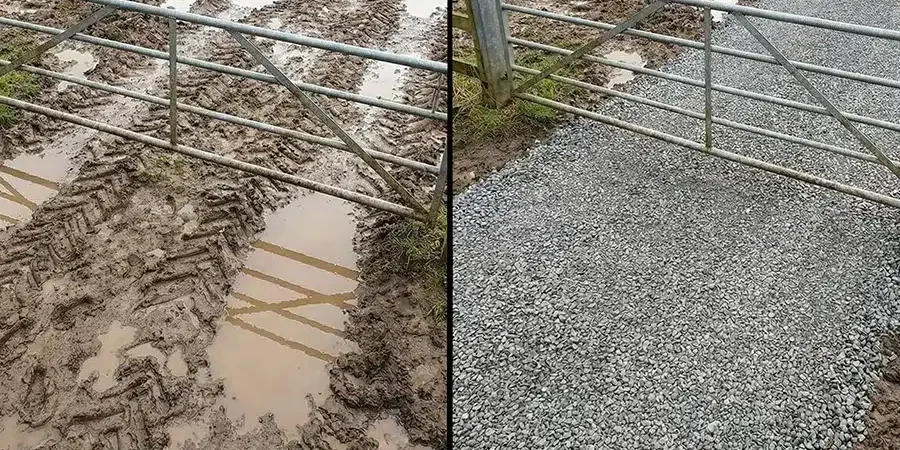
Every property has one. That gate entrance—the driveway mouth, the farm gate, the pasture entry—where every tire, hoof, boot, and piece of equipment crosses the same narrow strip of ground dozens of times a day. It’s the first place Mud Control Gate Entrances takes over. Water pools in the ruts. Gravel disappears into the subsoil. What started as a firm entrance becomes a slick, churned-up mess that gets worse with every rain and every vehicle that passes through. You’ve added gravel.
You’ve added more gravel. You’ve regraded it with a tractor blade. And six weeks later, it’s mud again. The problem isn’t your gravel—it’s that nothing is holding it in place. This guide shows you how to build a gate entrance that stays firm, drains instantly, and never needs regrading, using BaseCore HD geocell ground grids.
Why Gate Entrances Always Fail First
Gate entrances are the single highest-traffic, most concentrated-wear point on any property. Understanding why they fail helps you understand why the fix needs to be different from what you’ve tried before.
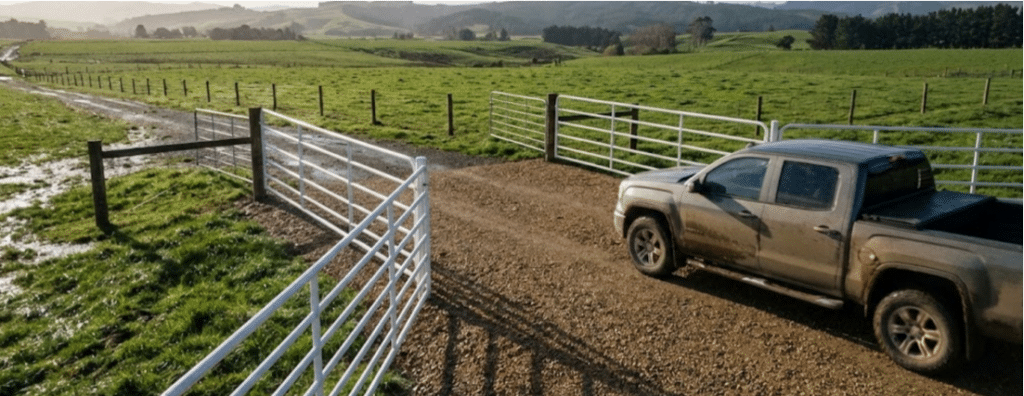
Concentrated traffic patterns. Every vehicle, animal, and person entering or leaving your property crosses the same narrow footprint. Unlike a long driveway where traffic spreads across a wider surface, a gate entrance funnels all that weight and movement into a strip typically 10–16 feet wide and 20–40 feet long. That’s an enormous amount of repetitive load on a very small area.
Turning and braking forces. Vehicles don’t just drive straight through a gate. They slow down, turn, sometimes stop to open the gate, then accelerate again. Each of those actions applies lateral shear force to the surface—pushing gravel sideways, carving ruts, and exposing bare soil. Straight-line driving is relatively easy on a gravel surface. Stop-and-go turning at a gate entrance is devastating.
Water collection point. Gate entrances are almost always at a low point or transition where water naturally collects. The gate itself often sits at a property boundary where drainage from the road, driveway, and adjacent land converges. Add tire traffic churning the wet surface, and you get the perfect conditions for rapid Mud Control Gate Entrances formation.
Subsoil migration. Here’s the hidden problem most people don’t realize: when you dump loose gravel on a gate entrance without any confinement system, the gravel doesn’t just spread sideways—it gets pushed down into the subsoil below. Every tire pass pushes aggregate particles into the soft ground beneath. The Mud Control Gate Entrances you’re driving through isn’t just surface water mixing with dirt. It’s your gravel slowly sinking into the earth and disappearing, leaving you with less material above ground and a weaker base below. This is why adding more gravel only works temporarily—you’re feeding it to the subsoil.
What Actually Solves the Problem: Cellular Confinement
The solution to a muddy gate entrance isn’t more material on top. It’s confining the material you have so it can’t move laterally or sink downward.
BaseCore HD geocell is a three-dimensional honeycomb grid made from high-density polyethylene (HDPE). You expand the panels across your gate entrance area, anchor them in place, lay them over geotextile fabric, and fill the cells with compacted angular gravel. Each cell acts as a miniature retaining wall, locking the aggregate in position so it can’t spread, shift, or sink—no matter how many times a truck turns through the entrance or how hard it rains.
The technology was developed for military applications in the 1970s, providing instant road surfaces for tanks and heavy equipment over soft, unstable ground. That same cellular confinement principle is exactly what a high-traffic gate entrance needs: the ability to handle repeated heavy loads on compromised soil while maintaining a stable, level surface.
The manufacturer’s published documentation states that 3 inches of geocell-confined gravel provides the same structural strength as 12 inches of loose, unconfined gravel. For a gate entrance that’s been eating gravel for years, that’s a transformative difference. You’re not just adding more material—you’re fundamentally changing how the ground handles load and water.

Why Gate Entrances Need BaseCore HD Specifically
We recommend BaseCore HD for gate entrances rather than standard geocell products. Here’s why this specific application demands the HD model.
Gate entrances experience a combination of forces that most ground surfaces don’t. Heavy vertical loads from trucks and trailers. Lateral shear from turning wheels. Vibration from idling engines while someone opens the gate. Repeated freeze-thaw cycles in the saturated soil. And all of this concentrated in a small area that never gets a break.
BaseCore HD features smaller cells and more cell walls per panel than standard geocell products. According to the manufacturer’s published specifications, this denser cell structure is “engineered for heavier traffic, animals, and steeper slopes.” More cell walls per square foot means more confinement points, which means each individual pocket of gravel is held more tightly in place. For a gate entrance where every square inch takes a beating, that additional density is the difference between a surface that holds and one that doesn’t.
The HD model also features double-welded seams with tensile strength rated at over 2,000 lbs per square foot, per published product data. At a gate entrance where turning tires apply lateral force that tries to pull the grid apart, seam strength matters. The perforated cell walls allow water to pass through freely—critical at a gate entrance that’s already a natural water collection point. Water drains through the gravel, through the cell perforations, through the geotextile fabric beneath, and into the subgrade. No pooling. No standing water mixing with soil. No mud.
The Gate Entrance Builds: Three Common Scenarios
Residential Driveway Entrance
The typical residential driveway entrance Mud Control Gate Entrance problem happens where your driveway meets the road. Mail carriers, delivery trucks, and your own vehicles brake and turn across the same 10-foot section daily. Rain washes material from the driveway onto the road, and road runoff pushes debris back onto your entrance. The result is a perpetually soft, uneven transition that cakes mud onto tires and looks terrible from the street.
For residential driveway entrances, a 3-inch BaseCore HD panel filled with compacted angular crushed stone handles cars, SUVs, and pickup trucks with massive load overhead. The area to stabilize is typically 10–16 feet wide and 15–25 feet deep—a manageable weekend project. The perforated cells handle the drainage issue that makes this spot problematic in the first place, and the confined gravel stays put instead of migrating onto the road.
Farm Gate Entrance
Farm gates take the worst abuse of any entrance type. Tractors with loaded implements. Livestock trailers with 10,000+ lbs of animals. Feed trucks. Hay deliveries. Cattle, horses, or other livestock crossing through on hoof. And all of this happening on ground that’s been churned to soup by generations of the same traffic.
For farm gate entrances, we recommend a 3-inch or 4-inch BaseCore HD panel depending on your heaviest regular vehicle load. The area to stabilize typically extends 10–20 feet on each side of the gate to capture the full turning radius and stopping zone. If livestock also cross through the gate, the geocell provides safe, stable footing that eliminates the deep Mud Control Gate Entrance that causes hoof injuries, thrush, and leg strain. The manufacturer’s documentation confirms that BaseCore is safe for horses and livestock, creating “a safe, slip-resistant surface” that “prevents hoof damage, joint strain, and leg injuries.”
Commercial or Estate Property Entrance
For properties with a formal entrance—estates, vineyards, event venues, rural businesses—the gate entrance is the first impression every visitor gets. A muddy, rutted entrance undermines the entire property aesthetic regardless of what lies beyond the gate.
Geocell with compacted angular gravel creates a clean, professional entrance surface that handles guest vehicles, delivery trucks, and service equipment without deteriorating. For properties where aesthetics matter alongside function, the geocell can also be filled with decorative angular stone that stays locked in place—unlike loose decorative gravel that scatters within weeks on an unconfined surface.
Step-by-Step: Building a Permanent Gate Entrance

Step 1: Define the Area
Map out your gate entrance stabilization zone. Include the full width of the entrance plus 2 feet on each side, and extend the depth to cover the entire area where vehicles slow, stop, turn, or accelerate. For most gate entrances, this is an area of roughly 12–20 feet wide and 20–40 feet long. Measure your gate opening and your heaviest vehicle’s turning radius to confirm.
Step 2: Excavate
Remove the existing failed surface material down to stable subgrade—typically 4–8 inches depending on how deep the Mud Control Gate Entrance damage goes. You want to reach soil that’s firm enough to support the new system. If you’re working with extremely soft or clay-heavy soil, excavate deeper and add a compacted gravel sub-base before laying the geocell.
Step 3: Grade for Drainage
This is the step most gate entrance repairs skip, and it’s why they fail. Grade the excavated area with a slight crown (higher in the center, sloping to the edges) so water sheds off the surface rather than pooling in the middle. A 2% grade—roughly a quarter inch per foot—is sufficient. Water should flow off the entrance surface and away from the gate area.
Step 4: Lay Geotextile Fabric
Roll heavy-duty non-woven geotextile fabric across the entire excavated area, overlapping seams by 8–12 inches. This is the critical separation layer that prevents subsoil from migrating up into your gravel—the exact problem that killed your previous gate entrance. We carry a 6 oz non-woven geotextile that’s nearly twice as thick as the standard fabric most suppliers offer, built specifically for high-traffic applications like gate entrances.
Step 5: Expand and Anchor BaseCore HD Panels
Expand each panel and anchor with flush-mount BaseCap stakes driven through the cells into the subgrade. Connect adjacent panels with BaseClips. Trim panels with scissors or a utility knife to fit the exact dimensions of your entrance. The flush-mount caps eliminate trip hazards for foot traffic and livestock—no exposed metal rebar sticking out of the ground.
Step 6: Fill and Compact
Fill each cell with angular crushed stone—not round pea gravel, which shifts within the cells and doesn’t compact properly. Angular gravel with fines (3/8″ to 3/4″ minus) is ideal because the irregular edges interlock under compaction, creating a dense, stable surface within each cell. Fill level with the top of the cells and compact with a plate compactor or by driving over the surface with a vehicle.
Your gate entrance is ready for immediate use. No curing time. No waiting period. Drive on it, walk on it, and run livestock through it the same day.
For a full walkthrough with detailed instructions, see our complete geocell installation guide.
What You’ll Stop Spending Money On
Once your geocell gate entrance is in, you can cross several recurring expenses off your list permanently. No more annual gravel top-ups—the confined aggregate stays in place instead of sinking into the subsoil or spreading into the ditch. No more regrading with a tractor blade every few months. No more tracking Mud Control Gate Entrance onto the road and getting complaints from the county about drainage. No more temporary fixes with plywood, rubber mats, or concrete blocks that shift and create new problems.
The geocell panels add roughly $1.00–$1.50 per square foot beyond basic gravel cost, but you’ll use approximately 50% less aggregate because the cellular confinement eliminates waste from migration and sinking. And you’ll never repurchase and re-spread that material. One installation. One time. The manufacturer rates the HDPE material for 75+ years of service life.
Beyond the Gate: Other Mud-Prone Areas on Your Property
Once you see how geocell transforms your gate entrance, you’ll recognize the same problem—and the same solution—in other high-traffic spots on your property. Common areas that benefit from the same treatment include barn entrances and aisle ways where foot traffic, wheelbarrows, and equipment converge; water trough surrounds where livestock stand and churn the soil into Mud Control Gate Entrance daily; feed station approaches where animals congregate and compact the ground; trailer loading zones where repeated heavy loads create permanent ruts; equipment storage pads where tractors, mowers, and implements sit on soft ground; and pathway connections between buildings where daily foot traffic wears through grass to bare soil.
The same BaseCore HD panels and installation method work for all of these applications. One product system for every Mud Control Gate Entrance control challenge on your property.
Browse our full BaseCore HD geocell products to find the right panel depth for your project, or contact our team for a free project evaluation.
Conclusion
A muddy gate entrance isn’t a maintenance problem you manage seasonally—it’s an engineering problem you solve once. Every load of gravel you’ve spread and watched disappear was treating the symptom while the real issue—unconfined aggregate on high-traffic, poorly drained ground—continued unchecked beneath the surface.
BaseCore HD geocell changes the equation by physically confining every particle of aggregate within a dense honeycomb of HDPE cells. Water drains through the perforated walls instead of pooling on the surface. Gravel locks in place instead of spreading, sinking, or washing away. And the surface handles repeated heavy loads from trucks, trailers, tractors, and livestock without rutting, churning, or failing—because the cellular confinement distributes force across the entire grid rather than concentrating it at individual tire contact points.
Whether it’s a residential driveway entrance, a farm gate, or a commercial property entry, the installation follows the same proven six-step process and delivers results the same day. No curing. No specialists. No ongoing re-grading.
Your next step: Contact our team for a free project evaluation. Tell us your gate entrance dimensions, your heaviest vehicle, and your soil conditions—and we’ll recommend the exact geocell configuration and material quantities to fix it permanently.
Frequently Asked Questions
Q: How thick should the geocell be for a farm gate entrance with heavy trucks?
A: For most farm gate entrances handling pickup trucks, livestock trailers, and tractors, a 3-inch BaseCore HD panel provides excellent performance. For entrances regularly used by fully loaded commercial trucks or heavy equipment, a 4-inch panel provides additional load distribution and depth.
Q: What type of gravel works best for a gate entrance geocell installation?
A: Angular crushed stone with fines—typically 3/8″ to 3/4″ minus—is ideal. The angular edges interlock under compaction, creating a dense, stable surface within each cell. Avoid round pea gravel, which shifts within the cells and doesn’t compact properly. Using angular, compacting gravel is essential for high-traffic areas.
Q: Will livestock hooves damage the geocell at a gate entrance?
A: No. Once filled and compacted, the gravel surface sits level with or slightly above the cell tops, so hooves contact the aggregate—not the grid. The manufacturer confirms BaseCore is safe for horses and livestock, creating a slip-resistant surface that prevents hoof injuries and eliminates the deep Mud Control Gate Entrance that causes thrush and leg strain.
Q: How large should my stabilized gate entrance area be?
A: Cover the full width of your gate opening plus 2 feet on each side, and extend at least 15–25 feet in depth on each side of the gate to capture the full braking, stopping, and turning zone. For farm gates with larger vehicles, extend to 30–40 feet to cover the complete traffic pattern.
Q: Can I install a geocell gate entrance myself?
A: Yes. Two people with basic tools—a shovel, rake, scissors or utility knife, and a plate compactor (rental)—can install a typical gate entrance in a weekend. No specialist contractors or heavy machinery required. Our team provides free project guidance to help you plan your specific installation.
This article is published by Backyard Bases for informational and educational purposes only. All BaseCore HD product specifications, load ratings, and performance claims are sourced from manufacturer-published documentation available at basecore.co. General geocell engineering principles are based on established cellular confinement technology originally developed for military applications. Specific results depend on site conditions, soil type, drainage patterns, traffic volume, vehicle weight, fill material selection, compaction quality, and installation method. The information provided does not constitute engineering advice for any specific project. For projects involving significant grading, drainage modification, or commercial-scale applications, consult a qualified engineer or contractor. For current product specifications and personalized project guidance, contact our team directly.
