
Quick Answer
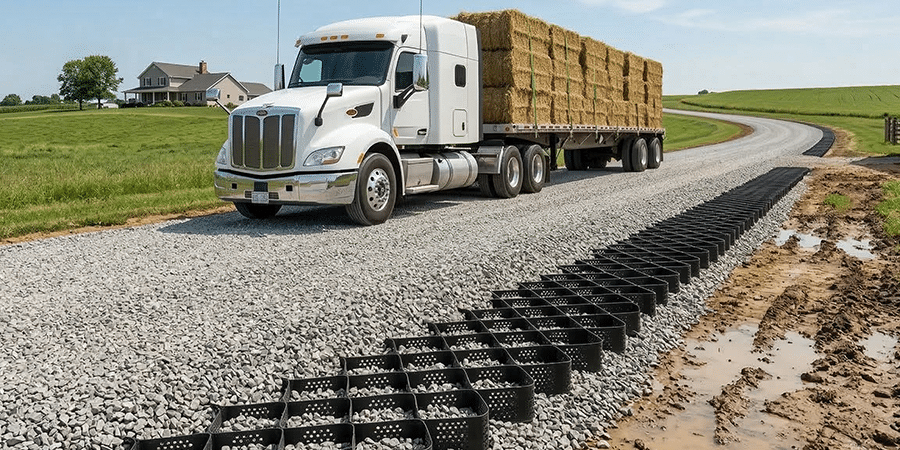
Geocell driveway installation involves laying ground grids over prepared base material, then filling with gravel. This system handles heavy farm equipment while preventing mud and ruts permanently.
Key Takeaways
- Geocell systems withstand tractors and hay delivery trucks better than loose gravel
- Installation requires minimal excavation compared to concrete or asphalt alternatives
- Permeable design eliminates standing water and mud formation
- Total project cost typically 60-70% less than traditional paving methods
Every spring, the same frustrating cycle repeats across rural America. Mud season arrives, transforming farm driveways into impassable swamps that trap delivery trucks and damage equipment. You patch with more gravel, only to watch it disappear into ruts by summer’s end. Geocell driveway installation offers a permanent solution specifically engineered for the weight demands and weather challenges rural properties face daily.
The Real Problem: Why Rural Driveways Fail Under Heavy Loads
Traditional gravel driveways fail because loose aggregate has no structural integrity under concentrated loads. When a 40,000-pound hay truck makes a delivery, individual stones displace laterally, creating the classic washboard effect and deep ruts.
The problem compounds with weather cycles. Spring frost heave loosens the base, summer heat expands materials unevenly, and fall rains wash fines away. Each cycle weakens the foundation further, requiring constant maintenance and fresh gravel applications.
Farm equipment creates additional challenges that residential driveways never face. Tractor implements with narrow contact patches concentrate tremendous pressure. Manure spreaders and hay wagons create dynamic loading as they bounce over uneven surfaces. Standard gravel simply cannot provide the lateral confinement needed for these applications.
The Solution: How Geocell Ground Reinforcement Works
Geocell technology transforms loose aggregate into a solid structural system through three-dimensional confinement. The honeycomb-shaped grid creates thousands of individual cells that prevent stone migration while maintaining permeability.
Principle 1: Load Distribution
BaseCore geocell systems distribute concentrated wheel loads across a much larger area.
Individual geocells share loads with neighboring cells via their interconnected walls. This reduces ground pressure by up to 75% compared to loose gravel.
Principle 2: Lateral Confinement
The cell walls prevent aggregate from moving horizontally under load. This confinement effect increases the bearing capacity of standard gravel by 300-400%, allowing thinner installation depths while supporting heavier loads.
Principle 3: Interlocking Stability
Individual geocell panels connect via integrated clips, creating a continuous reinforced mat. This interlocking system prevents panel separation and maintains structural integrity even under severe loading conditions.

Proof: Performance Under Real Farm Conditions
Geocell systems have demonstrated superior performance in agricultural applications through decades of field testing. The technology originated from military engineering requirements for rapid deployment of heavy equipment over soft soils.
Independent testing shows geocell-confined aggregate maintains structural integrity under cyclic loading equivalent to thousands of heavy vehicle passes. The three-dimensional confinement prevents the progressive failure mode that destroys conventional gravel surfaces.
Permeability testing confirms that properly installed geocell systems drain 40% faster than compacted gravel while maintaining superior load-bearing capacity. This combination eliminates the traditional trade-off between drainage and strength.
What to Expect Working with Backyard Bases
The geocell driveway installation process begins with site evaluation and material calculations. Backyard Bases provides detailed project planning including excavation depth requirements, aggregate specifications, and panel quantities based on your specific traffic patterns and soil conditions.
BaseCore geocell systems ship directly to your property with installation instructions and technical support. The modular design allows phase construction for long farm roads or immediate full installation for smaller areas.
Professional consultation ensures proper base preparation and drainage integration. While geocell installation is DIY-friendly, foundation success depends on correct subgrade preparation and aggregate selection for your local conditions.

Addressing Common Concerns About Geocell Strength
“Will This Really Handle My Tractor?”
BaseCore geocell systems are engineered for loads exceeding 100,000 pounds per square foot. (Geocell Driveway: The Smarter Alternative to Concrete) Agricultural tractors typically exert 20-30 PSI ground pressure, well within the system’s design parameters. The distributed loading through multiple cells actually reduces ground pressure compared to the tractor’s contact patch on bare soil.
“How Does Cost Compare to Concrete?”
Geocell installation typically costs 60-70% less than equivalent concrete applications. (How Much Does a Permeable Driveway Cost?) A 1,000-foot farm road requires approximately 30-40 cubic yards of concrete at $150-200 per yard, totaling $4,500-8,000 plus installation. Comparable geocell coverage uses $2,000-3,000 in materials with minimal site preparation costs.
“What About Long-Term Durability?”
Geocell systems maintain performance for 60+ years. The HDPE material resists UV degradation, chemical attack, and freeze-thaw cycling. Unlike concrete, which cracks and requires expensive repair, geocell systems distribute stress to prevent failure initiation.
“Can I Install This Myself?”
Geocell installation requires basic construction skills but no specialized equipment. Panel connection uses simple clips, and aggregate placement follows standard compaction practices. Most farm owners complete installation using existing tractors and implements.
Frequently Asked Questions
How much weight can a geocell driveway support?
BaseCore geocell systems support loads exceeding 100,000 PSF, easily handling farm equipment, delivery trucks, and emergency vehicles.
What gravel works best for geocell installation?
Crushed stone aggregate 3/4-inch minus with angular particles provides optimal performance. Avoid rounded river rock or oversized material.
How long does geocell driveway installation take?
Typical farm driveway installation takes 1-3 days depending on length. Base preparation accounts for most time investment.
Can geocell handle freeze-thaw cycles?
HDPE geocell material withstands temperature cycling from -40°F to 140°F without degradation. Permeable design prevents frost heave.
What maintenance does geocell require?
Properly installed systems require minimal maintenance. Occasional aggregate top-dressing may be needed in high-wear areas after several years.
Ready to End Driveway Problems Forever? Here’s Your Next Step
Rural property owners cannot afford the ongoing cycle of driveway maintenance and equipment damage. Geocell driveway installation provides permanent ground reinforcement engineered for agricultural demands while eliminating mud and rutting problems.
Contact Backyard Bases today to calculate your project requirements and receive detailed installation specifications. Stop fighting mud and start building infrastructure that supports your operation’s success.
Disclaimer: This article provides general information and recommendations. Always consult with a qualified professional or engineer before undertaking any construction project to ensure proper design and installation for your specific site conditions.
