

The average homeowner replaces or repairs their gravel driveway every 3–5 years, spending $1,200–$2,500 each time on materials, equipment rentals, and labor. Parking pads sink under vehicle weight. Shed foundations shift after heavy rains. The root cause is almost always the same: loose aggregate without structural reinforcement cannot handle real-world loads.
Heavy-duty geocell panels solve this problem through cellular confinement technology. These engineered HDPE honeycomb grids lock gravel or soil into thousands of interconnected cells, distributing weight across the entire surface while allowing water to drain naturally through the fill material. Unlike concrete slabs that crack or asphalt that deteriorates, heavy-duty geocell foundations handle vehicle traffic, equipment loads, and freeze-thaw cycles without the maintenance headaches—and you can install them yourself in a single weekend.
This guide explains why traditional foundations fail under heavy loads, how geocell ground grid technology addresses those failure points, and exactly how to build a heavy-duty permeable foundation for driveways, parking areas, carports, and load-bearing structures using Backyard Bases’ BaseCore HD™ system.
Why Traditional Foundations Fail Under Heavy Loads
When a homeowner notices their gravel driveway developing ruts, their parking pad sinking in tire tracks, or their shed floor becoming uneven, they’re seeing symptoms of three engineering problems working together.
Weak or Saturated Subgrade
The native soil beneath any outdoor project is rarely uniform or stable. Clay soils expand when wet and contract when dry. Sandy soils compact unevenly under load. Silty soils hold water and turn to mud during rain. When you place aggregate directly on unstable subgrade, the gravel simply pushes down into the soft spots, creating depressions exactly where vehicles drive or structures sit.
According to research from Penn State Extension’s soil science program, soil compaction from vehicle traffic can reduce water infiltration by 70–90% in high-use areas, creating a feedback loop where poor drainage further weakens the subgrade.
No Lateral Confinement
Loose gravel migrates sideways under pressure—this is basic physics. When a vehicle tire presses down on aggregate, the stones have nowhere to go but outward, spreading away from the load point. Each pass pushes more material to the edges, creating ruts in the traffic path and berms along the sides. The same principle applies to shed foundations: the weight of the structure slowly displaces the gravel beneath it, leading to uneven settling.
Traditional solutions like adding more gravel or re-grading the surface treat the symptom, not the cause. Within weeks or months, the migration starts again because nothing physically prevents the aggregate from moving.
No Water Management
Concrete and asphalt create impermeable surfaces that force water to run off rather than drain through. This runoff erodes surrounding landscaping, pools in low spots, and during winter, creates ice dams that accelerate surface cracking. But porous surfaces without proper structure face the opposite problem: water saturates the base layer and subgrade, weakening load-bearing capacity exactly when you need it most.
The solution isn’t choosing between drainage and stability—it’s engineering a foundation that provides both simultaneously.
How Heavy-Duty Geocell Panels Solve These Problems
BaseCore HD™ heavy-duty geocell panels address all three failure causes through a single engineered system. Understanding the mechanics explains why this approach outperforms both poured concrete and loose aggregate installations.
Cellular Confinement Engineering
Each panel consists of interconnected HDPE cells that expand into a honeycomb grid pattern. When filled with aggregate, these cells create thousands of small compartments that physically prevent lateral migration. The gravel can’t spread sideways because the cell walls contain it. Under load, the filled cells work together as a unified structural layer, distributing weight across a much larger area than the contact point.
The engineering principle is similar to how an egg carton protects eggs—individual compartments prevent movement while the overall structure absorbs and distributes force. Geocell technology applies this concept at scale for ground stabilization.
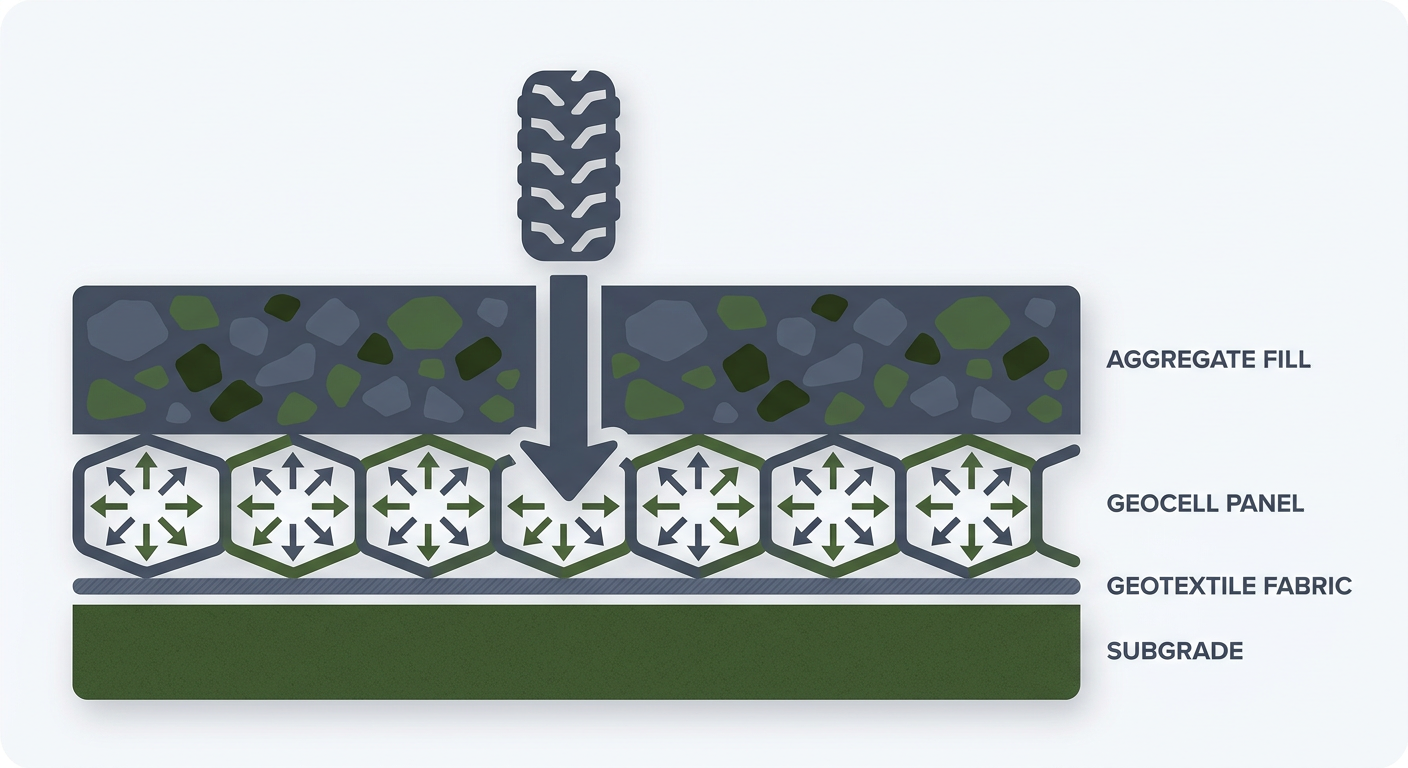
Geocell panels distribute vertical pressure horizontally across the honeycomb structure, reducing stress on the soil.
Load Distribution Across Soft Subgrade
Heavy-duty geocell panels spread point loads across the entire panel surface rather than concentrating them directly into the soil below. A 4,000-pound vehicle wheel exerting pressure on one square foot gets distributed across several square feet of subgrade contact. This reduces the pounds-per-square-inch pressure on weak soils, preventing the punching-through effect that creates ruts and sinkholes.
BaseCore HD™ panels are manufactured from thicker HDPE material than standard geocells, with reinforced cell walls designed for repeated vehicle traffic and equipment loads. The driveway applications page shows real installations handling daily vehicle use without degradation.
Permeable Drainage Without Sacrificing Stability
Unlike concrete slabs, geocell-confined aggregate remains fully permeable. Rainwater drains vertically through the gravel fill, through the open-bottom cells, and into the subgrade below. This eliminates surface ponding, reduces runoff erosion, and prevents the hydrostatic pressure buildup that causes concrete to crack and heave.
The key is that permeability doesn’t compromise structural integrity. The cell walls provide lateral confinement whether the fill material is wet or dry. According to EPA stormwater management guidance, permeable surfaces reduce runoff volume by 70–90% compared to conventional pavement, making geocell foundations both structurally superior and environmentally responsible.
Ready to build a foundation that handles real loads? Shop BaseCore HD™ heavy-duty geocell panels at Backyard Bases or call 888-897-2224 for sizing help with your specific project.
Choosing the Right Heavy-Duty Geocell Depth
Heavy-duty geocell panels come in multiple depths, and selecting the right one depends on your specific application’s load requirements and subgrade conditions.
Application Recommended Depth Typical Load Capacity Pedestrian walkways, garden paths 2 inches Light foot traffic only Sheds, gazebos, hot tub pads 2–3 inches Static structural loads up to 150 PSF Residential driveways, parking pads 3–4 inches Passenger vehicles, light trucks RV pads, equipment storage 4 inches Heavy recreational vehicles, tractors Commercial parking, delivery areas 6 inches Repeated heavy truck traffic
For most residential vehicle applications, BaseCore HD™ in 3-inch or 4-inch depth provides the load-bearing capacity needed without overbuilding. If your subgrade is particularly soft (clay-heavy or frequently saturated), sizing up one depth category adds insurance against settling.
Step-by-Step Installation Guide for Heavy-Duty Geocell Foundations
Installing a heavy-duty geocell foundation is a straightforward DIY project that most homeowners complete in a single weekend. The process requires basic tools, no heavy equipment, and no concrete mixing.
Tools and Materials Needed
- BaseCore HD™ geocell panels (sized for your project area plus 10% overage)
- Geotextile fabric (prevents subgrade contamination)
- Steel landscape edging (contains edges under vehicle traffic)
- Crushed angular gravel (3/4-inch minus or similar)
- Shovel, rake, and wheelbarrow
- Plate compactor (rent from equipment supplier)
- Utility knife or snips for trimming panels
- Stakes or J-pins for panel anchoring
- String line and stakes for layout
Step 1: Excavate and Grade the Area
Mark your project boundaries with stakes and string. Excavate 4–6 inches below your desired finished grade, depending on geocell depth and gravel overfill. Slope the excavation 1–2% away from structures for drainage. Remove any organic material, roots, or debris that could decompose and create voids.
For detailed grading instructions, the geocell installation manual provides slope calculations for different project types.
Step 2: Compact the Subgrade
Run a plate compactor over the exposed subgrade in overlapping passes. This step is critical for heavy-duty applications—soft spots left uncompacted will eventually settle under load. If you encounter extremely soft areas, consider removing additional material and backfilling with compactable base material before proceeding.
Step 3: Install Geotextile Fabric
Roll out geotextile fabric across the entire excavated area, overlapping seams by 6–12 inches. The fabric prevents subgrade soil from migrating up into the aggregate fill over time, maintaining the drainage capacity and structural integrity of your foundation layer.
Lay the geotextile fabric completely beneath the expanded geocell panels to prevent soil mixing.
Step 4: Set Steel Edging at Perimeters
For vehicle applications, install steel landscape edging along all edges exposed to traffic. The edging contains the geocell panels and prevents aggregate from migrating out of the confined area at transitions. Stake edging firmly into the subgrade.
Step 5: Expand and Position Geocell Panels
BaseCore HD™ panels ship collapsed for efficient delivery. Pull the panels open into their honeycomb configuration and position them across the geotextile fabric. Connect adjacent panels using the integrated fastening system. Trim panels to fit irregular boundaries using a utility knife—the HDPE material cuts easily.
Anchor panel edges with stakes or J-pins every 3–4 feet along perimeters and at connection points. For sloped installations, anchor the uphill edge first.
Step 6: Fill with Angular Gravel
Shovel or dump crushed angular gravel into the expanded cells, overfilling by approximately 1 inch above the cell tops. Angular aggregate (not rounded river rock) interlocks within the cells for maximum stability. The gravel driveway guide explains aggregate selection in detail.
Step 7: Compact the Filled Surface
Run the plate compactor across the filled geocell surface in overlapping passes until the gravel settles flush with or slightly below the cell tops. This compaction locks the aggregate into the cellular structure, activating the load distribution properties.
Total installation time for a typical 300-square-foot driveway section: 6–8 hours with two people.
How Much Gravel Do Heavy-Duty Geocell Foundations Require?
One of the most common questions homeowners ask is whether geocell foundations use more or less gravel than traditional installations. The answer depends on your comparison baseline.
For a heavy-duty 3-inch geocell driveway, you’ll need approximately 0.3 cubic yards of gravel per 10 square feet of surface area, accounting for cell fill plus 1-inch overfill. A 300-square-foot single-car driveway requires roughly 9 cubic yards of aggregate.
Compared to a properly built loose-gravel driveway (which requires 6–8 inches of aggregate depth to achieve similar load-bearing capacity), the geocell approach typically uses 30–50% less material while providing superior long-term stability. The cellular confinement multiplies the structural value of each inch of aggregate depth.
Use the foundation calculator to estimate materials for your specific project dimensions.
Is a Heavy-Duty Geocell Foundation Cheaper Than Concrete?
Direct cost comparisons between geocell and concrete foundations depend heavily on regional labor rates, site conditions, and project size. However, the total cost picture consistently favors geocell for most residential applications.
A professional concrete driveway installation typically runs $8–$15 per square foot including excavation, forms, reinforcement, pouring, and finishing. A DIY geocell driveway using BaseCore HD™ panels with materials purchased directly costs approximately $4–$7 per square foot—and requires no special skills or equipment beyond a rental plate compactor.
The long-term cost advantage expands further because geocell foundations require virtually no maintenance. Concrete driveways crack, spall, and require sealing or replacement every 15–25 years. Properly installed geocell foundations remain stable indefinitely because there’s nothing to crack, nothing to seal, and no freeze-thaw damage mechanism.
What Applications Are Heavy-Duty Geocell Panels Best For?
Heavy-duty geocell panels excel in applications where load-bearing capacity, permeability, and DIY installation intersect. The project gallery showcases real installations across these categories.
Driveways and Access Roads
Residential driveways handling daily vehicle traffic benefit from 3-inch or 4-inch BaseCore HD™ panels. The driveway erosion control guide addresses the specific challenges of sloped or drainage-problem driveways.
Parking Pads and RV Pads
Dedicated RV parking areas require foundations that can handle 10,000+ pound loads without rutting. Heavy-duty geocell panels in 4-inch depth provide the necessary support while maintaining permeability for stormwater compliance.
Carport and Equipment Foundations
Metal carports and equipment sheds need stable, level foundations that won’t shift under structural loads. The carport foundation guide explains the specific requirements for these structures, including drainage considerations and anchor point preparation.
Farm and Agricultural Applications
Barn aprons, equipment storage areas, and livestock pathways face unique challenges from heavy machinery and animal traffic. Agricultural geocell applications handle these loads while solving the mud problems that plague traditional gravel surfaces.
Can You Put Pavers Over Heavy-Duty Geocell Panels?
Yes—geocell panels create an excellent structural base for permeable paver installations. The cellular confinement provides the stable, load-distributing foundation that pavers require, while maintaining the permeability that stormwater regulations increasingly demand.
For paver applications, install BaseCore HD™ panels as described above, fill with compactable base material, then set pavers directly on the geocell surface. The permeable paver base guide details this installation method, which eliminates the need for thick concrete or compacted aggregate sub-bases.
How Long Do Heavy-Duty Geocell Foundations Last?
BaseCore HD™ panels are manufactured from high-density polyethylene (HDPE) that resists UV degradation, chemical exposure, and biological breakdown. When installed below grade and covered with aggregate, the panels face minimal environmental stress. Properly installed geocell foundations maintain structural integrity for decades without degradation.
The aggregate fill material is the only component that may require attention over time—and even then, heavy-duty geocell panels dramatically reduce the replenishment frequency. Where a loose gravel driveway might need annual top-dressing, a geocell-stabilized driveway may go 10–15 years between minor touch-ups.
Do Heavy-Duty Geocell Panels Work on Slopes?
Geocell panels perform exceptionally well on sloped installations where loose gravel would wash away. The cellular confinement prevents aggregate migration even on grades up to 30% when properly anchored. For erosion control applications, geocells can be installed on steeper slopes with vegetation or soil fill.
On sloped driveways, anchor the uphill edge securely and install perpendicular to the slope direction. Water drains through the permeable surface rather than running down and eroding the aggregate.
FAQ
What size geocell panels do I need for a driveway?
For residential driveways with regular passenger vehicle traffic, 3-inch or 4-inch BaseCore HD™ panels provide adequate load-bearing capacity. Choose 4-inch depth if you have trucks, trailers, or particularly soft subgrade soil. Commercial or heavy equipment areas may require 6-inch panels for repeated heavy loads.
Can I install heavy-duty geocell panels myself?
Yes—geocell installation is designed for DIY homeowners. The panels ship collapsed and expand on-site without special tools. The only rental equipment needed is a plate compactor for aggregate consolidation. Most homeowners complete a driveway-sized project in a single weekend with basic landscaping tools.
How much does a geocell foundation cost compared to concrete?
DIY geocell foundations typically cost 40–60% less than professional concrete installations when comparing material and equipment costs. Exact pricing varies by project size and aggregate availability in your region. Visit the order page for current BaseCore HD™ pricing.
Will heavy-duty geocell panels prevent my gravel from spreading?
Absolutely—this is the primary engineering function of cellular confinement. The honeycomb cell walls physically contain aggregate within each compartment, preventing the lateral migration that creates ruts and bare spots in loose gravel installations. The problem-solving guide shows before-and-after examples.
Do geocell foundations meet stormwater regulations?
Geocell foundations with aggregate fill are fully permeable and typically qualify as pervious surfaces under local stormwater ordinances. Unlike concrete or asphalt, water infiltrates through the gravel directly into the subgrade. Check with your local building department for specific requirements, but permeable geocell installations generally meet or exceed infiltration standards.
Building a foundation that handles heavy loads while managing water correctly doesn’t require pouring concrete or hiring contractors. Heavy-duty geocell panels give DIY homeowners access to the same cellular confinement engineering used in commercial and infrastructure applications—at a fraction of the cost and with a single-weekend installation timeline.
Build your heavy-duty foundation with BaseCore HD™ geocell panels. Order online at Backyard Bases or call 888-897-2224 for project sizing assistance.
This article is for informational purposes only. The guidance provided reflects Backyard Bases’ product documentation, published build guides, and general ground stabilization principles. Soil conditions, climate, drainage, and load requirements vary by property—consult Backyard Bases or a qualified contractor for site-specific recommendations. For current product information, sizing help, and pricing, visit backyardbases.com or call 888-897-2224.
