
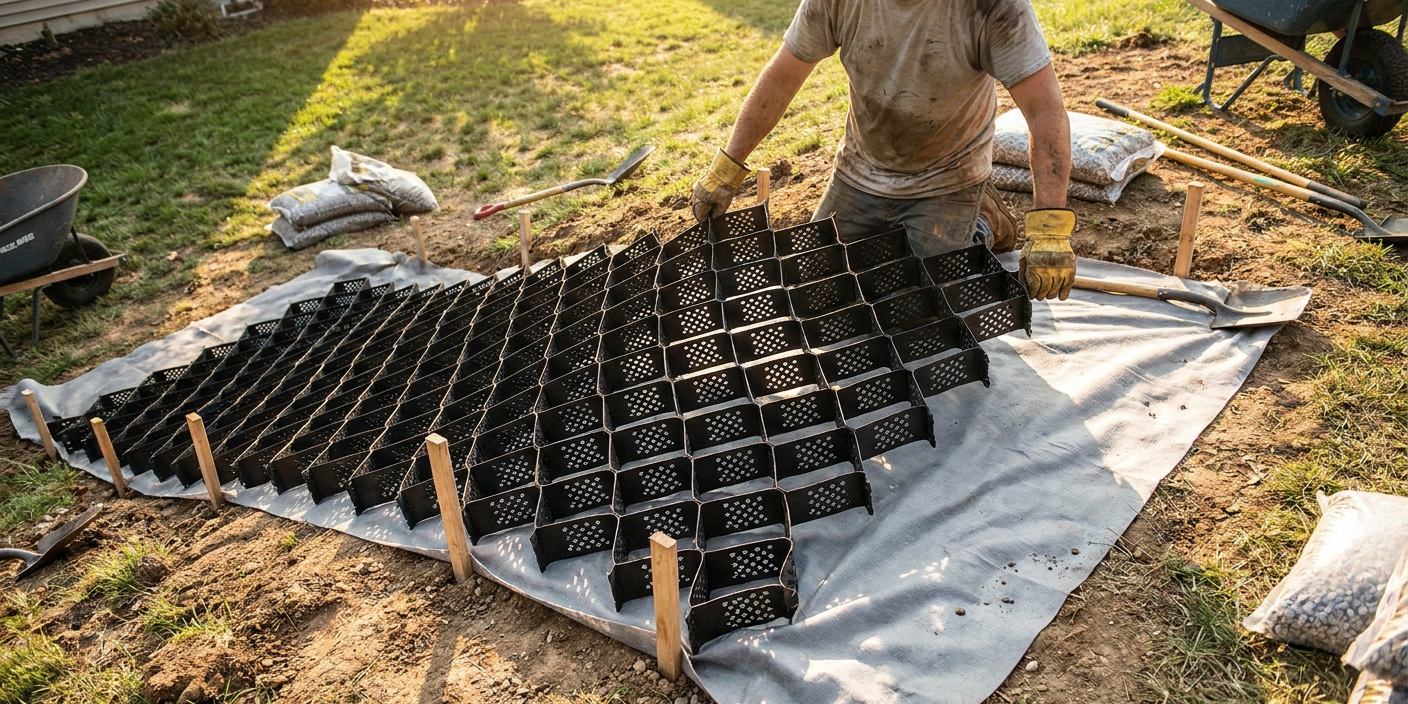
Every heavy rain washes away more of your sloped yard. You watch soil migrate downhill, gravel disappear into low spots, and erosion channels carve deeper into your property. The typical homeowner with a sloped yard spends hundreds of dollars annually on topsoil, gravel, and re-grading—only to watch it wash away again.
Geocell ground grids stop hillside erosion by locking fill material into a honeycomb cell structure that prevents lateral movement and resists gravity’s pull on slopes. Unlike loose gravel or topsoil that migrates downhill under rain and gravity, geocell systems create a unified, interlocked surface that stays in place—even on grades up to 45 degrees. Backyard Bases’ BaseCore™ geocell system gives homeowners a DIY-friendly solution that stops erosion permanently without concrete, retaining walls, or professional contractors.
This guide explains why sloped yards erode, how geocell technology solves the root cause, and exactly how to install a geocell system on your hillside in a single weekend.
Why Your Sloped Yard Keeps Eroding
That gully forming in your backyard isn’t random—it’s physics working against you. Understanding why slopes fail helps you choose a permanent fix instead of a temporary patch.
What You’re Seeing
The visible symptoms of slope erosion follow predictable patterns:
- Bare soil patches where grass won’t establish
- Gravel migrating to the bottom of the slope after every rain
- Erosion channels (rills) that deepen over time
- Exposed tree roots and foundation edges
- Sediment buildup in low areas, gardens, or drainage features
The Root Engineering Cause
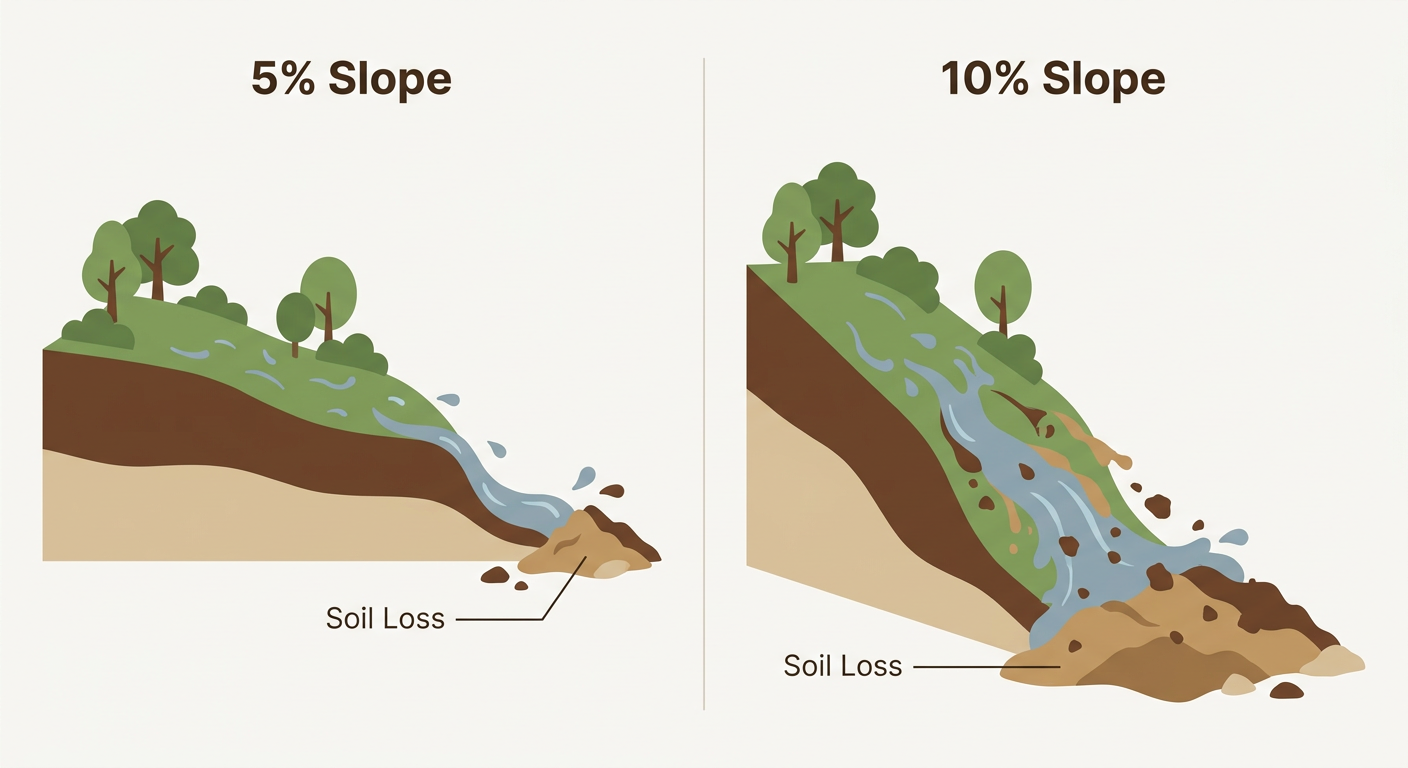
Gravity plus water plus loose material equals erosion. On flat ground, aggregate and soil stay relatively stable because friction holds particles in place. On slopes, gravity constantly pulls material downhill. Add rainwater—which both lubricates soil particles and adds kinetic energy through impact—and you get accelerating erosion.
According to the USDA Natural Resources Conservation Service, soil erosion rates increase exponentially with slope steepness. A 10% slope erodes roughly four times faster than a 5% slope under identical rainfall conditions.
The three core failure causes that Backyard Bases identifies in all ground stabilization failures apply directly to slopes:
- Weak or saturated subgrade: Rainwater infiltrates the slope, saturating soil and reducing friction between particles
- No lateral confinement: Loose gravel, topsoil, and mulch have nothing holding them in place against gravity’s constant pull
- No water management: Uncontrolled surface runoff concentrates into channels, carving deeper rills with each storm
Why Typical DIY Fixes Fail
Adding more gravel to a slope is like pouring sand into a funnel—it flows right through. Re-grading temporarily smooths the surface but doesn’t address the lack of confinement. Even planting grass often fails on steep slopes because erosion removes soil faster than roots can establish.
Concrete and retaining walls work but require significant investment, heavy equipment, and often professional installation. For most homeowners, these solutions are overkill for stabilizing a backyard slope.
How Geocell Stops Slope Erosion Permanently
Geocell technology solves the confinement problem directly. Instead of hoping loose material will stay put, you give it a structure that physically prevents lateral movement.
The Engineering Principle
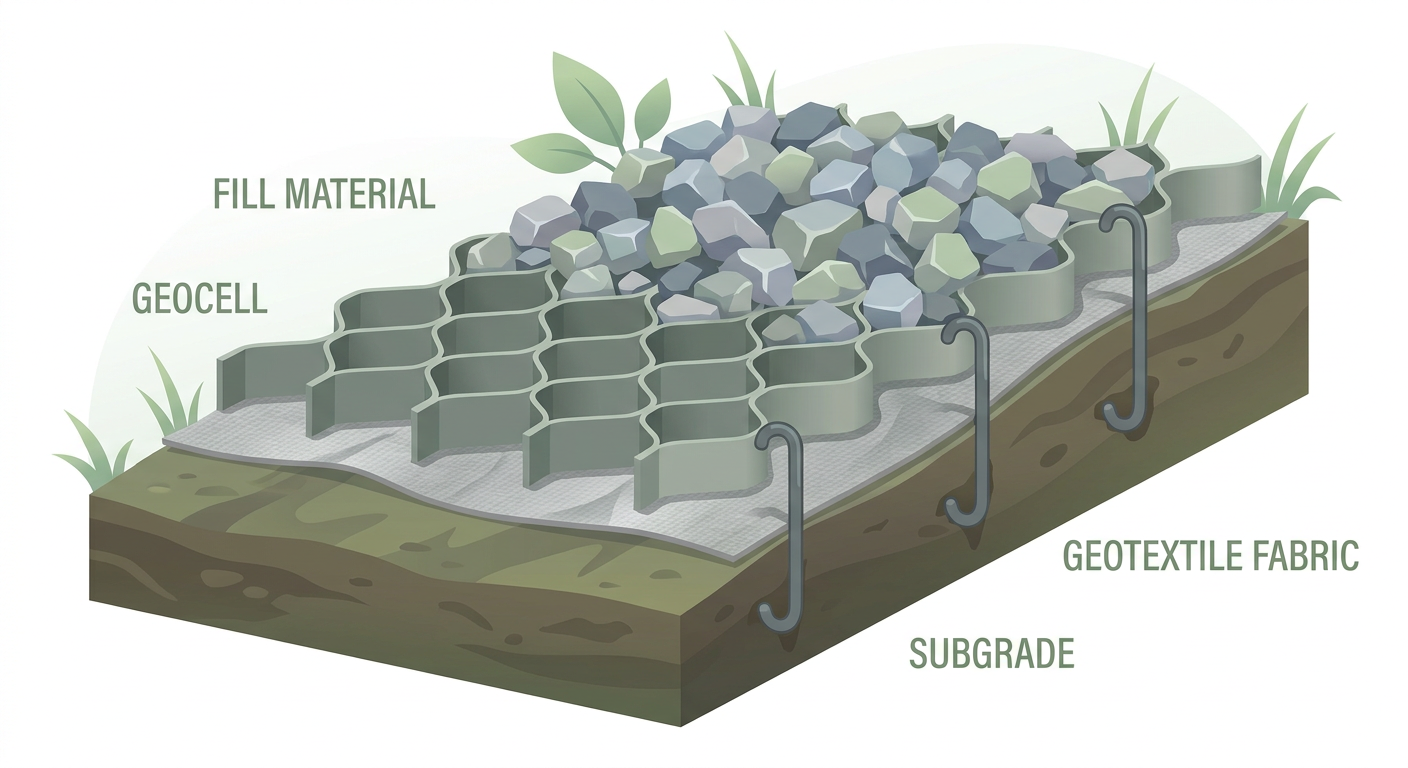
BaseCore™ geocells create a honeycomb grid of interconnected cells that expand across your slope. When you fill these cells with gravel, soil, or aggregate, each cell becomes a confined unit. Material can’t migrate sideways because the cell walls block it. Material can’t slide downhill because it’s locked into the grid structure.
Think of it like an egg carton laid on your slope. Each compartment holds its contents independently, and the entire structure stays anchored to the subgrade. The geocell erosion control approach works because it addresses the root cause—lack of confinement—rather than just adding more loose material.
Why BaseCore Works on Slopes
The BaseCore™ system brings several advantages to slope stabilization:
- Cellular confinement: Each cell locks fill material in place against both gravity and water flow
- Permeable design: Water drains through the system instead of pooling and saturating the subgrade
- Flexible structure: The grid conforms to irregular slope contours without rigid forms
- Anchoring capability: Stakes driven through the grid anchor the entire system to the subgrade
For moderate slopes (up to 30%), the standard BaseCore™ line provides sufficient confinement. For steeper grades, heavy traffic areas, or unstable soils, BaseCore HD™ offers thicker cell walls and higher load capacity.
Choosing the Right Geocell Depth
Geocell depth depends on your slope’s steepness and intended use:
- 2-inch cells: Light erosion control, pedestrian paths, garden terracing on gentle slopes (under 15%)
- 3-inch cells: Moderate slopes (15–30%), light vehicle access, general hillside stabilization
- 4-inch cells: Steep slopes (30–45%), vehicle traffic, areas with heavy runoff
The Backyard Bases foundation calculator helps you determine material quantities once you’ve measured your slope dimensions.
Ready to stabilize your sloped yard? Shop BaseCore™ geocell kits at Backyard Bases or call 888-897-2224 for sizing help on your specific slope.
Step-by-Step: Installing Geocell on a Sloped Yard
This installation guide covers a typical residential slope stabilization project. Most homeowners complete a 200–400 square foot slope in a single weekend without heavy equipment.
Tools and Materials Needed
Tools:
- Flat shovel and rake
- Utility knife or heavy scissors (for trimming geocell)
- Rubber mallet
- Tape measure
- String line and stakes (for establishing grade)
- Wheelbarrow
- Hand tamper or plate compactor (rental recommended for larger projects)
Materials from Backyard Bases:
- BaseCore™ or BaseCore HD™ geocell panels (sized to your project)
- Geotextile fabric (to separate subgrade from fill and prevent soil migration)
- Ground stakes (included with BaseCore kits)
Fill material: Crushed angular gravel (3/8″ to 3/4″) works best. You’ll need approximately 1 ton per 50 square feet at 3-inch depth. For vegetated slopes, use a soil-gravel mix or topsoil in the upper portion of each cell.
Step 1: Prepare the Slope (2–4 hours)
Remove existing loose material, debris, and vegetation from the slope surface. You’re not trying to change the grade—just create a stable, consistent surface for the geocell.
If the slope has active erosion channels deeper than 2 inches, fill them with compacted soil or gravel before proceeding. The goal is a reasonably smooth surface without major voids.
Install any necessary drainage features at this stage. On slopes with significant water flow, a French drain or swale at the top of the slope diverts water before it reaches your stabilized area.
Step 2: Install Geotextile Fabric (30–60 minutes)
Roll out geotextile fabric across the entire slope, overlapping seams by 6 inches. The fabric serves two critical functions: it prevents subgrade soil from migrating up into your fill material, and it provides additional friction between the geocell system and the underlying slope.
On steep slopes, use landscape staples every 3 feet to hold the fabric in place while you work.
Step 3: Position and Expand the Geocell (30–60 minutes)
Start at the bottom of the slope and work uphill. This lets each row anchor the row above it.
Expand the collapsed BaseCore™ panel to its full dimensions and position it on the slope. The panels arrive compressed—simply pull the ends apart to expand into the honeycomb structure.
Drive anchor stakes through the geocell walls into the subgrade. On slopes, increase stake density compared to flat installations: one stake per 2–3 square feet provides solid anchoring against gravity’s pull.
Continue expanding and staking panels, connecting them using the included clips or by overlapping cells. The geocell installation manual shows exact connection methods.
Step 4: Fill the Cells (2–4 hours depending on area)
Shovel or wheelbarrow fill material into the expanded cells. Overfill each cell by approximately 1 inch—the material will settle during compaction.
For slopes, fill from bottom to top in rows. This prevents material from the upper cells from spilling into lower cells during the filling process.
Fill material options:
- Crushed gravel: Best for driveways, paths, and heavy-use areas. Angular stone locks together better than rounded river rock.
- Topsoil/grass seed: For vegetated slopes, fill the lower 2/3 of each cell with gravel for drainage, then top with soil and seed. Grass roots will eventually grow through the cell walls, adding biological reinforcement.
- Decorative stone: For visible landscaping areas. The geocell keeps decorative material from migrating downhill.
Step 5: Compact and Finish (1–2 hours)
Compact the filled cells using a hand tamper or plate compactor. Work from the bottom of the slope upward. Compaction is critical—loose fill within cells can still shift and settle over time.
After compaction, add additional fill to any cells that have settled below the cell wall tops. The finished surface should be level with or slightly above the cell walls.
If using steel landscape edging at the slope boundaries, install it now to create clean transitions to adjacent areas.
Common Mistakes to Avoid
- Starting at the top: Work bottom-to-top so each row anchors the row above
- Under-staking: Slopes need more anchors than flat installations—don’t skimp
- Skipping geotextile: Without fabric separation, subgrade soil migrates into your fill and weakens the system
- Using rounded gravel: River rock rolls; angular crushed stone locks together
- Insufficient compaction: Loose fill settles unevenly and creates low spots that collect water
Time Estimate
A typical 200-square-foot slope takes 6–8 hours total for one person, or 4–5 hours with a helper. Larger slopes or steeper grades may require a full weekend. The most time-consuming step is usually filling and compacting—budget accordingly.
Can Geocell Be Used on Steep Hillsides?
Yes, geocell systems effectively stabilize slopes up to approximately 45 degrees (100% grade) when properly installed with adequate anchoring. The cellular confinement structure resists gravity’s pull by locking fill material into place, and ground stakes anchor the entire system to the subgrade.
For slopes steeper than 30 degrees, use BaseCore HD™ with 4-inch cell depth and increase stake density to one anchor per 1.5–2 square feet. Very steep or unstable slopes may benefit from professional geotechnical consultation before installation.
What Fill Material Works Best in Geocells on Slopes?
Angular crushed gravel in the 3/8-inch to 3/4-inch range provides the best combination of drainage, compaction, and interlocking stability for sloped geocell installations. The angular edges lock together under compaction, creating a unified mass that resists movement even on grades.
Avoid rounded river rock, which rolls and shifts within cells. For vegetated slopes where you want grass coverage, use angular gravel in the lower two-thirds of each cell for drainage, then top with quality topsoil and appropriate seed mix. The grass driveway guide covers vegetation establishment over geocell in detail.
How Does Geocell Compare to Retaining Walls for Erosion Control?
Geocell costs significantly less than retaining walls, requires no heavy equipment or concrete work, and can be installed by homeowners in a weekend rather than requiring professional contractors. While retaining walls are necessary for vertical grade changes or structural loads, most residential slope stabilization projects work effectively with geocell alone.
The geocell vs. traditional approaches comparison shows typical cost savings of 40–60% compared to concrete or block retaining walls for equivalent slope coverage. Geocell also maintains permeability—water drains through rather than building pressure behind a wall.
Conclusion
Hillside erosion isn’t inevitable—it’s a solvable engineering problem. BaseCore™ geocell addresses the root cause by confining fill material in a honeycomb structure that resists both gravity and water flow. Unlike loose gravel or topsoil that washes away with every rain, a properly installed geocell system creates a stable, permeable surface that lasts for years without maintenance.
Stop fighting erosion season after season. Order your BaseCore™ geocell kit at backyardbases.com and stabilize your sloped yard this weekend.
Frequently Asked Questions
How thick should geocell be for slope stabilization?
For gentle slopes under 15%, 2-inch BaseCore™ cells provide adequate stabilization. Moderate slopes (15–30%) typically require 3-inch cells. Steep slopes over 30% or areas with vehicle traffic benefit from 4-inch cells for maximum confinement and load distribution.
Can you install geocell on a slope yourself?
Yes, geocell installation is a straightforward DIY project. Most homeowners complete a 200–400 square foot slope in 6–8 hours without heavy equipment. The BaseCore™ system arrives compressed and expands on-site—you simply stake, fill, and compact.
What angle slope can geocell handle?
Properly installed geocell systems stabilize slopes up to approximately 45 degrees (100% grade). Steeper slopes require increased stake density and deeper cell profiles. BaseCore HD™ with 4-inch cells provides maximum stability for challenging grades.
Is geocell better than riprap for erosion control?
Geocell offers advantages over riprap for most residential slopes: lower material cost, easier installation, and a more finished appearance. Unlike heavy riprap that requires equipment to place, geocell panels expand by hand and fill with standard gravel or soil.
How long does geocell last on slopes?
High-density polyethylene geocell like BaseCore™ resists UV degradation and maintains structural integrity for decades. The material won’t rot, rust, or decompose. With proper installation and quality fill, a geocell slope system provides permanent stabilization without ongoing maintenance.
This article is for informational purposes only. The guidance provided reflects Backyard Bases’ product documentation, published build guides, and general ground stabilization principles. Soil conditions, climate, drainage, and load requirements vary by property—consult Backyard Bases or a qualified contractor for site-specific recommendations. For current product information, sizing help, and pricing, visit backyardbases.com or call 888-897-2224.
