
The average homeowner watches their carport settle, crack, or turn into a mud pit within 3–5 years of installation. Whether you poured concrete that developed fractures or spread gravel that migrated into your lawn, the frustration is the same: money spent on a foundation that didn’t last.
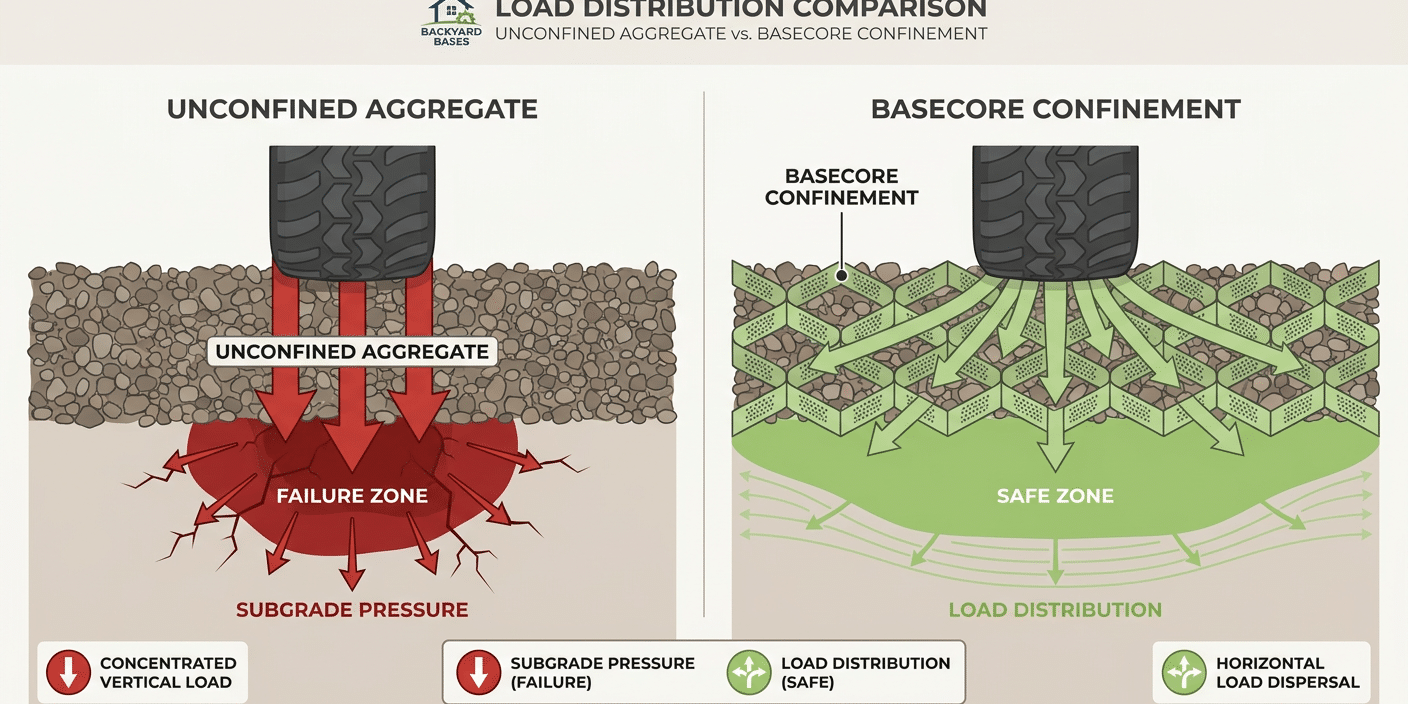
A carport base grid system solves this by locking aggregate into a honeycomb structure that distributes vehicle weight evenly, prevents gravel migration, and allows rainwater to drain naturally—eliminating the three root causes of carport foundation failure. This cellular confinement approach creates a permanent, load-bearing surface you can install yourself in a single weekend without pouring concrete or renting heavy equipment.
In this guide, you’ll learn why carport foundations fail, how geocell ground grid technology from Backyard Bases prevents those failures, and the exact steps to build a permanent carport base that handles daily vehicle traffic for decades.
Why Carport Foundations Fail (And Keep Failing)
If you’ve ever parked on a gravel carport pad and watched your tires sink deeper each month, you’ve experienced the most common carport foundation failure. But what you’re seeing on the surface—ruts, puddles, spreading gravel—traces back to three engineering problems happening underground.
Weak or Saturated Subgrade
Your native soil compresses unevenly under the weight of a vehicle. Clay soils hold water and turn soft; sandy soils shift and settle. When rain saturates the ground beneath your carport, a 4,000-pound vehicle creates localized pressure points that push soil aside, forming the depressions you see as tire ruts.
No Lateral Confinement
Loose gravel has nothing holding it in place. Every time you drive onto your carport, your tires push aggregate sideways. Over months, this lateral migration moves gravel from the center of your pad to the edges—and eventually into your yard. Adding more gravel only delays the problem; it doesn’t solve it.
No Water Management
Concrete carport pads shed water to the edges, creating drainage problems at the perimeter. But they also crack when that water freezes and expands underneath. Loose gravel drains well initially, but once ruts form, water pools in the low spots, accelerating subgrade saturation and making the foundation even weaker.
The typical DIY fix—adding more gravel, regrading the surface, or patching concrete cracks—addresses symptoms without solving root causes. That’s why homeowners find themselves repeating the same maintenance every year or two. For a deeper look at these patterns, see carport foundation ideas that address root causes rather than symptoms.
How Geocell Grid Systems Create Permanent Carport Foundations
A BaseCore™ geocell grid system addresses all three failure causes in a single installation layer. Here’s how the engineering works in plain terms:
Cellular Confinement Locks Aggregate in Place
BaseCore™ grids expand into a honeycomb pattern of interconnected cells. When you fill these cells with gravel, each cell becomes a mini-column of confined aggregate. Your tires press down on these columns, but the cell walls prevent the gravel from migrating sideways. The aggregate stays exactly where you put it—year after year, regardless of traffic.
Load Distribution Protects Your Subgrade
Instead of concentrating vehicle weight at two tire contact points, the geocell structure spreads that load across the entire grid surface. A 4,000-pound vehicle creates roughly 30 PSI at each tire contact patch on loose gravel. The same vehicle on a geocell-confined base distributes that pressure across hundreds of cells, reducing point loading on your subgrade to a fraction of what it would otherwise be.
Permeability Eliminates Standing Water
Unlike concrete, geocell grids allow rainwater to drain straight through the aggregate and into the soil below. There’s no surface runoff to manage, no edge drainage required, and no pooling water to saturate your subgrade. This permeable design also means no freeze-thaw damage—water doesn’t collect where it can expand and crack your foundation.
For carport applications handling daily vehicle traffic, BaseCore HD™ geocells in 3″ or 4″ depth provide the load-bearing capacity needed. The HD version uses thicker cell walls designed specifically for vehicular loads—standard BaseCore™ works for pedestrian traffic and lighter structures like sheds, but carports need the heavy-duty option.
Ready to build your permanent carport foundation? Shop BaseCore HD™ kits at backyardbases.com or call 888-897-2224 for sizing help with your specific project.
Step-by-Step: How to Build a Carport Base Grid Foundation
This installation covers a typical single-vehicle carport pad (12′ × 20′ = 240 square feet). Adjust quantities proportionally for larger projects. Most homeowners complete this project in 6–8 hours with basic tools.
Tools and Materials You’ll Need
- BaseCore HD™ geocell panels (3″ or 4″ depth) — quantity based on your square footage
- Geotextile fabric — extends 6″ beyond grid edges on all sides
- BaseEdge HD steel edging — perimeter linear feet plus 10% for cuts
- Crushed angular gravel (¾″ minus or #57 stone) — approximately 1 ton per 80 square feet at 3″ depth
- Landscape stakes or ground staples
- Shovel and rake
- Plate compactor (rental) or hand tamper for smaller areas
- Utility knife or snips for trimming panels
- Tape measure and string line
Step 1: Clear and Level the Site
Remove all vegetation, roots, and organic material from the carport footprint plus 12″ on each side. Grade the area to remove high spots—you want a roughly level surface, though geocells can accommodate up to 10% slope for drainage. For soft or clay-heavy soil, excavate 2–4″ deeper to allow for a compacted base layer.
Step 2: Install Geotextile Fabric
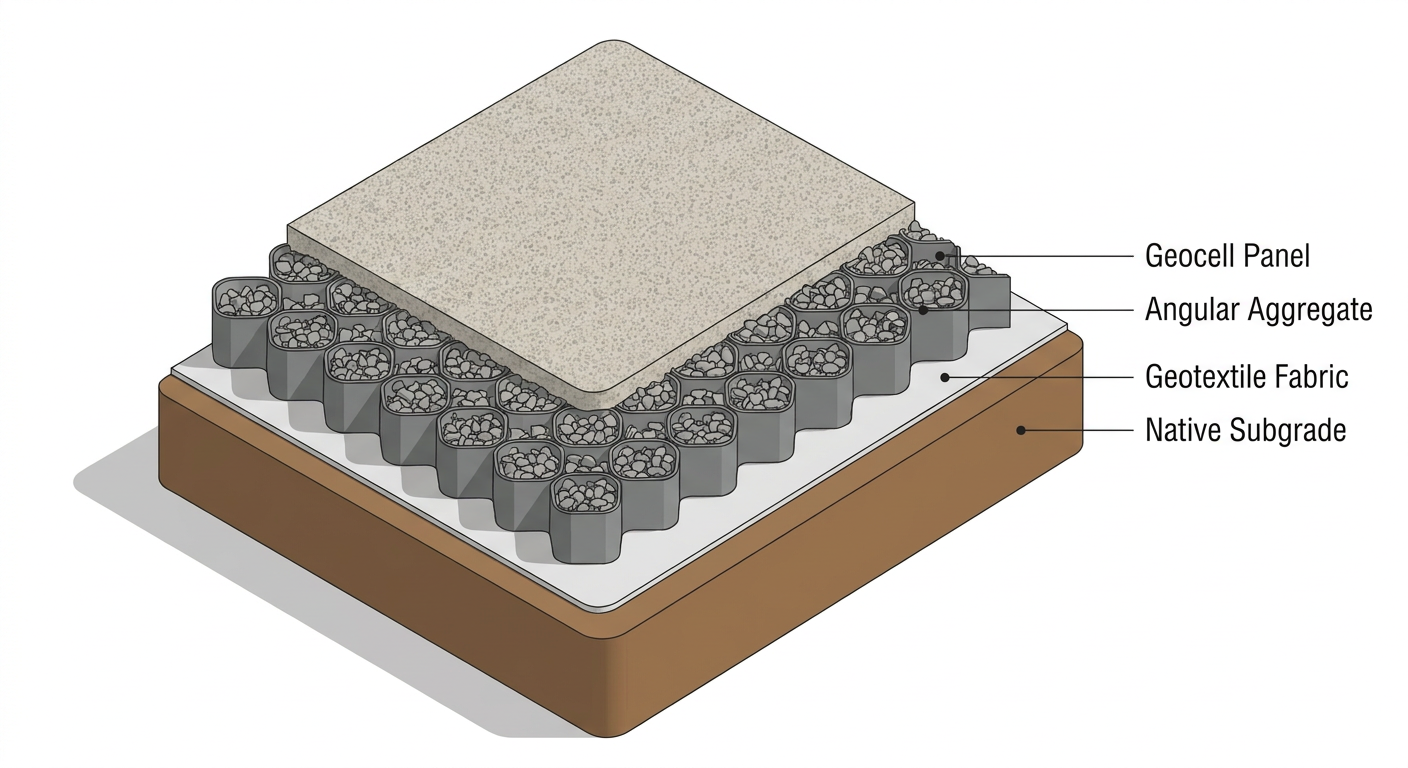
Roll out geotextile fabric across the entire area, overlapping seams by 6″ minimum. This layer separates your aggregate from the native soil below, preventing fine particles from migrating upward into your gravel and weakening the base. Extend fabric 6″ past your intended grid edge—you’ll trim it after edging installation.
Step 3: Set Your Edging
Install steel landscape edging around the perimeter to contain the geocell panels and aggregate. Drive stakes every 3′ and at all corners. The edging should sit at the height of your finished gravel surface—typically 3–4″ above the geotextile.
Step 4: Expand and Place Geocell Panels
Remove BaseCore HD™ panels from packaging and expand each one to its full honeycomb shape. Place panels inside the edging, connecting adjacent panels with the integrated clips. Stagger seams like brickwork for maximum stability. Trim edge panels to fit using a utility knife—the HDPE material cuts easily.
Step 5: Fill Cells with Angular Gravel
Shovel or wheelbarrow crushed angular gravel into the cells, overfilling slightly to account for compaction. Use ¾″ minus or #57 stone—angular edges lock together better than rounded river rock. For a 3″ geocell, fill to approximately 3.5″ before compaction. Rake the surface roughly level.
Step 6: Compact and Top Off
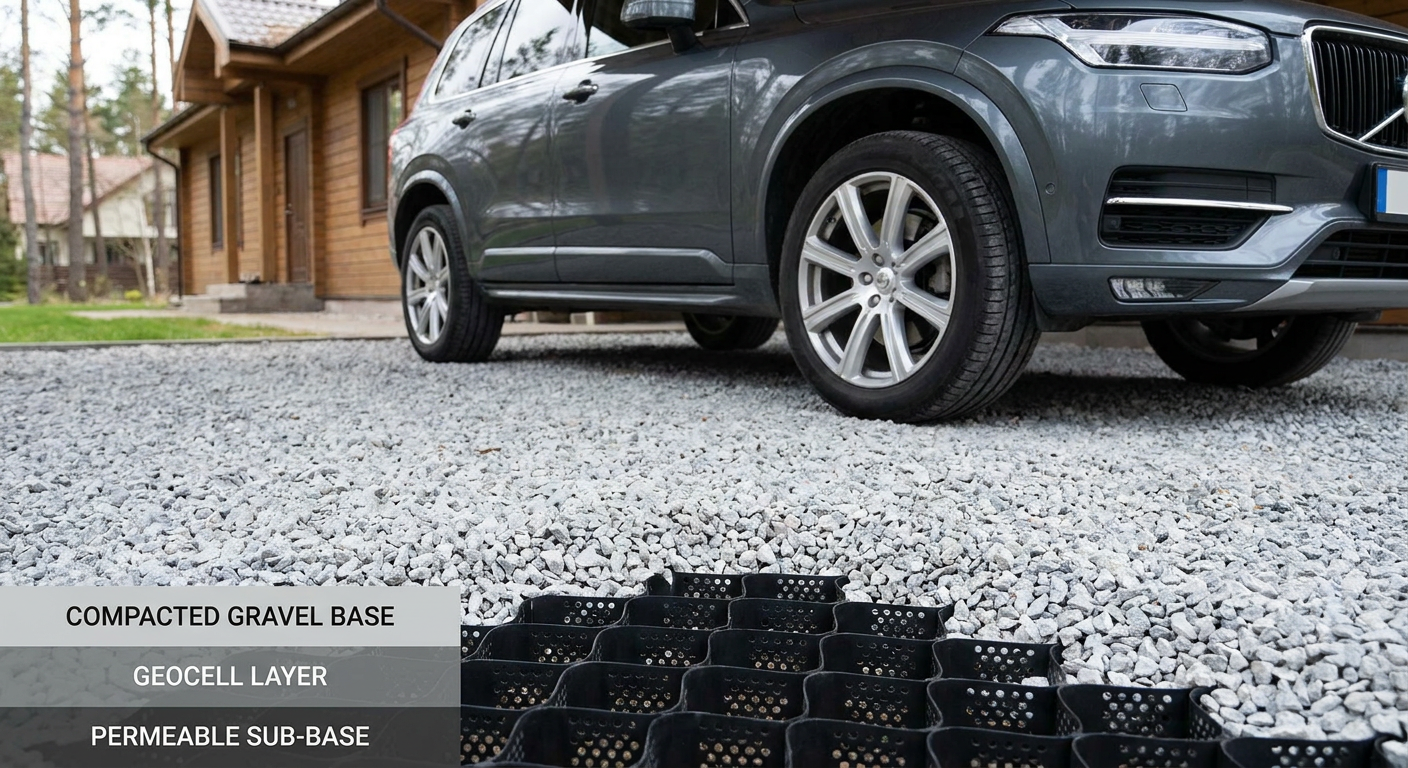
Run a plate compactor across the entire surface, making two passes in perpendicular directions. This forces aggregate into cell corners and eliminates air pockets. After compaction, add additional gravel to bring the surface level with or slightly above the cell walls, then compact again. Your finished surface should show minimal cell wall visibility.
Common Mistakes to Avoid
Skipping the geotextile layer allows soil to contaminate your aggregate over time, reducing drainage and stability. Using rounded gravel instead of angular stone means aggregate won’t lock together under compaction—you’ll see more surface migration. Under-filling cells leaves the honeycomb structure exposed to UV degradation and direct tire wear.
For visual examples of completed carport foundations, browse the Backyard Bases project gallery to see how other homeowners have executed similar installations.
How Thick Should a Geocell Carport Base Be?
Geocell depth for carport applications depends on vehicle weight and traffic frequency. For standard passenger vehicles (sedans, SUVs, light trucks under 6,000 lbs), 3″ BaseCore HD™ provides adequate load distribution across stable subgrades. If you’re parking heavier vehicles, using the carport for an RV, or working with soft clay soil, step up to 4″ depth for additional bearing capacity.
The 4″ option also makes sense for carports in regions with severe freeze-thaw cycles, as the deeper aggregate layer provides more insulation and drainage capacity. See the complete carport building guide for depth recommendations based on specific vehicle types.
Is a Geocell Carport Base Better Than Concrete?
Concrete costs $6–$12 per square foot installed professionally, requires forms, curing time, and often cracks within 5–10 years in freeze-thaw climates. A geocell carport base costs significantly less in materials, installs in a single weekend with no professional labor, and won’t crack because there’s no rigid surface to fracture.
Concrete also creates impermeable surfaces that require drainage solutions—gutters, French drains, or sloped edges to redirect runoff. Geocell bases are fully permeable, eliminating drainage engineering and reducing stormwater management requirements. For homeowners comparing these options, the concrete alternative guide breaks down the long-term cost and maintenance differences.
Can You Build a Carport Base Grid on a Slope?
Geocell systems can accommodate slopes up to 10% (roughly 1″ of drop per foot of run) without special modifications. For steeper grades, terracing with multiple grid levels or consulting a grading professional is recommended. The cellular structure actually provides erosion resistance on sloped surfaces—cells prevent aggregate from washing downhill during heavy rain, which is a common problem with loose gravel on inclines.
If your carport site has drainage issues beyond simple slope, review driveway drainage solutions for techniques that integrate with geocell installations.
Conclusion
A carport base grid system eliminates the three engineering failures that cause conventional foundations to deteriorate: weak subgrade, lateral aggregate migration, and poor drainage. By confining gravel in a honeycomb structure, distributing vehicle loads across hundreds of cells, and allowing rainwater to drain naturally, BaseCore HD™ creates a permanent foundation you install once and never rebuild.
Build your permanent carport foundation this weekend. Order your BaseCore HD™ kit at backyardbases.com or call 888-897-2224 for help sizing your project.
Frequently Asked Questions
How much gravel do I need for a geocell carport base?
For a 3″ BaseCore HD™ installation, plan approximately 1 ton of crushed angular gravel per 80 square feet of carport area. A standard 12′ × 20′ single-vehicle carport requires roughly 3 tons. Order 10% extra to account for compaction and overfill.
What size geocell should I use for a carport?
BaseCore HD™ in 3″ or 4″ depth handles standard passenger vehicle traffic. Choose 3″ for cars and light trucks on stable soil; upgrade to 4″ for heavier vehicles, RVs, soft subgrades, or severe freeze-thaw climates where deeper aggregate provides better insulation.
How long does a geocell carport foundation last?
BaseCore™ geocells are manufactured from UV-stabilized HDPE designed for decades of outdoor use. With proper installation and adequate gravel cover to protect cell walls from direct UV exposure, expect 25+ years of service without rebuilding or significant maintenance.
Can I install a carport base grid myself without professional help?
Yes—geocell installation is specifically designed for DIY homeowners. Basic tools (shovel, rake, utility knife) and a rented plate compactor are all you need. Most single-vehicle carport pads take 6–8 hours to complete. The geocell installation manual provides detailed guidance.
Is a geocell carport base cheaper than pouring concrete?
Geocell carport foundations typically cost 40–60% less than poured concrete when you factor in materials, labor, and equipment. Concrete requires professional installation, forms, and curing time; geocell installs in one weekend with no special skills. Long-term savings increase further since geocells don’t crack or require sealing.
This article is for informational purposes only. The guidance provided reflects Backyard Bases’ product documentation, published build guides, and general ground stabilization principles. Soil conditions, climate, drainage, and load requirements vary by property—consult Backyard Bases or a qualified contractor for site-specific recommendations. For current product information, sizing help, and pricing, visit backyardbases.com or call 888-897-2224.
