

Every year, homeowners across the United States spend hundreds of dollars fighting the same backyard battles: gravel driveways that rut and scatter, shed foundations that sink unevenly, and patios that erode into muddy messes after heavy rain. The frustration isn’t just financial—it’s the lost weekends spent re-grading surfaces that fail again within months.
A cellular confinement system solves these problems by locking fill material into a honeycomb-like grid of interconnected cells, preventing lateral movement, distributing weight evenly across the subgrade, and allowing water to drain through rather than pool on the surface. This engineering approach—originally developed for military road construction—is now available to DIY homeowners through products like BaseCore™ geocell ground grids, creating foundations that resist the three core failure causes behind most backyard project disasters.
This guide explains exactly how cellular confinement systems work, the specific benefits they deliver for residential landscapes, and how to choose the right geocell solution for sheds, driveways, carports, and other backyard projects.
Why Traditional Backyard Foundations Fail
Before understanding the benefits of cellular confinement, you need to understand what causes the problems it solves. When a gravel driveway develops ruts, a shed starts leaning, or a patio surface erodes, the visible damage traces back to one or more of three engineering root causes.
Weak or Saturated Subgrade
The native soil beneath your project compresses unevenly under load or turns to mud when water saturates it. Clay soils are particularly problematic—they expand when wet and shrink when dry, creating a foundation that literally moves with the seasons. According to the USDA Natural Resources Conservation Service, soil bearing capacity can drop by 50% or more when saturated, explaining why projects that seemed stable in summer fail during spring thaw.
No Lateral Confinement
Loose aggregate—whether gravel, crushed stone, or decomposed granite—migrates sideways under pressure. When your car tires push down on a gravel driveway, the stones have nowhere to go but out. Over time, this creates ruts in high-traffic areas and gravel berms along the edges. The same principle sinks shed corners: without confinement, the foundation material shifts away from concentrated load points.
No Water Management
Surface water that can’t drain through a foundation pools on top, erodes edges, and freezes in winter. Traditional solutions like concrete actually make this worse by creating impermeable surfaces that redirect water toward landscaping, basement walls, and property boundaries. The Penn State Extension notes that impervious surfaces contribute to localized flooding and accelerate erosion in adjacent areas.
Most DIY fixes—adding more gravel, re-compacting, pouring concrete patches—address symptoms without solving root causes. The gravel migrates again. The concrete cracks at expansion joints. The cycle repeats. Understanding this failure pattern is essential to appreciating why cellular confinement technology works where other approaches don’t.
How Cellular Confinement Systems Work
A cellular confinement system consists of interconnected cells—typically made from high-density polyethylene (HDPE)—that expand into a honeycomb-like grid when deployed. You fill each cell with aggregate, soil, or other material, and the cell walls prevent that fill from moving laterally under load.
The engineering principle is straightforward: when a vehicle tire or heavy structure presses down on a single point, the load spreads across multiple cells rather than concentrating in one spot. The confined aggregate in each cell resists sideways movement, creating a semi-rigid surface that acts more like a solid slab than loose gravel—but with drainage that concrete can’t match.
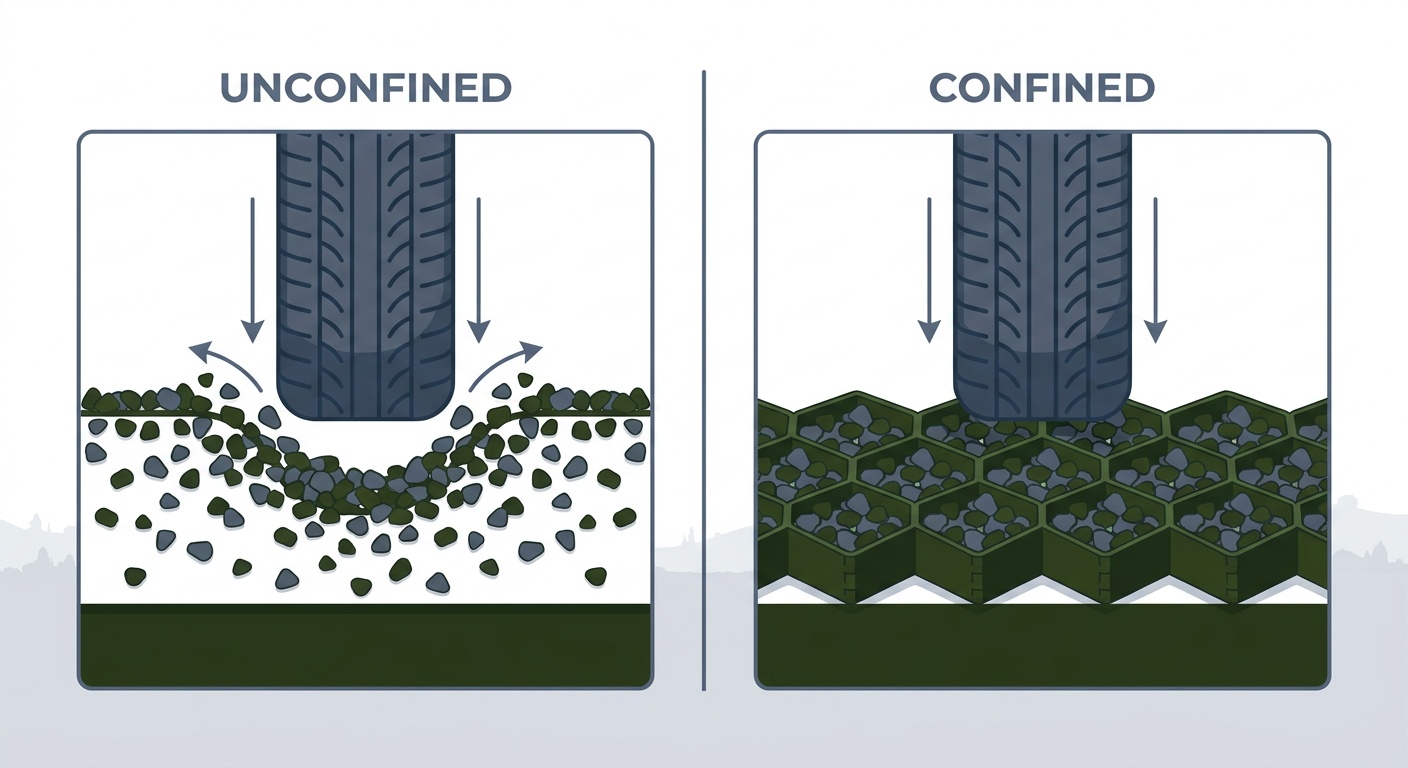
Cellular confinement prevents lateral movement, stopping the ruts and shifting common in loose gravel.
BaseCore™ and BaseCore HD™ geocells from Backyard Bases use this same technology in a DIY-friendly format. The panels arrive folded flat, expand to cover your project area, and accept gravel, crushed stone, or even grass plugs depending on your application. Cell depths range from 2 inches for pedestrian-traffic applications to 6 inches for heavy commercial loads.
The Three-System Approach
Maximum stability comes from combining three components. First, geotextile fabric separates your aggregate from native soil, preventing mixing and weed growth while allowing water to pass through. Second, the geocell grid itself confines your fill material. Third, steel edging at project borders prevents edge migration and creates clean visual lines.
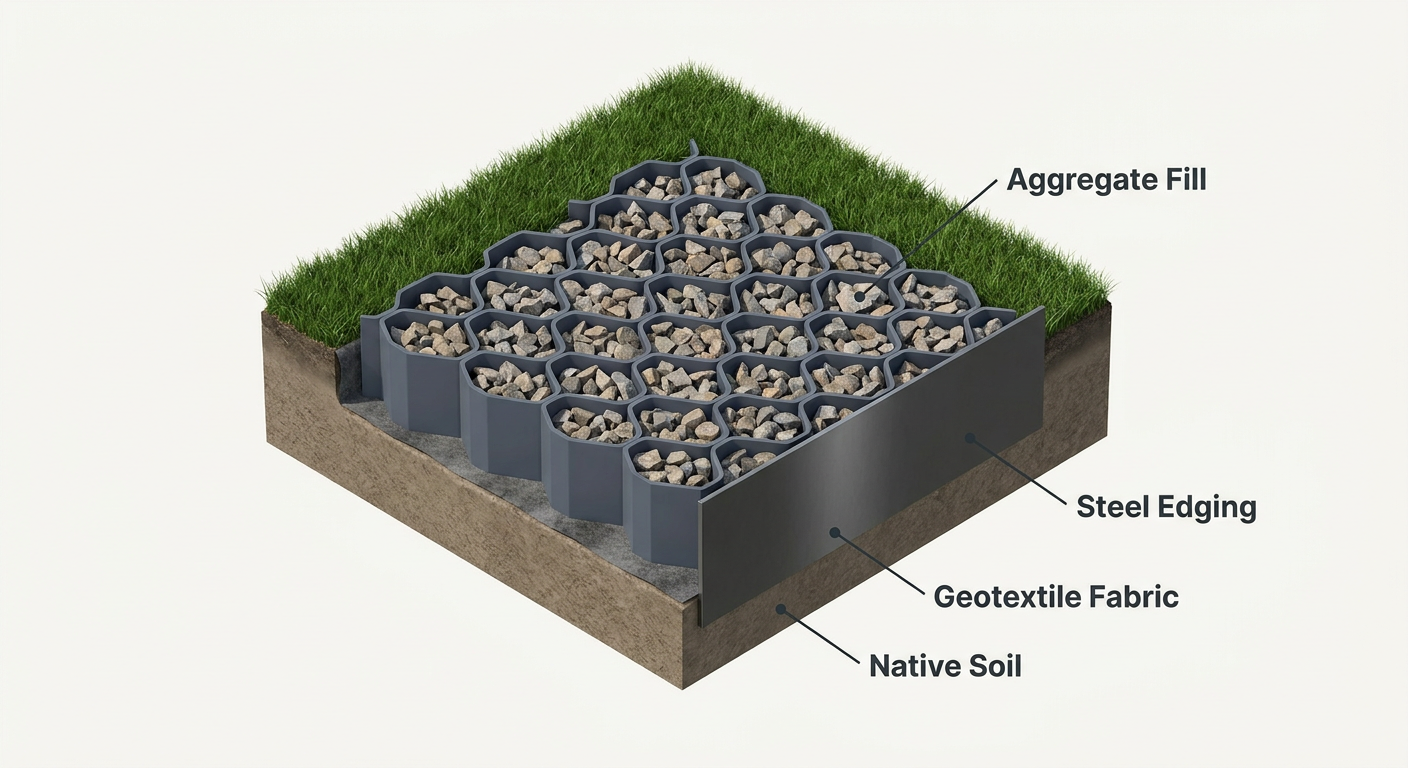
A layered view of how geocells, geotextile fabric, and aggregate work together to form a stable foundation.
This system addresses all three root failure causes simultaneously: the geotextile stabilizes weak subgrade, the geocell provides lateral confinement, and the permeable design handles water management naturally.
Ready to build a foundation that actually lasts? Explore BaseCore™ geocell kits at backyardbases.com/order-now or call 888-897-2224 for help sizing your project.
7 Key Benefits of Cellular Confinement Systems for Homeowners
The engineering principles translate into practical advantages that matter for weekend DIY projects and long-term property value.
1. Eliminates Gravel Migration and Rutting
The most immediate benefit homeowners notice is the end of gravel scatter. Each cell wall acts as a barrier, keeping aggregate exactly where you placed it. Driveways stay smooth instead of developing tire ruts. Pathways maintain their surface instead of shedding gravel onto adjacent lawns. The BaseCore geocell driveway system locks gravel in place so thoroughly that many homeowners report zero maintenance for years after installation.
2. Distributes Load to Prevent Sinking
When concentrated weight—a car tire, a shed corner, a hot tub leg—presses down on one point, the cellular structure spreads that load across a wider area of subgrade. This load distribution is why a properly installed geocell foundation can support heavy structures on soil that would cause bare gravel to sink. For shed foundations, this means no more seasonal releveling or corner shimming.
3. Allows Full Water Permeability
Unlike concrete, asphalt, or traditional pavers, cellular confinement systems let rainwater drain straight through into the soil below. This permeability prevents surface pooling, reduces erosion at project edges, and eliminates the freeze-thaw cycle damage that cracks rigid surfaces. For homeowners in areas with stormwater regulations, permeable foundations may also help meet impervious surface limits—worth confirming with local building departments.
4. Reduces Material Requirements
Confined aggregate performs better than unconfined aggregate at the same depth. In practical terms, this means you can often use less total gravel while achieving equal or better load-bearing capacity. A 3-inch BaseCore HD™ installation with crushed stone can match or exceed the performance of a 6-inch loose gravel base, cutting material costs and delivery weight significantly.
5. Enables True DIY Installation
Cellular confinement systems require no heavy equipment, no wet concrete work, and no specialized skills. The installation process involves clearing and leveling your site, laying geotextile fabric, expanding the geocell panels, staking them in place, filling with aggregate, and compacting. Most residential projects—parking pads, shed bases, patio foundations—complete in a single weekend with basic hand tools.
6. Works Across Multiple Applications
The same technology that stabilizes a driveway also works for carport foundations, hot tub pads, gazebo bases, and farm applications like paddock footing and equipment storage areas. You’re not learning a new system for each project—the core technique stays consistent while cell depth and fill material adjust to match load requirements.
7. Provides Long-Term Cost Savings
The upfront cost of a geocell system typically runs higher than loose gravel alone but lower than poured concrete. The real savings come from reduced maintenance: no annual re-grading, no gravel replenishment, no crack repair, no releveling. Over a 10-year span, a geocell foundation that requires zero maintenance often costs less total than a “cheaper” loose gravel base that needs attention every year or two.
How to Install a Cellular Confinement Foundation: Step-by-Step
The following steps apply to most residential geocell projects. Adjust cell depth based on your specific application—2 inches for pedestrian traffic and light structures, 3–4 inches for vehicle traffic, 6 inches for heavy commercial loads.
Tools needed: shovel or flat spade, rake, wheelbarrow, stakes (included with BaseCore kits), utility knife, plate compactor (rental), tape measure, string line, and safety glasses.
Materials needed: BaseCore™ or BaseCore HD™ geocell panels, geotextile fabric, crushed stone or angular gravel (3/4-inch minus works well for most applications), and optional steel edging for borders.
Step 1: Excavate and Level the Site
Remove grass, roots, and topsoil to the depth of your geocell plus 1–2 inches for the base layer. For a 3-inch BaseCore HD™ driveway, excavate approximately 4–5 inches total. Use a string line and level to check for high and low spots. Compact the exposed subgrade with a plate compactor—this step is critical for preventing settlement.
Step 2: Install Geotextile Fabric
Roll out geotextile fabric across the entire excavated area, overlapping seams by 6 inches. The fabric separates your aggregate from native soil, preventing contamination that weakens the base over time. Extend the fabric 6 inches beyond your project borders—you’ll trim it after installing edging.
Step 3: Expand and Position Geocell Panels
Pull the compressed geocell panels apart to their full expanded size. Position them across your project area, butting panels together without gaps. Use the included stakes to anchor the grid at corners and along edges. For larger projects, BaseClips connect adjacent panels into a continuous grid.
Step 4: Fill Cells with Aggregate
Shovel or wheelbarrow crushed stone into each cell, slightly overfilling. Angular stone (crushed gravel, limestone, or granite) locks together better than round river rock. Fill all cells before compacting—this ensures even settlement.
Step 5: Compact the Surface
Make two or three passes with a plate compactor over the entire surface. The aggregate will settle into the cells, creating a firm, level surface. Add more stone to any low spots and re-compact. Final surface should be flush with or slightly above the cell walls.
Step 6: Install Edge Treatment (Optional but Recommended)
For driveways and parking areas, steel landscape edging at the borders prevents edge migration and creates clean transitions to adjacent surfaces. Stake the edging, then trim excess geotextile fabric.
Time estimate: A 10×12-foot shed pad typically takes 4–6 hours for two people. A 12×40-foot single-car driveway takes a full weekend including excavation.
Do cellular confinement systems work on slopes?
Yes—cellular confinement systems are particularly effective for sloped applications where loose material would wash away. The cell walls physically hold fill in place, and the permeable structure allows water to drain through rather than sheet across the surface. For slopes steeper than 3:1 (approximately 18 degrees), consider using deeper cells or adding intermediate anchor stakes.
Geocell erosion control applications on hillsides and embankments use this same principle at larger scales. Backyard projects like terraced garden beds, sloped pathways, and graded driveways all benefit from the stability cellular confinement provides.
Can you use geocells under pavers or concrete?
Geocells work excellently as a permeable paver base, providing drainage and load distribution beneath the finished surface. Fill cells with compacted crushed stone, then set pavers on a thin sand bedding layer above. This combination drains better than a traditional concrete-sand base while resisting the shifting that causes paver surfaces to become uneven.
For concrete pads, geocells can stabilize the subgrade before pouring—though at that point, you’re adding concrete cost to a system that performs well without it. Most homeowners choose one approach or the other based on aesthetic preference and budget.
How long do cellular confinement systems last?
High-quality HDPE geocells like BaseCore™ and BaseCore HD™ resist UV degradation and chemical exposure for decades. The panels themselves typically outlast the structures placed on them. The practical lifespan depends more on installation quality than material degradation—a properly compacted base with appropriate cell depth for the load will perform indefinitely.
Browse the Backyard Bases project gallery to see real installations across various applications and soil conditions.
Choose the Right Cellular Confinement System for Your Project
Selecting the appropriate geocell depth depends on your application’s load requirements:
| Application | Recommended Depth | Product Option |
| Walkways, garden paths, light pedestrian traffic | 2 inches | BaseCore™ 2″ |
| Shed foundations, gazebos, patio bases | 2–3 inches | BaseCore™ or BaseCore HD™ 2″–3″ |
| Residential driveways, parking pads, carports | 3–4 inches | BaseCore HD™ 3″–4″ |
| Heavy vehicle traffic, commercial parking, farm equipment | 4–6 inches | BaseCore HD™ 4″–6″ |
Soil conditions also influence your choice. Soft clay or frequently saturated ground benefits from deeper cells and a thicker aggregate layer above the geotextile. Sandy, well-draining soils may perform well with shallower systems. The foundation calculator helps estimate material quantities for your specific project dimensions.
Conclusion: Build Once, Build Right
Cellular confinement systems address the three engineering failures—weak subgrade, no lateral confinement, and poor water management—that cause most backyard projects to deteriorate within a few years. By locking aggregate into a stable grid structure, geocell foundations eliminate the annual cycle of gravel replacement, re-leveling, and frustration.
Whether you’re building a shed foundation, stabilizing a gravel driveway, or creating a parking pad that handles vehicle traffic without rutting, the benefits remain consistent: load distribution, material confinement, full permeability, and DIY-friendly installation that doesn’t require concrete trucks or specialized contractors.
Order your BaseCore™ geocell kit at backyardbases.com/order-now or call 888-897-2224 for sizing recommendations based on your specific project.
Frequently Asked Questions
What is a cellular confinement system?
A cellular confinement system is a honeycomb-like grid of interconnected cells made from high-density polyethylene (HDPE). When filled with gravel, crushed stone, or soil, the cells prevent lateral movement under load, distribute weight across a wider area, and allow water to drain through. BaseCore™ geocells are a DIY-friendly version of this technology for residential foundations.
How deep should a geocell foundation be?
Geocell depth depends on your application’s load requirements. Use 2-inch cells for walkways and light pedestrian traffic, 3–4 inches for residential driveways and carport foundations, and 4–6 inches for heavy vehicle traffic or commercial applications. Softer soils may require deeper cells for adequate support.
Can I install a cellular confinement system myself?
Yes—geocell systems are specifically designed for DIY installation with no heavy equipment or specialized skills required. The typical process involves excavating, laying geotextile fabric, expanding the panels, staking, filling with aggregate, and compacting. Most shed foundation projects complete in a single weekend.
Are geocells better than concrete for foundations?
Geocells and concrete serve different purposes. Geocell foundations are fully permeable, require no curing time, resist freeze-thaw damage, and cost less to install without professional help. Concrete provides a solid, flat surface but cracks over time and creates drainage problems. For most backyard projects, geocells offer better long-term performance with lower maintenance.
What type of gravel works best in geocell systems?
Angular crushed stone in 3/4-inch minus size works best for most geocell applications. The angular edges lock together when compacted, creating a stable surface. Avoid round river rock, which shifts more easily. For gravel driveways, crushed limestone, granite, or recycled concrete all perform well.
This article is for informational purposes only. The guidance provided reflects Backyard Bases’ product documentation, published build guides, and general ground stabilization principles. Soil conditions, climate, drainage, and load requirements vary by property—consult Backyard Bases or a qualified contractor for site-specific recommendations. For current product information, sizing help, and pricing, visit backyardbases.com or call 888-897-2224.
