

The average homeowner spends 15–25 hours per year fighting mud—spreading gravel that disappears, raking ruts, and scraping boots at the back door. If your backyard turns into a swamp every time it rains, you’re dealing with a solvable engineering problem, not just bad luck.
The most effective permanent mud control solution for backyards is a geocell ground grid system filled with gravel. Geocells are honeycomb-shaped panels that lock aggregate in place, distribute weight across a wider surface area, and allow water to drain through instead of pooling on top. Unlike loose gravel that sinks into saturated soil or concrete that cracks and blocks drainage, geocell systems like BaseCore™ from Backyard Bases create stable, mud-free surfaces you can install in a single weekend without heavy equipment.
This guide explains why your backyard stays muddy, how geocell technology solves the root causes, and exactly how to install a permanent mud control system yourself.
Why Your Backyard Stays Muddy (And Why Quick Fixes Fail)
That persistent mud pit behind your garage or along the side of your house isn’t random. Backyard mud follows predictable patterns tied to three engineering failures that most homeowners never address.
Root Cause 1: Weak or Saturated Subgrade
Your native soil—the dirt underneath everything—determines how well your yard handles water. Clay-heavy soils found across much of the eastern and midwestern United States drain poorly. When rain saturates clay, it holds moisture for days or weeks rather than letting it percolate downward.
According to the USDA Natural Resources Conservation Service, clay soils can have infiltration rates as low as 0.06 inches per hour—meaning a one-inch rainstorm takes more than 16 hours to absorb. Meanwhile, you’re walking on it, driving on it, and compressing it into a slick, muddy mess.
Root Cause 2: No Lateral Confinement for Aggregate
The classic DIY response to mud is dumping gravel. It works for about three weeks.
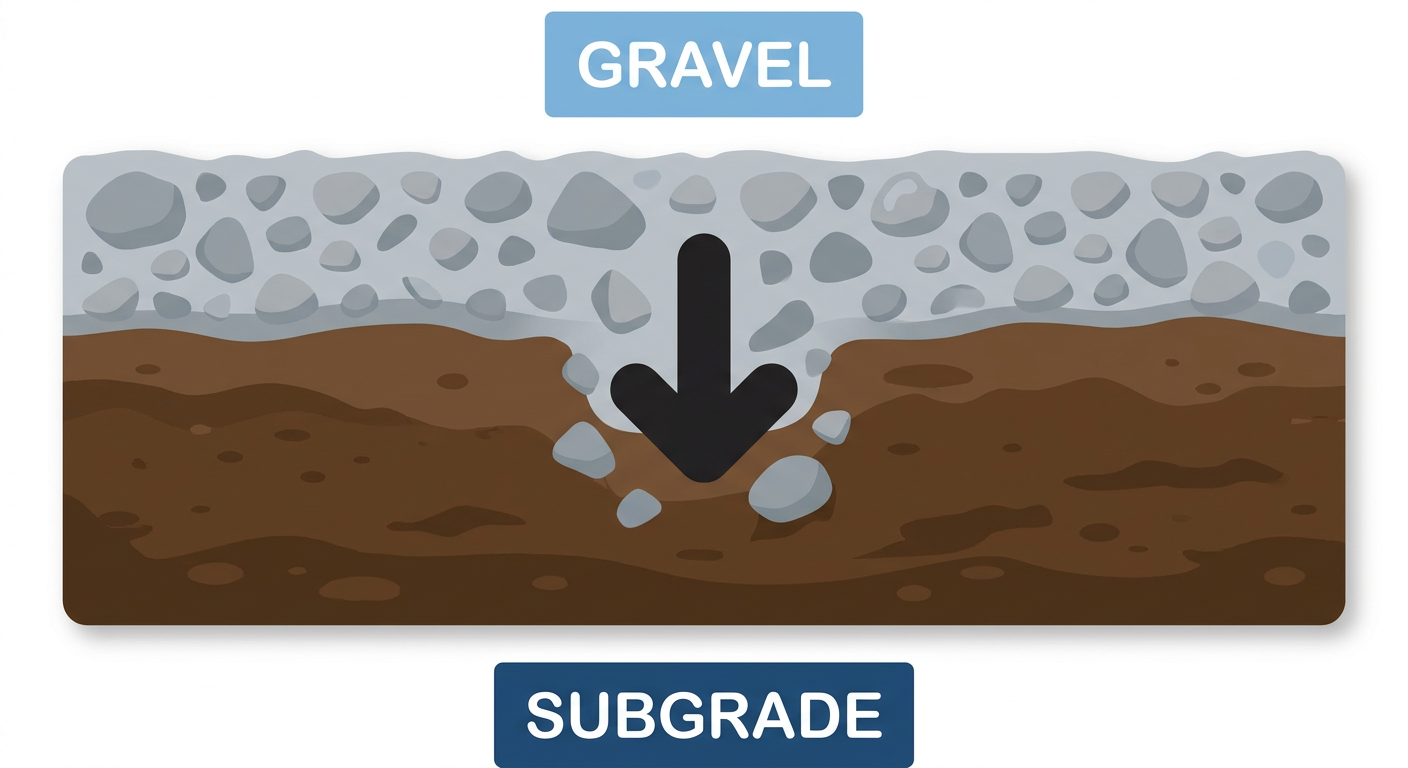
Without confinement, loose gravel migrates sideways under foot traffic and vehicle weight. Every step or tire rotation pushes aggregate toward the edges, leaving you with a muddy center and gravel piled against your fence line. You’re not building a stable surface—you’re just temporarily covering the problem.
Root Cause 3: No Water Management Strategy
Most backyard mud zones share a drainage problem: water arrives faster than the soil can absorb it, and there’s nowhere else for it to go. Roof runoff, slope direction, and compacted high-traffic paths all funnel water into the same low spots.
Concrete and asphalt make this worse by creating impervious surfaces that redirect water somewhere else—usually the next lowest spot in your yard. The Penn State Extension notes that impervious surfaces can increase runoff volume by 200–300% compared to natural ground cover.
Why Adding More Gravel Never Works Long-Term
Here’s what happens when you dump another load of gravel on a muddy area:
- The new gravel sits on saturated soil that can’t support weight
- Foot traffic and vehicle loads push gravel down into the mud
- Gravel spreads sideways because nothing holds it in place
- Within weeks, you’re back to mud with expensive rocks mixed in
You haven’t addressed any of the three root causes. You’ve just added another layer to the mud sandwich. Understanding how to fix a muddy yard properly requires treating the underlying soil and drainage conditions, not just covering them.
How Geocell Grids Solve Backyard Mud Problems
BaseCore™ geocell panels work by addressing all three root causes simultaneously—something no other single product accomplishes.
Cellular Confinement Locks Gravel in Place
Geocells are interconnected honeycomb chambers made from heavy-duty HDPE plastic. When you fill the cells with gravel, each chamber becomes a locked-in pocket of aggregate that can’t migrate sideways. The cell walls transfer horizontal forces into vertical compression, keeping your surface flat and stable.
Think of it like an ice cube tray for gravel. The aggregate stays exactly where you put it because the walls won’t let it move.
Load Distribution Protects Weak Soil
When you step on loose gravel over mud, all your weight concentrates in a small footprint that punches through to the saturated soil below. Geocells spread that load across a much wider area—the connected cell structure distributes force horizontally before it reaches the subgrade.
This is the same engineering principle used in highway construction over soft soils. The Federal Highway Administration has documented geocell use in road base stabilization since the 1970s, originally developed by the U.S. Army Corps of Engineers for building roads over beach sand and swampy terrain.
Built-In Drainage Through Every Cell
Unlike concrete pads that force water to run off somewhere else, geocell systems are inherently permeable. Water drains straight down through the gravel in each cell, reducing surface pooling and erosion. The cells prevent the gravel from washing away while still allowing infiltration.
For backyards with serious drainage issues, pairing geocells with geotextile fabric underneath creates a separation layer that prevents fine soil particles from migrating up into the aggregate while still allowing water movement.
Comparing Mud Control Approaches
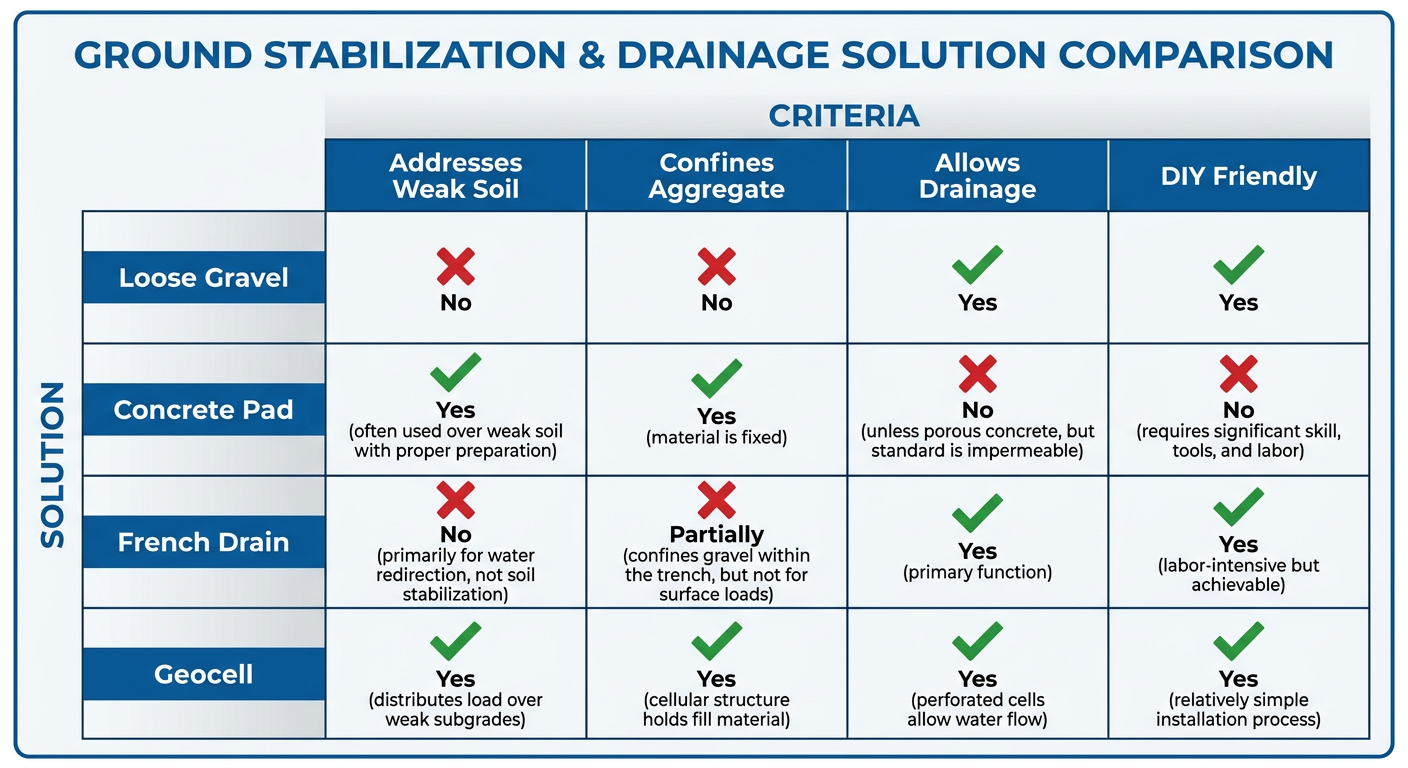
Understanding how geocells stack up against common alternatives helps clarify why they work where other methods fail:
Solution Addresses Weak Soil? Confines Aggregate? Allows Drainage? DIY Friendly? Loose gravel No No Partially Yes Concrete pad No (transfers load)N/A No No French drain No No Redirects only Moderate Geocell + gravel Yes Yes Yes Yes
Which Geocell Depth Handles Your Traffic?
BaseCore™ panels come in multiple depths, and choosing the right one depends on what’s creating your mud:
- 2-inch BaseCore™: Ideal for pedestrian paths, around sheds, dog runs, and light-use areas. Handles foot traffic and wheelbarrows without issue.
- 3-inch or 4-inch BaseCore HD™: Required for vehicle traffic—parking pads, driveways, carport bases. The added depth distributes heavier loads across more aggregate.
- 6-inch BaseCore HD™: Heavy-duty applications like RV pads, farm equipment paths, or commercial parking with truck traffic.
Browse the full BaseCore™ product line to match your specific application.
Ready to eliminate your backyard mud? Shop BaseCore™ geocell kits at backyardbases.com/order-now or call 888-897-2224 for help sizing your project.
Step-by-Step DIY Geocell Installation for Mud Control
Installing a geocell mud control system is a single-weekend project for most backyard applications. Here’s exactly how to do it.
Tools and Materials You’ll Need
- BaseCore™ or BaseCore HD™ panels (calculate square footage of your mud zone plus 6 inches on each side)
- Geotextile fabric (same square footage as geocell coverage)
- Crushed stone or clean gravel—typically 3/4-inch minus or recycled concrete aggregate
- Landscape stakes or steel edging for perimeter containment
- Shovel, rake, and wheelbarrow
- Plate compactor (rent from any equipment rental center for roughly $80–100/day)
- Utility knife or heavy shears for trimming panels to fit
Step 1: Excavate to Create a Stable Base
Remove 4–6 inches of topsoil and organic material from your mud zone. You’re not trying to reach hardpan—just getting below the root layer and any decomposing matter that holds moisture.
Create a slight crown (1–2% slope from center to edges) or a consistent slope away from structures. Water needs somewhere to go, and grading it away from your house or shed prevents future problems.
Step 2: Lay Geotextile Fabric
Roll out geotextile fabric across the entire excavated area, overlapping seams by 6–12 inches. This separation layer performs two critical functions:
- Prevents fine soil particles from migrating up into your aggregate over time
- Adds tensile strength to distribute loads more evenly
Extend the fabric 6 inches beyond where your geocell panels will end—you’ll fold it up against the edges later.
Step 3: Expand and Position Geocell Panels
BaseCore™ panels ship flat and expand into a honeycomb grid. Stretch each panel to its full dimensions and stake corners to hold the shape. Connect adjacent panels using the built-in interlocking edges—no special clips required for most applications, though BaseClips ensure a tighter connection for vehicle traffic areas.
Trim panels to fit irregular shapes using a utility knife. The HDPE material cuts cleanly with basic tools.
Step 4: Fill Cells with Gravel
Shovel or dump crushed stone into each cell, filling slightly above the cell walls (1/2 inch overfill is typical). Use angular crushed stone rather than round river rock—the sharp edges interlock and resist shifting better than smooth stones.
For a 100-square-foot mud zone with 3-inch geocells, plan on roughly 1.5–2 tons of gravel depending on your overfill preference. Your local aggregate supplier can calculate exact quantities based on your dimensions.
Step 5: Compact the Surface
Run a plate compactor over the filled geocell system in overlapping passes. This settles the aggregate into the cells and creates interlock between stones. You’ll see the surface drop slightly—that’s expected.
Add more gravel to any low spots and compact again. Two passes typically achieves full compaction for pedestrian areas; vehicle traffic zones benefit from three passes.
Step 6: Install Perimeter Edging
Contain the edges of your geocell installation with steel landscape edging or treated timber borders. Edge restraint prevents the outermost cells from spreading and keeps your installation looking sharp.
Fold the excess geotextile fabric up against the inside of your edging before backfilling the perimeter.
Time Estimate by Project Size
Project SizeEstimated Install TimeCrew Size50–100 sq ft (dog run, side yard path)3–4 hours1 person100–200 sq ft (parking pad, shed surround)4–6 hours1–2 people200–400 sq ft (driveway section, carport base)Full weekend2 people
Common Installation Mistakes to Avoid
- Skipping the geotextile: Without a separation layer, fine soil particles migrate into your gravel over 2–3 years, reducing drainage and reintroducing mud from below.
- Using round river rock: Smooth stones roll and shift. Angular crushed stone interlocks within the cells for a stable surface.
- Underfilling cells: Aggregate should slightly overfill each cell. Underfilled cells expose the plastic grid to UV degradation and don’t distribute loads properly.
- No compaction: Loose gravel settles unevenly over time. Proper compaction during installation eliminates ruts before they start.
Review the complete geocell installation manual for detailed technical guidance and troubleshooting tips.
Will Geocells Work in My Backyard?
Geocell mud control works across a wide range of backyard applications. Here’s what homeowners most commonly ask before starting.
How deep should a geocell base be for mud control?
For pedestrian traffic areas—paths, dog runs, around sheds—2-inch geocells provide adequate stabilization. Vehicle traffic requires 3–4 inch depth to handle the concentrated wheel loads without deformation. The depth distributes force across more aggregate before it reaches your subgrade, so heavier loads need deeper cells.
Do geocells work on clay soil?
Yes—clay soil is actually one of the primary reasons to use geocells. Clay’s poor drainage creates the saturated conditions that cause mud, and geocells address this by distributing loads across the surface rather than relying on the soil’s bearing capacity. Geotextile fabric underneath prevents clay particles from migrating into the aggregate layer.
How much does a geocell mud control system cost?
Total project cost depends on area size and geocell depth. For current pricing on BaseCore™ panels, geotextile fabric, and accessories, visit the order page or use the foundation calculator to estimate materials for your project. Compared to concrete pads that require professional installation, geocell systems typically cost 40–60% less for the same coverage area and can be installed without hiring a contractor.
Specific Mud Control Applications
Different backyard mud problems call for slightly different approaches. Here’s how to apply geocell solutions to the most common trouble spots.
Dog Runs and Pet Areas
High-traffic pet areas churn into mud faster than almost any other backyard zone. Dogs dig, run in circles, and wear paths that compact soil and kill grass. A 2-inch BaseCore™ panel filled with pea gravel or small crushed stone creates a surface that drains quickly after rain and stands up to paw traffic.
The permeable surface also makes waste cleanup easier—liquids drain through rather than pooling on top.
Shed and Structure Surrounds
The area immediately around sheds, gazebos, and hot tubs takes concentrated foot traffic and often collects roof runoff. Install geocell panels extending 2–3 feet beyond the structure footprint to create a mud-free access zone that also improves drainage away from the foundation.
Side Yard Paths and High-Traffic Corridors
Narrow strips between houses and fences often stay perpetually soggy because they’re shaded, receive runoff from both sides, and get walked on constantly. A geocell path 3–4 feet wide eliminates the mud while maintaining permeability so water can still infiltrate.
Parking Areas and Driveways
Vehicle traffic creates the most demanding mud control challenge. Tires concentrate thousands of pounds into small contact patches that churn loose gravel into underlying soil. BaseCore HD™ for driveways in 3–4 inch depths handles passenger vehicles, while 6-inch panels support trucks and RVs.
The project gallery shows completed installations across these applications—helpful for visualizing how the finished product looks in real backyards.
Conclusion
Backyard mud is a solvable problem once you understand its root causes: weak soil, unconfined aggregate, and poor drainage. Geocell ground grid systems like BaseCore™ address all three in a single DIY installation—no concrete, no contractors, no annual maintenance.
Stop fighting the same mud every season. Order your BaseCore™ kit at backyardbases.com or call 888-897-2224 for help sizing your project.
Frequently Asked Questions
How long does a geocell mud control system last?
BaseCore™ geocell panels are made from UV-stabilized HDPE plastic rated for 20+ years of outdoor exposure. The gravel fill doesn’t degrade, and properly installed systems require no maintenance beyond occasional topping-off if aggregate settles. Most homeowners consider this a permanent solution.
Can I install geocells over existing mud or do I need to wait for it to dry?
You should excavate the muddy topsoil layer rather than installing over it. Geocells work best on stable subgrade, even if that subgrade is saturated clay. Remove 4–6 inches of organic material and mud, lay geotextile fabric, then install your BaseCore™ panels.
What type of gravel works best with geocells for mud control?
Angular crushed stone in 3/4-inch minus or recycled concrete aggregate works best. The sharp edges interlock within the cells and resist shifting under load. Avoid smooth river rock or pea gravel for high-traffic areas—the round shapes roll and don’t compact as firmly.
Do I need a permit to install a geocell mud control system?
Most residential geocell installations don’t require permits because they’re considered pervious surfaces that don’t affect stormwater runoff. However, local regulations vary—check with your municipality if you’re covering more than 200–400 square feet or installing near property lines.
Can geocells handle freeze-thaw cycles?
Yes. BaseCore™ HDPE material remains flexible in temperatures from -40°F to 160°F. The cellular structure accommodates ground movement during freeze-thaw without cracking, and the permeable design allows water to drain before it freezes into destructive ice lenses.
