

The average homeowner who builds a traditional gravel parking pad watches it deteriorate within two years—ruts forming under tire tracks, gravel migrating into the yard, and mud surfacing after every rain. The problem isn’t your gravel choice or your installation effort. The problem is physics: loose aggregate shifts under load because nothing holds it in place.
A DIY gravel parking pad built with geocell ground grids solves this by locking aggregate into a honeycomb structure that distributes vehicle weight across the entire surface while allowing water to drain through. The cellular confinement prevents the lateral gravel migration that causes ruts, meaning your parking pad stays flat and firm for years without maintenance. BaseCore™ geocell parking pad kits from Backyard Bases make this a true weekend project—no concrete, no heavy equipment, and no specialized skills required.
This guide walks you through everything: why conventional gravel parking pads fail, how geocell technology prevents those failures, the exact tools and materials you need, and step-by-step installation instructions you can complete in a single weekend.
Why Traditional Gravel Parking Pads Fail
Every gravel parking pad experiences the same three forces working against it. Understanding these forces explains why adding more gravel never fixes the problem—and why geocells do.
Lateral Migration Under Vehicle Load
What it looks like: Tire ruts that deepen over time, gravel pushed to the edges of the parking area, and bare spots forming in high-traffic zones.
The engineering cause: When a vehicle tire presses down on loose gravel, the stones have nowhere to go but sideways. Each parking event pushes aggregate outward a few millimeters. Over hundreds of cycles, those millimeters become inches of displacement. The Penn State Extension program documents how unconfined aggregate bases lose structural integrity under repeated loading—exactly what happens beneath your parking pad.
Subgrade Failure and Soft Spots
What it looks like: Uneven settling, spongy areas after rain, and gravel sinking into the native soil.
The engineering cause: Native soil beneath gravel parking pads—especially clay-heavy soils—compresses unevenly under concentrated wheel loads. When that soil becomes saturated with water, it loses bearing capacity entirely. Your gravel doesn’t disappear; it pushes down into the softened subgrade, mixing with mud and losing the clean separation that made it functional.
Poor Drainage Creating Erosion
What it looks like: Gravel washing away during storms, channels forming across the parking surface, and puddles that take days to drain.
The engineering cause: Without proper water management, surface runoff follows the path of least resistance—which often means cutting through your parking pad. The USDA Natural Resources Conservation Service identifies concentrated water flow as the primary cause of aggregate erosion on unpaved surfaces. Even a slight grade sends water racing across your parking area, carrying gravel with it.
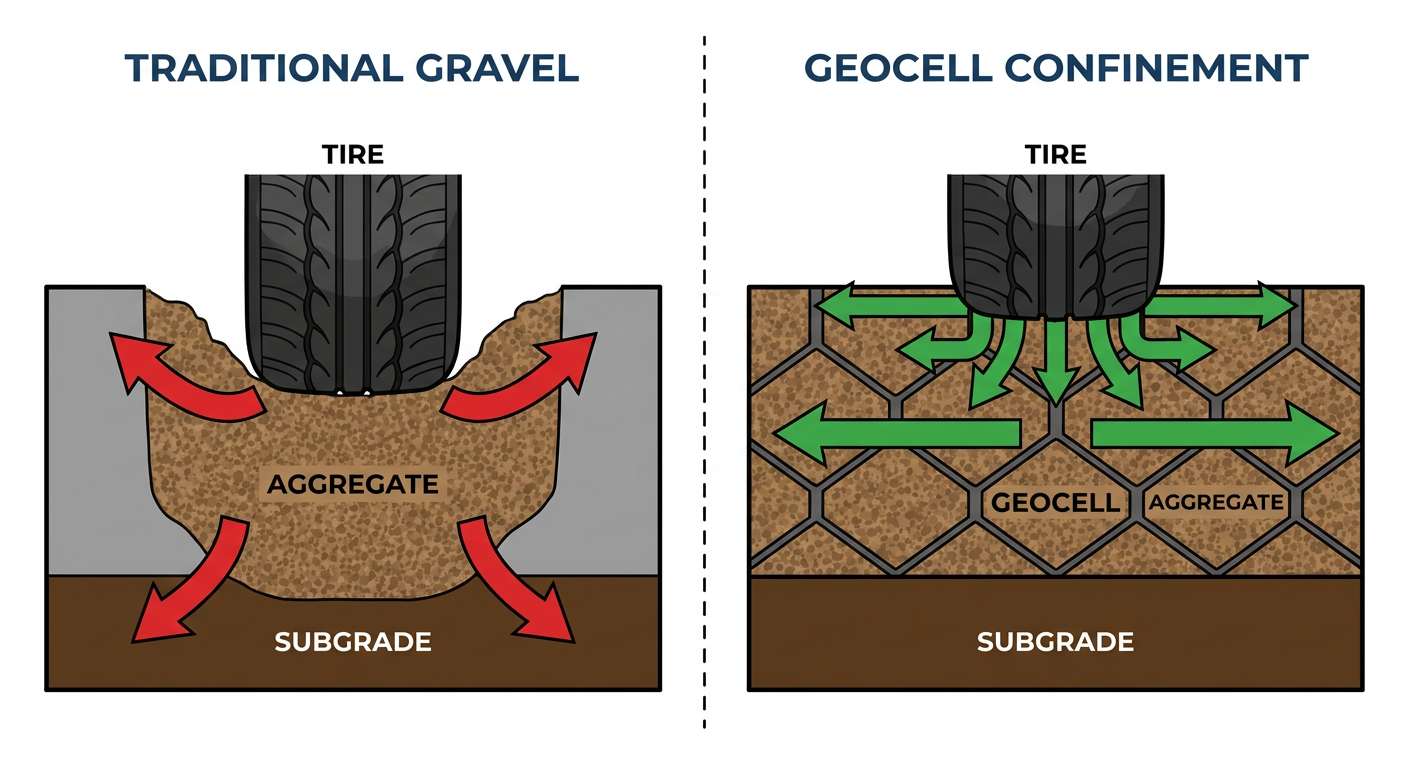
Geocells transform vertical pressure into lateral tension, preventing ruts and protecting the soil subgrade.
The common DIY response—adding more gravel, re-grading, or spreading crushed stone over the problem areas—treats symptoms while ignoring causes. Within months, the same failures return because the underlying physics haven’t changed.
How BaseCore™ Geocells Solve Parking Pad Failures
Geocell technology addresses all three root causes of parking pad failure through a single engineering principle: cellular confinement. When you fill a honeycomb grid structure with aggregate, you transform loose material into a semi-rigid surface that behaves more like a slab than a pile of rocks.
Lateral Confinement Eliminates Migration
Each cell in a BaseCore™ geocell panel measures approximately 8 inches across and forms a complete enclosure around the aggregate inside it. When a tire presses down on the gravel, the cell walls prevent lateral movement. The load transfers vertically through the stone and spreads across multiple cells rather than pushing gravel sideways. This is why geocell ground grids create surfaces that resist rutting under repeated vehicle traffic.
Load Distribution Protects the Subgrade
The interconnected cell structure spreads concentrated wheel loads across a much larger area of the subgrade. Instead of your tire’s contact patch—roughly 30 square inches—bearing the full vehicle weight, the geocell grid distributes that load across several square feet. This reduces soil stress by up to 50%, according to civil engineering research on cellular confinement systems. Even softer subgrades can support vehicle traffic when the load disperses this effectively.
Permeability Prevents Water Damage
Unlike concrete or asphalt, a geocell-stabilized gravel pad allows water to drain directly through the surface and into the soil below. There’s no pooling, no concentrated runoff cutting channels across your parking area, and no freeze-thaw damage from trapped water. The aggregate within each cell maintains drainage paths even under compaction.
For vehicle applications like parking pads, BaseCore HD™ in 3-inch or 4-inch depth provides the structural capacity needed to support cars, trucks, and SUVs. The standard BaseCore™ panels work well for lighter applications, but parking pads see regular vehicle loads that benefit from the heavier-duty construction.
Ready to build a parking pad that lasts? Shop BaseCore™ geocell kits at backyardbases.com or call 888-897-2224 for help sizing your project.
Tools and Materials for Your DIY Gravel Parking Pad
One advantage of geocell construction is the minimal tool requirement. You need basic landscaping equipment that most homeowners already own or can rent affordably for a weekend.
Tools Needed
- Shovel and rake for excavation and gravel spreading
- Wheelbarrow for moving materials
- Tape measure and stakes for layout
- String line and line level for grade checking
- Utility knife or circular saw for trimming geocell panels
- Plate compactor (rental recommended for vehicle-rated surfaces)
- Safety glasses and work gloves
Materials Needed
Material quantities depend on your parking pad dimensions and local soil conditions. Use the Backyard Bases foundation calculator for precise estimates based on your project size.
- BaseCore HD™ geocell panels – 3-inch depth for standard vehicles, 4-inch for heavier trucks or frequent heavy use
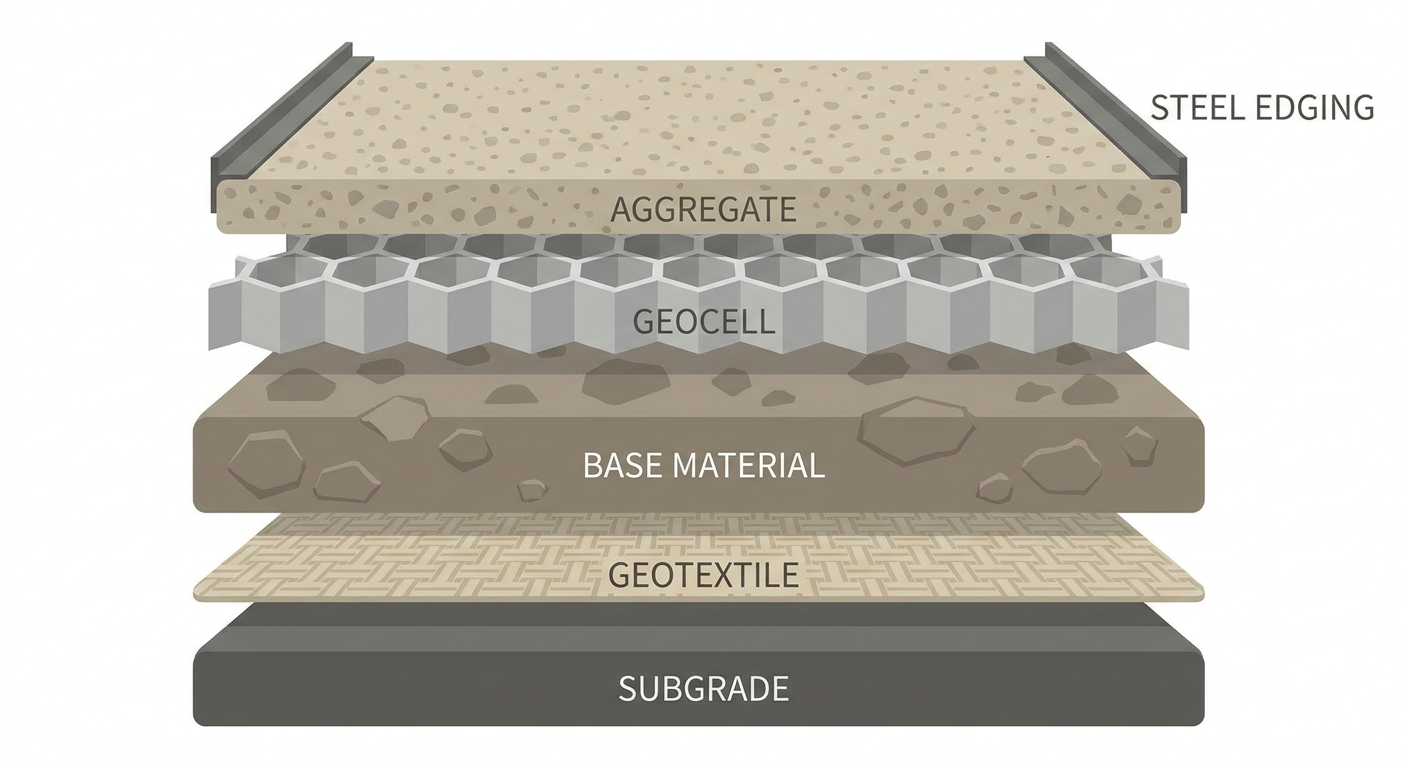
- Geotextile fabric – covers the excavated area to separate aggregate from native soil
- BaseEdge HD steel edging – secures the perimeter and prevents edge creep
- Crushed angular aggregate – typically 3/4-inch minus or crusher run, roughly 1.5 tons per 100 square feet for 3-inch depth
- Base material – 2-4 inches of compacted crusher run beneath the geocell layer if your subgrade is soft
Choosing the Right Gravel
Angular crushed stone with fines (the dust created during crushing) compacts better than rounded river rock. The gravel driveway guide covers aggregate selection in detail, but for parking pads, 3/4-inch crusher run or dense grade aggregate provides the best combination of compaction, drainage, and surface stability.
Step-by-Step: Building Your Geocell Gravel Parking Pad
A typical single-vehicle parking pad (10 feet by 20 feet) takes one to two days to complete, depending on soil conditions and whether you need to address drainage issues. Multi-vehicle pads scale linearly—double the area means roughly double the time and materials.
Step 1: Plan Your Layout and Check Drainage
Mark your parking pad dimensions with stakes and string. Add 6 inches beyond your finished dimensions on each side to accommodate edging and allow working room during installation.
Assess the natural drainage pattern. Water should flow away from your parking area, not toward it. If the site collects runoff from higher ground, you may need to address drainage before building—otherwise, water will undermine your pad from below regardless of how well you construct the surface.
Time estimate: 30-60 minutes
Step 2: Excavate to Proper Depth
Calculate your excavation depth by adding together:
- Geocell depth (3-4 inches for vehicle applications)
- Base layer if needed (2-4 inches for soft or clay soils)
- Any desired finished height above grade
For most installations on reasonably firm soil, excavating 4-6 inches provides adequate depth. Remove vegetation, topsoil, and any organic material. Grade the excavated area to maintain your planned drainage slope—typically 1-2% away from structures.
Time estimate: 2-4 hours for a single-vehicle pad, depending on soil conditions
Step 3: Install Geotextile Fabric
Roll geotextile fabric across the excavated area, extending it up the sides of the excavation. Overlap seams by at least 12 inches. The fabric performs two critical functions: preventing native soil from mixing with your aggregate (which creates mud) and distributing load across a broader subgrade area.
Secure the fabric at corners with landscape staples or small gravel piles to prevent shifting during the next steps.
Time estimate: 20-30 minutes
Step 4: Add and Compact Base Material (If Needed)
If your subgrade is soft, clay-heavy, or prone to saturation, add 2-4 inches of crusher run or road base material before installing geocells. Spread the material evenly, moisten it lightly, and compact it with a plate compactor until it no longer shifts underfoot.
Skip this step if your subgrade is naturally firm and well-draining. The geocell installation manual provides guidance on assessing subgrade conditions.
Time estimate: 1-2 hours including compaction
Step 5: Expand and Position Geocell Panels
BaseCore™ panels arrive compressed. Stretch each panel to its full expanded dimensions and position it on the prepared surface. Connect adjacent panels using the integrated connection system—the panels interlock without additional fasteners.
Work from one corner outward, maintaining alignment as you go. Trim panels to fit your perimeter using a utility knife or circular saw. Unlike rigid pavement, geocells conform to slight grade changes while maintaining structural integrity.
Time estimate: 30-45 minutes for a single-vehicle pad
Step 6: Install Perimeter Edging
Position BaseEdge HD steel edging around the perimeter of your geocell grid. The edging serves two purposes: it contains the aggregate within the cells and provides a clean visual transition to your lawn or landscape. Stake the edging firmly into the subgrade at 3-4 foot intervals.
The steel landscape edging guide covers detailed installation techniques for various edge conditions.
Time estimate: 30-45 minutes
Step 7: Fill Cells with Aggregate
Dump or wheelbarrow crushed stone onto the expanded geocell grid. Use a rake to spread aggregate into each cell, slightly overfilling above the cell walls. The goal is complete coverage with no visible gaps in any cell.
For a 3-inch geocell depth, plan on approximately 150 pounds of aggregate per square foot of parking pad. A single-vehicle 10×20 pad requires roughly 1.5 tons of stone.
Time estimate: 1-2 hours depending on aggregate delivery method
Step 8: Compact and Top-Dress
Run a plate compactor across the filled geocell surface in overlapping passes. The aggregate will settle approximately half an inch during compaction. Add additional stone to any cells that show exposed walls after compacting, then make a final compaction pass.
Some homeowners add a thin top-dress of decorative gravel after compaction for aesthetic reasons, though the crusher run alone provides a fully functional surface.
Time estimate: 45-60 minutes
Total Project Time: 6-10 hours for a single-vehicle parking pad
Common Mistakes to Avoid
Even well-intentioned DIY installations can underperform if certain details get overlooked. These mistakes appear frequently in parking pad projects:
Skipping geotextile fabric: Without fabric separating aggregate from native soil, the two materials gradually mix. Within a year or two, you’ll see mud pumping up through your gravel surface—the exact problem you built the parking pad to avoid.
Using round river rock instead of angular aggregate: Round stones roll under pressure; angular crushed stone interlocks. River rock looks attractive but provides poor structural performance in load-bearing applications. Check the geocell versus gravel comparison for more on aggregate selection.
Insufficient compaction: If the aggregate isn’t fully compacted into the geocells, the surface will settle unevenly after the first few vehicle uses. Rent a plate compactor rather than hand-tamping; the mechanical compaction force makes a significant difference.
Ignoring drainage: A geocell parking pad drains well through its surface, but if the surrounding grade directs water onto or under your pad, long-term problems develop. Address uphill drainage before building.
How Much Does a DIY Geocell Parking Pad Cost?
Material costs vary by region and project size, but a geocell parking pad typically costs significantly less than poured concrete or asphalt alternatives. The Backyard Bases order page provides current pricing for geocell panels, fabric, and edging.
Beyond initial cost, the maintenance comparison matters. Concrete requires sealing every few years and eventually cracks; asphalt needs resurfacing. A properly installed geocell gravel pad requires no maintenance beyond occasional top-dressing if surface gravel displaces over many years of use.
Do I Need a Permit for a Gravel Parking Pad?
Permit requirements vary by municipality. Many jurisdictions exempt unpaved parking surfaces from permit requirements entirely, while others require permits for any new impervious surface—though geocell gravel pads are technically pervious.
Check with your local building department before beginning work. Even if permits aren’t required, some homeowners’ associations have approval processes for visible exterior changes.
How Long Will a Geocell Parking Pad Last?
The high-density polyethylene (HDPE) used in BaseCore™ geocells resists UV degradation, chemical exposure, and physical stress. Under normal residential parking use, the geocell structure remains functional for decades. The Backyard Bases gallery shows installations that have maintained structural integrity for years under regular vehicle traffic.
The aggregate within the cells may require periodic replenishment—typically adding a half-inch of stone every few years—as surface material migrates slightly or compacts further. This is minimal maintenance compared to the crack-filling, resealing, and resurfacing that paved surfaces require.
Can I Build on a Slope?
Geocells perform well on moderate slopes—in fact, they’re widely used for erosion control on hillsides. For parking applications, slopes under 8% work well with standard installation techniques. Steeper slopes may require additional engineering considerations or terracing.
The cellular structure actually provides better slope performance than loose gravel, which tends to migrate downhill over time. The confinement keeps aggregate in place even as vehicles drive up and down slight grades.
What Else Can I Build with Geocells?
The same cellular confinement technology that stabilizes parking pads works for a wide range of backyard projects. Many homeowners start with a parking pad and later expand to gravel driveways, shed foundations, or carport bases using the same techniques.
The BaseCore geocell foundation guide covers the full range of applications, from lightweight pedestrian surfaces to heavy-duty commercial installations.
Build a Parking Pad That Lasts
A DIY gravel parking pad built with geocell technology solves the physics problems that cause traditional gravel surfaces to fail. Cellular confinement prevents lateral migration, load distribution protects your subgrade, and permeable construction eliminates water damage. The result is a stable, maintenance-free parking surface you can build yourself in a single weekend.
Start your project today. Order your BaseCore™ geocell kit at backyardbases.com or call 888-897-2224 for help sizing your parking pad.
Frequently Asked Questions
How thick should my geocell layer be for a parking pad?
For standard passenger vehicles, 3-inch BaseCore HD™ geocells provide adequate load distribution and structural support. If you regularly park heavy trucks, trailers, or RVs, upgrade to 4-inch depth for additional bearing capacity. Lighter geocell depths work for pedestrian applications but won’t withstand repeated vehicle loads.
How much gravel do I need for a geocell parking pad?
Plan for approximately 150 pounds of aggregate per square foot with 3-inch geocell depth. A single-vehicle parking pad measuring 10×20 feet requires roughly 1.5 tons of crushed stone. Use the Backyard Bases foundation calculator for precise estimates based on your specific dimensions and chosen geocell depth.
Can I install a geocell parking pad over existing grass?
No—you must remove vegetation and organic topsoil before installation. Grass and roots decompose over time, creating voids beneath your parking surface that lead to settling and failure. Excavate to mineral soil, install geotextile fabric, then proceed with geocell and aggregate installation.
Is a geocell parking pad cheaper than concrete?
Yes, in both upfront and lifetime costs. Geocell parking pads typically cost a fraction of poured concrete for materials, require no specialized contractors, and need no ongoing maintenance like sealing or crack repair. The BaseCore™ system also installs in a weekend rather than requiring weeks for forming, pouring, and curing.
Will weeds grow through my geocell parking pad?
Geotextile fabric beneath the geocell layer blocks weed growth from below. Any seeds that land in the gravel surface rarely establish because vehicle traffic and the loose aggregate environment prevent root development. Occasional spot-treatment handles any stray weeds that do appear at edges.
